


Understanding the 100 Watt Solar Panel Price in Zimbabwe and Its Global Context
If you're researching a 100 watt solar panel price in Zimbabwe, you're tapping into a global movement towards accessible, decentralized energy. This search often reflects a practical need for reliable power, whether for a rural homestead, a small business, or a backup system. But the price tag on a single panel is just the starting point. The real value lies in a complete, efficient, and durable solar energy system. At Highjoule, with nearly two decades of experience as a global leader in advanced energy storage, we see this quest for affordable solar power as part of a bigger picture: achieving true energy independence and resilience, from households in Harare to microgrids in California.
The Price Puzzle: More Than Just a Panel
A quick online search for a 100 watt solar panel price in Zimbabwe might show a range from $80 to $150 or more. This variation isn't random. It's driven by several critical factors:
- Panel Technology: Monocrystalline panels (more efficient, often more expensive) vs. Polycrystalline.
- Brand & Quality: Established brands with certified durability versus uncertified, generic imports.
- Import Duties & Logistics: As a landlocked nation, Zimbabwe's final prices are heavily influenced by shipping costs, taxes, and supply chain complexities.
- Local Market Dynamics: Fluctuating currency rates and local demand can cause significant price swings.
However, focusing solely on the panel's sticker price is a common pitfall. As the saying goes, "you can't power a fridge with just a panel." The panel is only one component of a functional solar energy system.
The Global Market vs. Local Realities
Globally, solar photovoltaic (PV) module prices have plummeted over the last decade, a trend documented by authorities like the International Energy Agency (IEA). This has made solar technology more accessible worldwide. Yet, in many markets, including Zimbabwe, the balance-of-system (BOS) costs—the inverter, batteries, wiring, and installation—now represent a larger portion of the total system cost than the panels themselves.
This is where the conversation shifts from commodity purchasing to smart system design. A cheap panel paired with a low-quality battery and inverter will lead to poor performance, short lifespan, and ultimately, a higher cost per reliable watt-hour. The goal is a harmonious system where all components are matched for optimal performance and longevity.

Image Source: Unsplash - A complete installation includes panels, mounting, and critical storage components.
A Case Study: The Solar Kiosk Initiative in Mashonaland East
Let's look at a real-world example that illustrates system thinking. A 2023 community project in Mashonaland East Province aimed to power a village kiosk for charging phones, running lights, and a small refrigerator for medicines. The initial plan was to source the cheapest 400W of panels (four 100W units).
| Component | Low-Cost Option (Initial Quote) | Quality System (Implemented) | Outcome |
|---|---|---|---|
| Panels (400W total) | $320 | $400 (Tier-1 monocrystalline) | 25% higher efficiency, 25-year warranty. |
| Battery Storage | Generic Lead-Acid (100Ah) | Highjoule LiFePO4 Integrated Battery (2.5kWh) | 5x longer cycle life, maintenance-free, built-in management. |
| Inverter/Charge Controller | Basic PWM Controller & Separate Inverter | Highjoule All-in-One Hybrid Inverter/Charger | Seamless integration, grid-backup capability, high conversion efficiency. |
| Projected System Lifespan | 3-4 years | 10+ years | Dramatically lower lifetime cost. |
The project chose the quality system. After 18 months, the kiosk operates flawlessly, has expanded services, and has required zero maintenance on the core power system. The upfront cost was higher, but the total cost of ownership is projected to be less than half over a decade. This case underscores that the true "price" is the cost per reliable kilowatt-hour delivered over the system's lifetime.
Thinking Beyond the Panel: The System is Key
For anyone considering solar—whether for a home in Zimbabwe, a cabin in the US, or a small business in Europe—the panel is just the beginning. Here’s what a robust system requires:
- Intelligent Energy Storage: This is the heart of an off-grid or backup system. The battery determines how much power you can use when the sun isn't shining.
- Smart Power Conversion: A high-efficiency inverter converts the DC power from panels and batteries to the AC power your appliances use. Modern hybrid inverters also manage grid interaction.
- System Monitoring & Control: The ability to monitor energy production, consumption, and battery health remotely is no longer a luxury; it's essential for system optimization.
Neglecting these components in your budget and planning is like buying a high-performance car engine but pairing it with a fragile transmission and no fuel gauge.
How Highjoule's Expertise and Products Maximize Your Solar Investment
Founded in 2005, Highjoule has dedicated itself to solving the core challenge highlighted by the search for a 100 watt solar panel price in Zimbabwe: delivering usable, reliable, and intelligent power. We don't manufacture solar panels; we specialize in the advanced technology that makes solar systems truly work.
Our solutions are designed for global applications, from residential homes in Europe to industrial microgrids in the Americas, all principles that apply directly to creating resilient power systems anywhere:
- Highjoule Energy Storage Systems: Our lithium iron phosphate (LiFePO4) battery systems offer exceptional safety, longevity (thousands of cycles), and high usable capacity. Unlike generic batteries, they come with integrated Battery Management Systems (BMS) for protection and longevity.
- Highjoule All-in-One Hybrid Inverters: These units combine a MPPT solar charge controller, a grid-tie inverter, and a backup battery charger in one compact device. They simplify installation and provide seamless switching between solar, battery, and grid power—a crucial feature for areas with unreliable grids.
- Highjoule Energy Management Software: Our platform allows users and installers to monitor system performance in real-time, optimize energy usage patterns, and diagnose issues remotely, ensuring the system operates at peak efficiency for years.

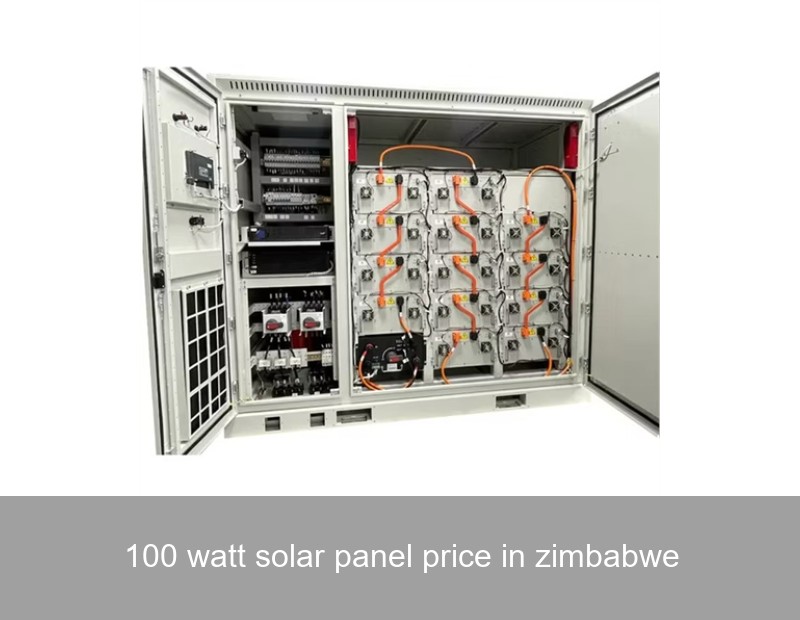
Image Source: Unsplash - Modern integrated storage systems like Highjoule's provide compact, safe, and intelligent power management.
For a project in Zimbabwe, this means partnering with a local installer who can source quality panels and pair them with a Highjoule storage and inverter core. This creates a system that not only captures solar energy but stores it intelligently and delivers it reliably, maximizing the return on every dollar spent on those initial panels.
What Does the Future of Personal Energy Look Like?
The journey that starts with searching for a 100 watt solar panel price in Zimbabwe is ultimately about empowerment and resilience. As battery technology continues to advance and smart energy management becomes the norm, the vision of a fully self-sufficient home or community is more achievable than ever.
We see a future where energy systems are adaptive, predictive, and integrated into the fabric of daily life. But this future is built on the decisions we make today. Are we buying isolated components, or are we investing in a synergistic, intelligent energy ecosystem?
So, we leave you with this question: When you think about powering your home or business, is your goal simply to purchase hardware, or is it to acquire a guaranteed stream of reliable, clean energy for the next decade? The answer will fundamentally shape your approach, your budget, and your long-term satisfaction.
 Inquiry
 Online Chat