


Understanding 18-Way Distribution Board Price and Value for Solar & Storage Systems
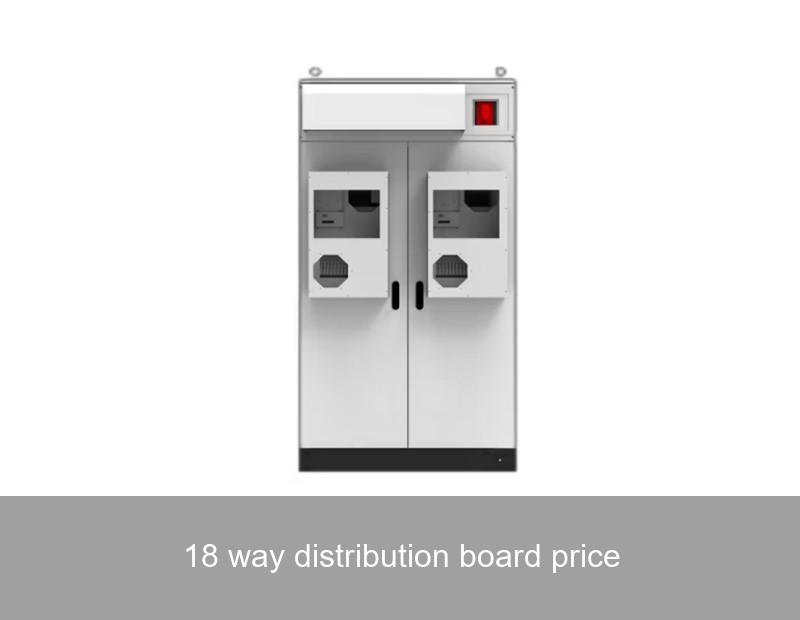
If you're planning a solar panel installation or a battery energy storage system (BESS), you've likely encountered the term "distribution board." And when sizing up a system, a common question arises: what factors influence an 18-way distribution board price? While it's tempting to view this critical component as just a cost line item, the reality is far more significant. In modern renewable energy systems, the distribution board is the intelligent nerve center, ensuring safety, optimizing efficiency, and enabling control. This article will demystify the costs, explore the crucial value-added features beyond price, and show you how choosing the right distribution solution can make or break your energy investment, especially for commercial and industrial applications in markets like Europe and the USA.
What Exactly is an 18-Way Distribution Board?
Let's start with the basics. A distribution board (DB), often called a fuse box or breaker panel, is the hub that divides an incoming electrical supply into subsidiary circuits. The "18-way" specifies its capacity: it can accommodate protection devices for up to 18 individual circuits. In a typical residential solar+storage setup, these circuits might feed your home's lights, sockets, and crucially, dedicated lines for your inverter, battery system, and backup loads.
However, in the context of renewable energy, we're often talking about a more advanced piece of equipment. An AC/DC combined distribution board or a PV distribution board manages not just standard AC household circuits but also the direct current (DC) from solar panels and the bidirectional flow from a battery inverter. This integration is where simple price comparison falls short and where value engineering begins.

Image: A well-organized distribution board is key for safety and scalability. (Source: Unsplash)
Decoding the 18-Way Distribution Board Price: Key Factors
So, what determines the cost? The 18-way distribution board price isn't a single number. It's a spectrum influenced by:
- Component Quality & Brand: The cost of miniature circuit breakers (MCBs), residual-current devices (RCDs), surge protection devices (SPDs), and isolators varies dramatically. Brands with proven reliability and certification (like IEC 61439) command a premium but offer long-term peace of mind.
- Intelligence & Monitoring: A basic metal box with breakers is one thing. A board with integrated energy metering, communication modules (Wi-Fi, Ethernet, Modbus), and remote monitoring capabilities is another. This "smart" functionality adds cost but transforms the board into a data gateway.
- Customization & Engineering: Off-the-shelf units are cheaper. A board custom-designed for your specific inverter, battery, and load profile—with optimized cable routing, labeling, and pre-commissioning—incurs engineering costs but ensures flawless integration and saves on installation time.
- Safety Certifications: Compliance with local regulations (e.g., NEC in the US, BS 7671 in the UK, VDE in Germany) is non-negotiable. Boards certified for specific markets often involve more rigorous testing and materials.
- Scale & Material: Commercial-grade boards with higher current ratings, robust enclosures (IP65 for outdoor use), and copper busbars are inherently more expensive than residential variants.
A Simple Price Component Table
| Feature Level | Typical Price Range* (USD/EUR) | Key Characteristics |
|---|---|---|
| Basic Residential (Off-the-Shelf) | $150 - $400 | Standard MCBs/RCDs, no monitoring, indoor enclosure. |
| Enhanced Residential/Small Commercial | $400 - $1,200 | Surge protection, basic metering, better brand components, some customization. |
| Advanced Commercial/Industrial | $1,200 - $3,000+ | Full smart monitoring, custom design, high-current capacity, robust outdoor enclosure, integrated communications for BMS. |
*Price ranges are indicative for the board assembly only, excluding protective devices and installation.
Beyond Price: Safety, Intelligence, and System Integration
Focusing solely on the 18-way distribution board price can be a costly mistake. The true cost of ownership includes installation labor, system downtime, and missed energy savings. A poorly specified board can become a bottleneck, limiting your system's expansion or failing to protect a €50,000 battery investment from electrical faults.
This is where companies like Highjoule redefine the value proposition. As a global provider since 2005, we see the distribution board not as a commodity, but as the critical integration point in our smart energy systems. Our Highjoule PowerHub series, for instance, is more than just an 18-way board. It's a pre-engineered, grid-interactive distribution unit designed specifically for solar and storage. It features:
- Integrated DC & AC Protection: Seamlessly manages PV string inputs and AC coupling from inverters.
- Grid-Forming Capability Ready: Designed to work with our advanced battery inverters for off-grid and microgrid applications.
- Real-Time Monitoring: Built-in sensors provide granular data on every circuit's performance, accessible via our Highjoule EnergyOS platform.
- Scalable Design: Modular architecture allows for easy expansion from an 18-way setup as your energy needs grow.
Real-World Impact: A UK Commercial Solar+Storage Case Study
Let's ground this in data. A medium-sized food processing plant in Birmingham, UK, faced high daytime energy costs and sought to maximize their 250 kW rooftop solar array. Their initial quote included a standard distribution board.
Phenomenon: They couldn't shift energy consumption to match solar production, exporting excess at low rates and importing at peak prices.
Data & Solution: Highjoule proposed a system centered around a 500 kWh battery storage unit and a customized 18-way PowerHub distribution board with advanced load management. The board was equipped with programmable logic controllers (PLCs) to automatically shed non-essential loads and prioritize critical cooling circuits based on solar generation and grid price signals.
Case Outcome: Within the first year:
- Grid import reduction: 68% during peak hours.
- Self-consumption of solar: Increased from 35% to over 85%.
- Payback period: Reduced by an estimated 2 years due to the optimized energy flow enabled by the intelligent distribution system.
The marginal increase in the 18-way distribution board price for this smart functionality was dwarfed by the operational savings it unlocked. As noted by the U.S. Department of Energy, advanced distribution equipment is key to managing high penetrations of solar on the grid.

Image: Commercial solar installations require robust and intelligent distribution systems. (Source: Unsplash)
The Highjoule Approach: Smart Distribution for Modern Energy Systems
For projects across Europe and North America, Highjoule's philosophy is to provide holistic power solutions. Our distribution boards are not standalone products; they are components optimized to work with our Highjoule Cube battery storage systems and Hybrid Inverters. This ecosystem approach ensures compatibility, simplifies commissioning, and delivers a unified user experience.
Whether for a residential microgrid in California or an industrial peak-shaving application in Germany, our technical team evaluates the entire system design. We ask: What are the critical loads? What is the fault current level? What communication protocol does the building management system use? The answers directly inform the specification of the distribution board—its price is a function of its engineered value, not the other way around.
This integrated design is crucial for resilience. According to a report by NREL, system-level integration and controls are among the top factors determining the reliability of solar-plus-storage for backup power.
Making the Right Choice for Your Project
When evaluating an 18-way distribution board price, shift the conversation from "cost" to "investment." Consider these questions:
- Does this board provide active safety for my entire energy asset (solar, battery, generator)?
- Can it provide the data I need to optimize my energy usage and prove ROI?
- Is it designed to work seamlessly with my chosen inverter and battery brand, or will it require costly adapters and extra labor?
- Does the supplier offer technical support and understand the specific grid codes of my region (like CEI 0-21 in Italy or VDE-AR-N 4105 in Germany)?
Your distribution board is the heart of your energy system. Would you choose a heart based solely on its price tag?
 Inquiry
 Online Chat