


Understanding 200Ah Solar Battery Prices in Zambia: A Guide to Smart Energy Investment
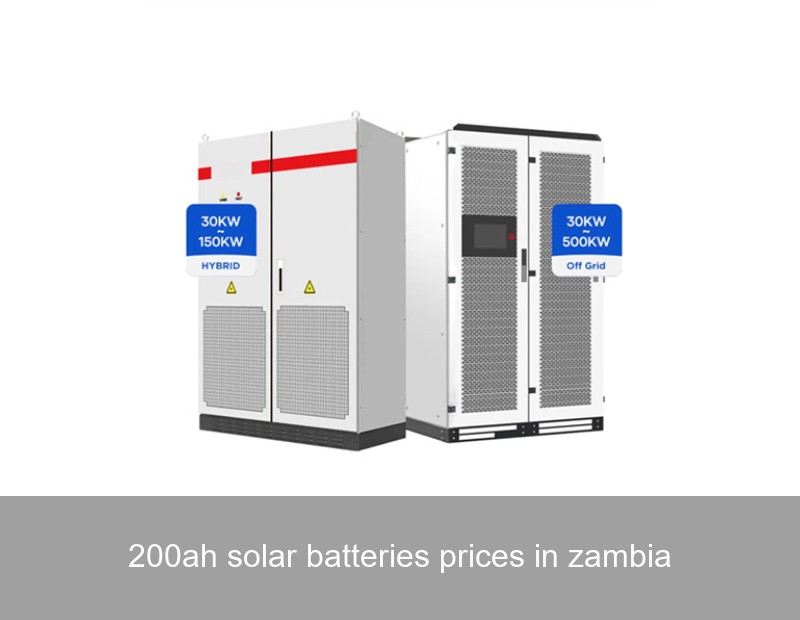
If you're exploring solar power in Zambia, you've likely encountered the term "200Ah solar battery" and a wide range of prices that can be confusing. The cost isn't just about a number on a price tag; it's about the value, longevity, and reliability of your entire energy storage system. For homeowners, businesses, and farms across Zambia, from Lusaka to Livingstone, choosing the right battery is the cornerstone of achieving true energy independence from an unpredictable grid. In this deep dive, we'll demystify the factors behind 200Ah solar batteries prices in Zambia, provide real-world data, and show you how to make an investment that powers your life for years to come.
Table of Contents
- What Really Drives 200Ah Solar Battery Prices?
- Battery Technology Breakdown: From Lead-Acid to LiFePO4
- The True Total Cost of Ownership: More Than Just Purchase Price
- Case Study: Solarizing a Lusaka Household
- How to Choose the Right Battery for Your Zambian Home or Business
- Highjoule's Smart Solutions for the Zambian Market
What Really Drives 200Ah Solar Battery Prices in Zambia?
You might see two batteries both labeled "200Ah" with a price difference of 50% or more. Why? The 200-ampere-hour (Ah) rating tells you the battery's capacity—roughly how much energy it can store—but it says nothing about its quality, technology, or how many cycles it will deliver. The key price drivers include:
- Battery Chemistry: This is the biggest factor. Traditional Flooded Lead-Acid (FLA) batteries are cheaper upfront. Sealed AGM (Absorbent Glass Mat) batteries are mid-range. Lithium Iron Phosphate (LiFePO4) batteries command a higher initial price but offer vastly superior performance and lifespan.
- Brand & Quality: Established brands with rigorous quality control and proven track records cost more. They use higher-grade materials and robust Battery Management Systems (BMS), especially critical for lithium batteries.
- Import Costs & Logistics: Zambia is a landlocked nation. Shipping, customs duties, and local distributor margins all add to the final retail price you see.
- Warranty & Support: A battery with a 10-year warranty is inherently more valuable than one with a 2-year warranty. This reflects the manufacturer's confidence in its product.
Battery Technology Breakdown: From Lead-Acid to LiFePO4
Let's compare the core technologies to understand their price-performance relationship.
| Technology | Typical Price Range (200Ah, ZMW)* | Depth of Discharge (DoD) | Cycle Life | Key Consideration |
|---|---|---|---|---|
| Flooded Lead-Acid (FLA) | 1,800 - 3,500 | ~50% | 500-1,200 cycles | Requires regular maintenance (watering); ventilation needed. |
| Sealed AGM | 3,000 - 5,500 | ~80% | 600-1,350 cycles | Maintenance-free; safer but sensitive to overcharging. |
| LiFePO4 (Lithium) | 7,500 - 15,000+ | ~90-100% | 3,500 - 6,000+ cycles | Zero maintenance; lightweight; high efficiency; long lifespan. |
*Price estimates are indicative and vary based on brand, supplier, and market fluctuations.
The True Total Cost of Ownership: More Than Just Purchase Price
Focusing only on the upfront price is the most common mistake. The savvy investor looks at Total Cost of Ownership (TCO). A cheaper lead-acid battery may need to be replaced 3 or 4 times before a single LiFePO4 battery reaches end-of-life.
Let's do a simplified 10-year TCO analysis for a typical off-grid system:
- Option A (AGM): Purchase Price: ZMW 4,500. Needs replacement in year 4 and year 8. Approx. 10-year TCO: ZMW 13,500.
- Option B (LiFePO4): Purchase Price: ZMW 12,000. No replacement needed in 10 years. Higher efficiency saves ~5% on solar panel costs. Approx. 10-year TCO: ZMW 12,000.
Suddenly, the "expensive" lithium option becomes the more economical long-term choice, while providing reliable, worry-free power.

Image: A modern, compact LiFePO4 home energy storage system. Source: Unsplash (Photographer: Kindel Media)
Case Study: Solarizing a Lusaka Household
Consider the Mwewa family in Lusaka's Roma area. Facing daily 8-hour load-shedding, they installed a 5kW solar system in 2021 to run lights, fridge, TV, and essential appliances.
- Initial Choice (2021): They opted for four 200Ah AGM batteries (ZMW 20,000 total) due to lower upfront cost.
- The Problem: By early 2024, battery capacity had degraded by over 40%. They couldn't get through a full night without the generator kicking in, defeating the solar purpose.
- The Solution & Data: In 2024, they upgraded to a single Highjoule HJ-PowerStack 10.2kWh LiFePO4 system (equivalent to ~850Ah at 12V). The upfront cost was higher (~ZMW 65,000 for the battery unit). However, the data tells the real story:
- Generator runtime dropped from 30 hours/month to 2 hours/month (saving ~ZMW 1,200/month in fuel).
- Usable storage increased by 150%.
- The system is guaranteed for 10 years, with an expected lifespan of 15+ years.
- The integrated smart BMS allows them to monitor performance via a smartphone app, optimizing energy use.
The Mwewas' story highlights that the right battery investment, even at a higher initial price, delivers superior long-term value and peace of mind. For more on Zambia's energy context, you can review reports from the International Renewable Energy Agency (IRENA).
How to Choose the Right Battery for Your Zambian Home or Business
Ask yourself these questions before buying:
- What is my daily energy need (in kWh)? An energy audit is essential. A 200Ah battery at 12V stores about 2.4kWh of energy, but only a portion is usable (depending on DoD).
- What is my budget horizon? Are you minimizing initial cash outlay or minimizing cost over 10+ years?
- Do I need maintenance-free operation? Lithium and AGM offer this; FLA does not.
- Is the supplier reputable? Do they offer technical support, warranty service, and have a local presence? A cheap battery with no local support is a high-risk purchase.
Highjoule's Smart Solutions for the Zambian Market
At Highjoule, with nearly two decades of global experience, we design our energy storage systems for markets like Zambia, where reliability is non-negotiable. We understand that 200Ah solar batteries prices in Zambia are a key entry point for the conversation, but our focus is delivering lifetime value.
Our HJ-PowerStack series is a modular LiFePO4 solution perfect for Zambian homes and businesses. Unlike a simple 200Ah battery, it's a complete, integrated AC-coupled storage system. Key advantages include:
- Plug-and-Play Installation: Simplifies setup and reduces installation costs.
- Scalability: Start with 5.1kWh and add modules as your needs grow.
- Smart Energy Management: Its AI-driven software learns your consumption patterns, maximizes solar self-consumption, and can provide backup power in under 20 milliseconds during a grid outage.
- Robust Design: Built to perform reliably in varied climatic conditions.
For larger commercial and industrial applications or microgrids, our HJ-GridMax containerized storage solutions provide utility-scale storage to stabilize operations, manage demand charges, and integrate renewable energy seamlessly. You can explore independent technical reviews of lithium technology at sources like ScienceDirect.

Image: Solar power and storage enabling energy independence for a rural property. Source: Unsplash (Photographer: Raphael Nogueira)
Your Energy Future in Zambia
The journey to energy independence starts with a single question: Are you buying a commodity battery based on a short-term price, or are you investing in a resilient energy solution that will power your aspirations for the next decade? The landscape of 200Ah solar batteries prices in Zambia is a map; understanding the terrain of technology, total cost, and trusted partnership is how you navigate to the right destination.
What specific energy challenge—be it running a farm irrigation pump through the night or keeping a clinic fully operational during load-shedding—would you like a sustainable storage solution to solve?
 Inquiry
 Online Chat