


30kWh Battery Storage: How Much Does It Cost and What Value Does It Deliver?
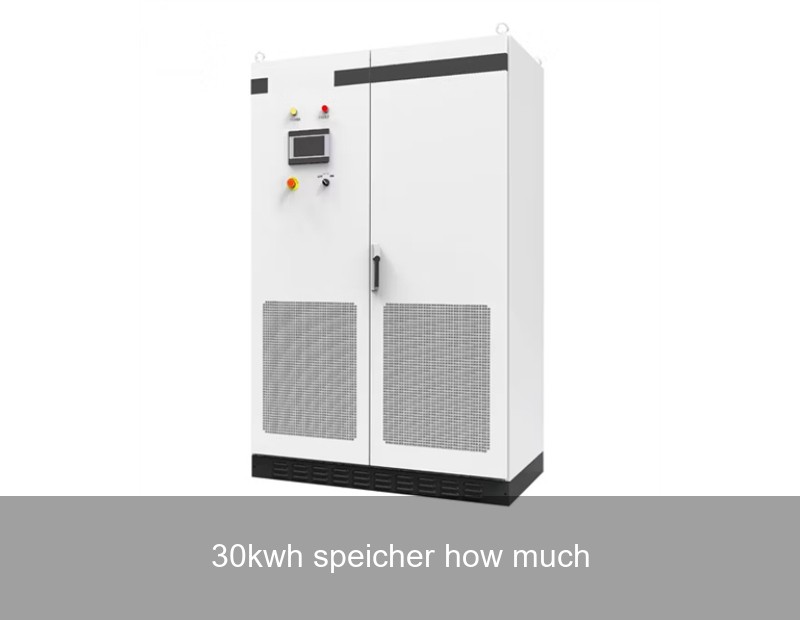
As a homeowner or business manager looking to harness solar power, you've likely encountered the term "30kWh battery storage." It's a popular capacity, promising significant energy independence. But the immediate question that follows is: 30kwh speicher how much? The answer isn't a single number. The true cost is a blend of hardware, software, and long-term value. In this guide, we'll demystify the investment for a 30kWh energy storage system, moving beyond the sticker price to explore the technology, real-world performance, and the intelligent solutions that make it a worthwhile cornerstone for modern energy management.
Table of Contents
The Price Breakdown: More Than Just a Battery
Let's address the core question directly. In markets like Germany or the United States, a complete 30kWh battery storage system installation typically ranges between $18,000 and $35,000 USD (or €16,000 to €32,000). That's a wide range. Why? Because you're not just buying a battery box. You're investing in an integrated energy system. The core battery modules (often Lithium Iron Phosphate or LiFePO4, the leading chemistry for safety and longevity) constitute a major part. However, the critical balance of system (BOS) components are equally vital:
- Inverter/Hybrid Inverter: The brain that converts DC power from solar and batteries to AC for your home. Its power rating (e.g., 10kW vs. 15kW continuous output) significantly impacts cost.
- Energy Management System (EMS): The intelligence that decides when to charge, discharge, or hold. A smart EMS is what unlocks true savings.
- Installation & Labor: Complexity, electrical panel upgrades, and local permit costs vary greatly by region.
- Brand & Warranty: Premium brands with robust 10+ year warranties and proven track records command higher prices.

Image: A professional installation is key to system safety and performance. (Source: Unsplash)
Understanding Capacity: Usable vs. Nominal
Here's a crucial technical nuance: a "30kWh battery" often refers to its total or nominal capacity. Reputable manufacturers like Highjoule design systems with a built-in buffer to maximize battery lifespan. This means a system with a 30.7kWh nominal capacity might have 27.5kWh of usable energy. This practice prevents deep discharge, ensuring the battery lasts for thousands of cycles. Always compare usable kWh when evaluating quotes.
Key Factors Influencing Your 30kWh System's Cost
To navigate the price range, consider these variables:
| Factor | Lower Cost Scenario | Higher Cost Scenario | Impact |
|---|---|---|---|
| Battery Chemistry | Standard LiFePO4 | Advanced LiFePO4 with higher cycle life & faster charging | Performance & Longevity |
| Inverter Power | Single 10kW hybrid inverter | Multiple inverters or 15kW+ for whole-home backup | Backup Capability & Load Management |
| System Integration | AC-coupled, retrofit to existing solar | DC-coupled with new solar, integrated smart home panel | Efficiency & Feature Set |
| Market Incentives | Federal ITC (USA) or state/local grants available | No applicable incentives | Final Net Cost |
For example, the U.S. federal Investment Tax Credit (ITC) can reduce your system cost by 30% through a tax credit. In Bavaria, a business might combine federal incentives with local utility programs. Always consult a local expert for the latest incentives.
The Real Question: What's the Value Proposition?
Shifting from cost to value changes the entire conversation. A 30kWh system isn't an expense; it's an energy asset. Let's break down its value drivers using the PAS framework:
Problem: Rising electricity costs, unreliable grid power, and the desire to maximize solar self-consumption.
Agitation: Without storage, excess solar energy is sold to the grid at low rates, only to buy it back at night at high rates. Power outages halt business operations and disrupt daily life. The volatility of energy markets makes budgeting difficult.
Solution: A 30kWh battery system directly addresses these pains. It stores cheap, self-produced solar energy for use during expensive peak periods (a strategy called peak shaving). It provides seamless backup power during outages. For businesses, it can participate in grid services programs, generating revenue. The value is measured in bill savings, risk mitigation, and potential earnings over a 15+ year lifespan.
Case Study: A German Bakery's Recipe for Resilience
Let's look at real data. A family-owned bakery in Hesse, Germany, faced high demand charges and needed reliability for its refrigeration units. Their existing 50kW solar rooftop system was exporting too much energy midday.
- Solution Deployed: A scalable commercial battery system with 32kWh usable capacity, integrated with their existing solar PV and a 20kW inverter.
- Results (Annual):
- Self-Consumption Increase: Rose from 35% to over 80%.
- Grid Cost Reduction: Reduced peak grid draw by 95%, slashing demand charges by approximately €2,800.
- Backup: Critical cooling loads secured for up to 8 hours during an outage.
- ROI: Projected payback period of under 7 years, factoring in German funding programs (BAFA).
This case shows how the 30kWh speicher capacity, when paired with intelligent control, solves tangible financial and operational problems. You can read more about the importance of demand charge management for businesses from the U.S. Department of Energy.
The Highjoule Solution: Intelligent 30kWh-Plus Systems
At Highjoule, we approach energy storage not as a commodity but as the intelligent core of your energy ecosystem. Our HPS Series for residential and commercial applications is designed around the capacities customers need most, including scalable solutions starting at 15kWh and easily expanding to 30kWh and beyond.
What sets a Highjoule system apart when evaluating "how much" it's worth?
- Adaptive AI-Driven EMS: Our system doesn't just react; it learns. It analyzes your consumption patterns, weather forecasts, and real-time electricity tariffs (like dynamic rates in California or Germany) to optimize every kilowatt-hour. It can automatically shift to the most economical mode, whether that's self-consumption, time-of-use arbitrage, or backup readiness.
- Unmatched Scalability & Service: Starting with a 30kWh configuration? You can later add more battery packs seamlessly as your needs grow. Our global service network provides peace of mind, ensuring your investment is protected.
- Grid-Smart Capabilities: For eligible users, our systems can be configured to participate in virtual power plant (VPP) programs, where aggregated batteries provide stability to the grid and earn you additional income. This turns your storage system from a cost center into a revenue-generating asset.

Image: A sleek, scalable battery system like Highjoule's HPS Series integrates discreetly into a home. (Source: Unsplash)
The Technology Behind the Longevity
Our systems utilize top-tier LiFePO4 cells with a proprietary thermal management system. This ensures stable performance from the freezing winters of Minnesota to the hot summers of Spain. With a design life exceeding 6,000 cycles while retaining over 80% capacity, the levelized cost of storage (LCOS)—the true measure of cost over its lifetime—becomes exceptionally competitive. For a deeper dive into battery lifespan science, refer to this study from the National Renewable Energy Laboratory (NREL).
Making Your Decision: Key Considerations
So, when you ask "30kWh speicher how much?", reframe the question. Ask instead:
- What is my primary goal? (Bill savings, backup power, environmental impact?)
- What is my current and future energy consumption? (An energy audit is key.)
- Does the provider offer a complete, intelligent system or just a battery pack?
- What is the total cost of ownership, including maintenance and warranty?
The market is evolving rapidly. New tariffs and grid structures are emerging. A system you buy today must be software-upgradable to adapt to tomorrow's energy markets.
Final Thoughts and Your Next Step
The journey to energy independence is exciting. A 30kWh battery storage system is a powerful step, but its true worth is unlocked by the intelligence that manages it. It's about transforming your relationship with energy from passive consumption to active management.
What specific energy challenge—be it a monthly bill that's too unpredictable or the critical need to keep operations running during a storm—is motivating you to explore a 30kWh solution today?
 Inquiry
 Online Chat