


Demystifying the 500 Watts Solar Panel Price in the Philippines: Your Path to Energy Independence
If you're researching a 500 watts solar panel price in the Philippines, you're likely looking for more than just a component cost. You're exploring a solution—a way to combat rising electricity bills, ensure power during outages, and contribute to a cleaner future. The quoted price is a starting point, but the true value lies in the complete system's performance, durability, and the intelligence behind it. This article will guide you through the real factors that determine cost and long-term savings, helping you make an informed investment in solar energy.
Table of Contents
- The Price Puzzle: Beyond the Panel Sticker
- The Data Reality: System Costs vs. Long-Term Value
- Case Study: A Cebu Resort's Journey to Energy Security
- The Highjoule Advantage: Intelligent Storage for Maximum ROI
The Price Puzzle: Beyond the Panel Sticker
Focusing solely on the 500 watts solar panel price in the Philippines is like buying an engine and calling it a car. The panel is just one part of a sophisticated ecosystem. A functional solar power system requires several key components, each impacting the total investment:
- The Solar Panels (Modules): High-efficiency 500W panels, typically monocrystalline, are the standard today. Prices vary by brand, warranty (often 25+ years), and efficiency rating.
- The Solar Inverter: This is the brain that converts the DC power from panels into usable AC power for your appliances. Its quality dictates system efficiency and reliability.
- The Battery Energy Storage System (BESS): This is the game-changer. Without storage, your system shuts off when the grid fails. Batteries store excess solar energy for use at night or during blackouts.
- Balance of System (BOS): Mounting structures, wiring, circuit breakers, and monitoring systems.
- Installation & Permits: Professional installation ensures safety and performance, while securing permits from distribution utilities (like Meralco) is a necessary step.
As a global leader in advanced energy storage, Highjoule emphasizes that the inverter and battery system are where true resilience and ROI are built. A cheap inverter can waste precious solar generation, and a low-quality battery can fail within a few years, negating any initial savings.
The Data Reality: System Costs vs. Long-Term Value
Let's translate this into numbers. While a standalone 500W panel might be advertised for a certain price, a functional system designed for backup power tells a different story. The following table breaks down a typical 3kW solar-plus-storage system (which might use six 500W panels), a common size for a Filipino household aiming for essential load coverage during outages.
| System Component | Estimated Cost Range (PHP) | Why It Matters |
|---|---|---|
| 6 x 500W Solar Panels | 60,000 - 90,000 | Your fuel source. Higher efficiency panels produce more power in limited roof space. |
| Hybrid Inverter (3-5kW) | 40,000 - 70,000 | Manages solar, battery, and grid power seamlessly. Efficiency losses here mean lost energy. |
| Battery Storage (5-10 kWh) | 80,000 - 200,000+ | The heart of resilience. Capacity (kWh) determines backup duration. Lithium-ion (LFP) is the standard for safety and cycle life. |
| Balance of System & Installation | 30,000 - 60,000 | Ensures safety, durability, and compliance with local regulations. |
| Estimated Total System Cost | 210,000 - 420,000 PHP | A complete solution for energy independence and savings. |
Notice the range? The higher end often reflects superior components like Highjoule's integrated battery systems, which feature built-in energy management software. This intelligence optimizes every kilowatt-hour, deciding when to store, use, or export solar energy based on your usage patterns and tariff rates. Over a 10-year period, this optimization can save you significantly more than the initial price difference. According to data from the International Energy Agency (IEA), solar PV costs have fallen dramatically, but the value of flexible storage is rising as grids modernize.

Image: A professional solar installation is crucial for long-term performance and safety. (Source: Unsplash)
Case Study: A Cebu Resort's Journey to Energy Security
Let's move from theory to a tangible example. Consider Azure Sands Resort in Cebu, which faced crippling operational costs from diesel generators during frequent, prolonged brownouts. Their goal was to power guest villas, the reception, and kitchen refrigeration during outages.
Their Solution: They installed a 15kW solar array (using thirty 500W panels) coupled with a Highjoule H2 Series Commercial Battery System with 40kWh capacity. The Highjoule system was chosen for its robust thermal management—critical in the Philippine heat—and its scalable architecture.
- Generator Fuel Savings: Reduced diesel generator runtime by 90%, saving approximately 25,000 PHP per month.
- Bill Savings: Reduced their daytime grid consumption by 70%, cutting their monthly Meralco bill by over 40%.
- ROI & Value: The system achieved a projected payback period of under 5 years. Beyond savings, the resort now markets itself as an "eco-resilient" destination, attracting environmentally conscious travelers.
"The initial investment was substantial," the resort manager noted, "but viewing it as just a 'solar panel price' would have been a mistake. We bought energy security and predictable costs. The Highjoule system's monitoring platform lets us see our energy flow in real-time, which is invaluable for management." This case underscores that for businesses, the investment is an operational upgrade, not just an energy purchase.
The Highjoule Advantage: Intelligent Storage for Maximum ROI
As the case study shows, the transformative element is often the storage system. This is where Highjoule's expertise shines. While you research the 500 watts solar panel price in the Philippines, we encourage you to think about what happens to that energy after it's harvested.
Highjoule's battery energy storage systems (BESS) for residential and commercial applications are built with:
- Lithium Iron Phosphate (LFP) Chemistry: Offers superior safety, longer lifespan (often over 6,000 cycles), and excellent performance in high-temperature environments like the Philippines.
- Integrated Energy Management System (EMS): This software intelligence is the true differentiator. It doesn't just store energy; it strategizes. It can be programmed to prioritize solar self-consumption, store energy when grid rates are low, and provide backup power instantly during an outage—all automatically.
- Scalability: Start with what you need and add more battery modules later as your needs grow, protecting your initial investment.
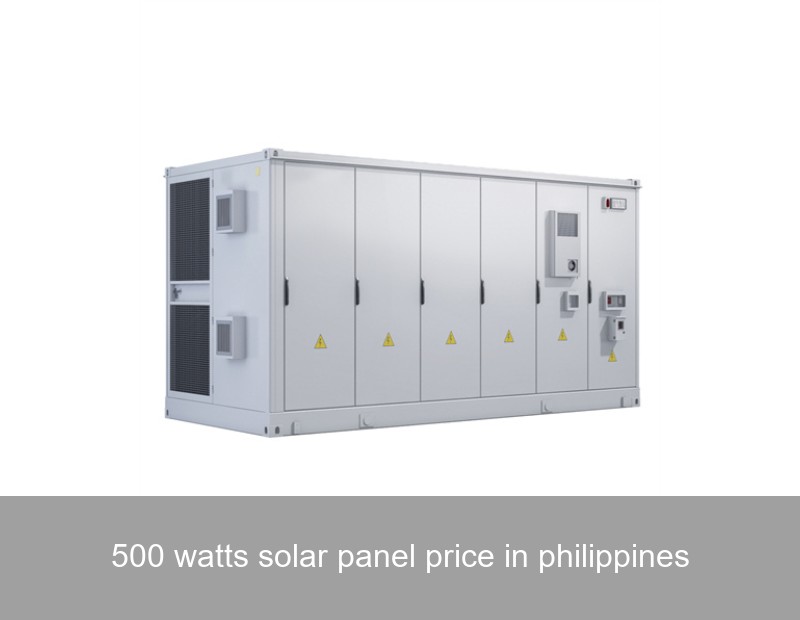
For larger-scale needs, such as industrial facilities or microgrids for remote islands, Highjoule provides containerized megawatt-scale solutions that can integrate with existing infrastructure, a topic explored by the National Renewable Energy Laboratory (NREL) in their grid modernization studies.

Image: A modern, wall-mounted home battery storage system, enabling energy independence. (Source: Unsplash)
Making the Right Choice for Your Filipino Home or Business
So, how should you proceed? Shift the question from "What is the price of a 500W panel?" to "What is the value of a reliable, intelligent energy system for my property?"
Key Questions to Ask Your Solar Provider:
- Is the quoted price for a complete, grid-tied with backup system?
- What is the brand, chemistry, and warranty (in years and cycles) of the battery you are proposing?
- Does the system include intelligent energy management software, or is it a basic setup?
- Can you provide a detailed simulation of my expected energy production, self-consumption, and bill savings?
Where Highjoule Fits In
Highjoule partners with a network of certified installers across key regions. We empower them with our technology, providing end-users with not just hardware, but a comprehensive energy solution. Our partners can design a system where the solar panels, inverter, and Highjoule BESS work in perfect harmony, maximizing the utility of every 500-watt panel on your roof.
Ready to move beyond a simple price tag and calculate the true value of energy independence for your specific situation? What would you power first during the next brownout, and how much is that peace of mind worth to you?
 Inquiry
 Online Chat