


All Powers R2500 for Sale: Your Questions Answered and a Smarter Alternative
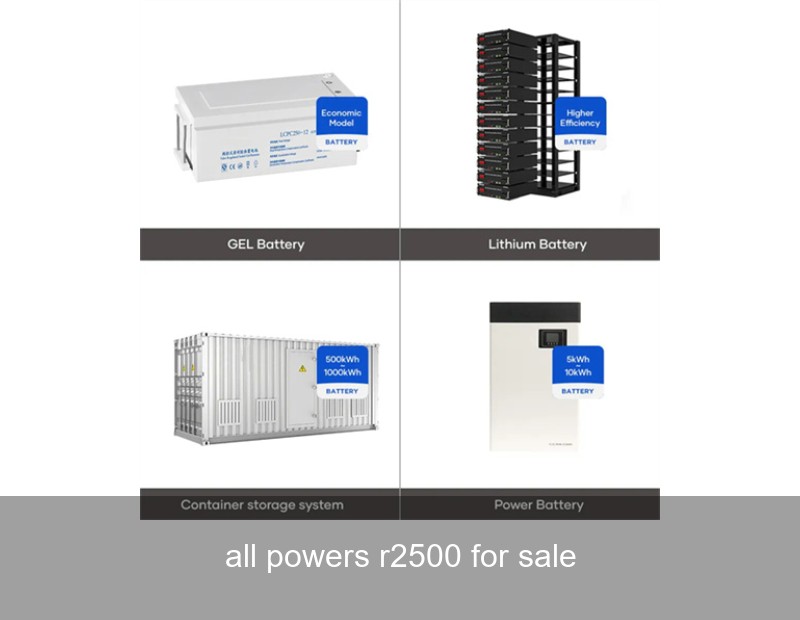
If you're searching for "All Powers R2500 for sale," you're likely in the market for a portable power station. It's a smart move. Whether you're a homeowner preparing for grid outages, a van-lifer needing reliable off-grid power, or a professional requiring on-site electricity, portable energy is more crucial than ever. But before you click "buy," let's explore what you're really looking for: dependable, clean, and sufficient power. This article will guide you through the key considerations, present a real-world case study, and introduce you to a more robust, permanent solution for true energy independence.
Table of Contents
- The Portable Power Craze: More Than a Gadget
- Decoding the Specs: What Does 2500W Really Mean for You?
- Case Study: The Limits of Portable Power in a German Bed & Breakfast
- Beyond the Portable: When Your Energy Needs Demand a System
- Highjoule's Integrated Approach: The Power Behind Your Life and Business
- Is a Standalone Unit Enough for Your Future Energy Goals?
The Portable Power Craze: More Than a Gadget
Portable power stations like the All Powers R2500 have surged in popularity. They're the modern answer to the gas-guzzling generator—quieter, cleaner, and incredibly convenient for short-term, mobile needs. The phenomenon is driven by increasing weather-related grid instability, a growing remote workforce, and our collective desire for energy resilience. According to the U.S. Energy Information Administration, the average U.S. customer experienced just over seven hours of power interruptions in 2021, a trend that pushes consumers toward personal power solutions. But here's the catch: these units are designed for portability, not necessarily for permanent, whole-property backup.

Image Source: Unsplash
Decoding the Specs: What Does 2500W Really Mean for You?
A 2500-watt (2.5kW) output sounds impressive. And it is—for specific applications. It can power a refrigerator, some lights, a laptop, and a TV simultaneously. But let's break it down with a simple table to understand its limitations:
| Appliance | Estimated Wattage | Runtime on a 2kWh Battery* |
|---|---|---|
| Refrigerator | 150-800W (cycling) | 3-13 hours |
| Space Heater | 1500W | ~1.3 hours |
| Electric Kettle | 1800W | ~1.1 hours |
| CPAP Machine | 50-100W | 20-40 hours |
*Assuming a typical portable station battery capacity. Runtime drops significantly with high-wattage devices.
The critical metric often overlooked is energy capacity (kWh). A unit might output 2500W, but if its battery is only 2kWh, running a 1500W heater will drain it in little over an hour. For extended outages or powering essential business equipment, this becomes a major constraint.
Key Questions Before You Buy "For Sale" Items
- Recharging Time: How long does it take to recharge from solar vs. a wall outlet? A 48-hour recharge time after an outage is impractical.
- Battery Chemistry: Is it LiFePO4 (lithium iron phosphate)? This chemistry offers 3-5x more charge cycles and superior safety compared to standard NMC lithium-ion, making it a wiser long-term investment.
- Scalability: Can you add external battery packs or link it to your home's solar panels? If your needs grow, can your solution grow with them?
Case Study: The Limits of Portable Power in a German Bed & Breakfast
Consider "Schwarzwald Idyll," a 6-room B&B in Germany's Black Forest. The owner, Klaus, purchased two high-wattage portable power stations after a storm caused a 12-hour blackout, disrupting his business. His goal was to keep the reception, kitchen fridge, and essential room lights on.
The Outcome: While the stations powered the fridge and lights, they couldn't handle the kitchen's water boiler or the peak demand when guests returned and charged multiple devices. The stations depleted in under 4 hours and took nearly a full sunny day to recharge via their attached solar panels. Klaus realized he was managing batteries, not ensuring seamless power. The financial loss from that single outage, coupled with guest dissatisfaction, far exceeded the cost of his portable units.
This is a common scenario. Portable stations are excellent tactical tools, but for strategic energy resilience—especially for businesses or homeowners who cannot afford downtime—a integrated system is non-negotiable.
Beyond the Portable: When Your Energy Needs Demand a System
This is where the conversation evolves from buying a product to investing in a solution. Think of it as the difference between a water bottle and a whole-house well. For true energy independence, you need an integrated system that:
- Seamlessly Connects: Integrates with your main electrical panel to automatically power critical circuits during an outage.
- Harnesses the Sun: Directly pairs with rooftop solar to recharge daily, turning sunlight into a reliable backup fuel.
- Scales Effortlessly: Offers modular battery capacity (10kWh, 20kWh, or more) to match your exact consumption, from a few essentials to the entire property.
- Manages Intelligently: Uses software to optimize when to draw from the grid, solar, or batteries, maximizing self-consumption and savings.

Image Source: Unsplash
Highjoule's Integrated Approach: The Power Behind Your Life and Business
At Highjoule, with nearly two decades of expertise since 2005, we design energy solutions that move beyond portable units. We understand that reliability isn't about having a backup device in the garage; it's about having an intelligent energy ecosystem that works silently in the background.
For homeowners, our Residential Energy Storage Systems are the cornerstone of this ecosystem. Unlike standalone portable power stations, our systems like the Highjoule HOMe Series are hardwired into your home. They feature:
- Modular LiFePO4 battery cabinets, scalable from 10kWh to over 30kWh.
- Seamless integration with new or existing solar PV installations.
- An intelligent hybrid inverter that manages grid, solar, and battery power flows with millisecond switching during outages.
- Smart energy management via an app, allowing you to track production, consumption, and savings.
For commercial and industrial clients, our C&I and Microgrid Solutions provide even greater scale and sophistication. These systems are engineered for demand charge reduction, peak shaving, and ensuring critical operations never halt. They can be configured for both on-grid and off-grid applications, providing a level of energy security and financial control that a portable unit simply cannot touch.
Our philosophy is simple: provide intelligent, efficient, and sustainable power that fits your life and business, not the other way around.
Why LiFePO4 is the Industry Standard for Stationary Storage
While some portable units use older battery tech, Highjoule's commitment to safety and longevity is why we use Lithium Iron Phosphate (LiFePO4) chemistry across our product line. As noted by the National Renewable Energy Laboratory (NREL), LiFePO4 batteries offer exceptional thermal and chemical stability, resulting in a longer lifespan and significantly lower risk of thermal runaway compared to other lithium-ion types. This makes them the undisputed choice for permanent installation in your home or business.
Is a Standalone Unit Enough for Your Future Energy Goals?
So, you searched for "All Powers R2500 for sale." That search reveals a desire for control, resilience, and perhaps a step toward sustainability. The question now is: does a portable power station fulfill that desire, or is it merely a first step? If your needs are truly mobile and short-term, it may suffice. But if you're looking to protect your home, secure your business, reduce your energy bills long-term, and contribute to a cleaner grid, then a portable unit is just the beginning of the conversation.
What would it mean for you to never think about power outages again? To know that your lights, your refrigeration, your critical business systems are protected not for hours, but for days, by a system that refuels itself from the sun? That's the peace of mind an integrated energy storage system is designed to deliver.
Are you ready to explore what a solution designed for your specific energy profile looks like?
 Inquiry
 Online Chat