


Australia's Battery Storage Revolution: Taming the Grid Peak with Smart Energy
a scorching Australian summer afternoon. Air conditioners are humming at full blast across Sydney and Melbourne, pushing the electricity demand to its absolute limit. This is the grid peak—a period of intense stress on the national network where prices skyrocket and the risk of blackouts looms. For years, managing this peak meant relying on expensive, carbon-intensive "peaker" gas plants. But a powerful solution is now changing the game: Australia battery storage. By deploying large-scale and distributed grid-connected batteries, Australia is not just backing up power; it's fundamentally reshaping how its energy system operates, turning a challenge into a strategic advantage. Companies like Highjoule are at the forefront, providing the intelligent storage solutions that make this transition reliable and efficient.
Table of Contents
- The Peak Problem: More Than Just a Summer Headache
- By the Numbers: How Battery Storage is Reshaping the Grid
- Case Study: The Victorian Big Battery & Grid Stability
- Beyond the Mega-Battery: The Distributed Grid Edge
- Highjoule's Role: Intelligent Storage for Every Scale
- The Road Ahead: Challenges and Opportunities
The Peak Problem: More Than Just a Summer Headache
Australia's grid peak is a unique beast. Driven largely by extreme temperatures—both hot and cold—it creates a "duck curve" effect, particularly in states with high solar penetration. During the middle of the day, rooftop solar floods the grid with cheap, clean energy. But as the sun sets and people return home, solar generation plummets just as demand for electricity surges. This creates a steep, rapid ramp-up requirement that traditional coal and gas plants struggle to meet quickly and economically.
The cost of this imbalance is staggering. The Australian Energy Market Operator (AEMO) spends hundreds of millions annually on frequency control and network support services. Ultimately, these costs are passed down to consumers and businesses. Furthermore, an over-reliance on fossil-fueled peaking plants undermines national emissions reduction targets. This is where battery storage enters as a game-changer, offering sub-second response times to stabilize frequency and inject power precisely when and where it's needed most.

Image Source: Wikimedia Commons (User: Renewables in Asia) - Illustration of the "Duck Curve" challenge
By the Numbers: How Battery Storage is Reshaping the Grid
The growth of utility-scale Australia battery storage is not anecdotal; it's a data-driven revolution. According to the Clean Energy Council, Australia's large-scale battery storage pipeline exceeded 40 GW in 2023, a monumental figure for any national market. Let's look at the tangible impacts:
| Metric | Impact of Grid-Scale Batteries |
|---|---|
| Response Time | Can deliver full power in milliseconds vs. minutes/hours for gas plants. |
| Frequency Control | Provide essential system security services, reducing AEMO's stabilization costs. |
| Peak Shaving | Discharge during peak hours, lowering wholesale spot prices for all. |
| Solar Integration | Soak up excess midday solar generation and release it in the evening. |
This isn't just about replacing peaker plants; it's about providing a multi-layered service that enhances grid resilience, enables more renewables, and puts downward pressure on energy bills. A study by the CSIRO suggests that integrating renewables supported by storage is the lowest-cost pathway for Australia's future energy system.
Case Study: The Victorian Big Battery & Grid Stability
One of the world's most prominent examples is the 300 MW / 450 MWh Victorian Big Battery (VBB) near Geelong. Operated by Neoen, it's a cornerstone of Victoria's energy security. In its first year of operation, the battery's impact was profound:
- Market Savings: It was estimated to have reduced grid stabilization costs in Victoria by over $150 million in its first two years of operation by providing frequency control and contingency services.
- Reliability: It secures the Victoria-New South Wales Interconnector (VNI), effectively "unlocking" additional transfer capacity and preventing potential load shedding during peak demand.
- Blueprint: The VBB demonstrated how a large-scale battery can be both a profitable private asset and critical public infrastructure, a model now being replicated nationwide.
This case shows that battery storage is moving from a niche technology to a central pillar of modern grid architecture, capable of responding to faults and stabilizing the network in ways previously impossible.
Beyond the Mega-Battery: The Distributed Grid Edge
While mega-batteries make headlines, the true transformation is also happening at the "grid edge"—in businesses, industrial parks, and residential communities. This distributed approach to Australia battery storage builds a more resilient and democratic energy network. Think of it as creating thousands of smaller, coordinated batteries that can:
- Reduce peak demand charges for commercial & industrial (C&I) users, a major line-item on electricity bills.
- Form "Virtual Power Plants" (VPPs), where aggregators control thousands of home batteries to act as a single, dispatchable power plant.
- Provide backup power for critical infrastructure, from hospitals to data centers, during grid outages.
This decentralized model flattens the grid peak from the bottom up, reducing strain on transmission lines and substations. It empowers consumers to become "prosumers," actively participating in the energy market.
Highjoule's Role: Intelligent Storage for Every Scale
This is where Highjoule's expertise becomes critical. Since 2005, we've been designing energy storage systems that are not just hardware, but intelligent platforms. For the Australian market and similar grids in Europe and the US facing peak challenges, our solutions are engineered for performance and durability.
For Commercial & Industrial applications, our Highjoule C&I ESS integrates seamlessly with onsite solar. Its advanced energy management system (EMS) automatically dispatches stored energy to shave peak demand, delivering a rapid return on investment. For a manufacturing plant or a cold storage facility, this can mean slashing power costs by 20-30%.
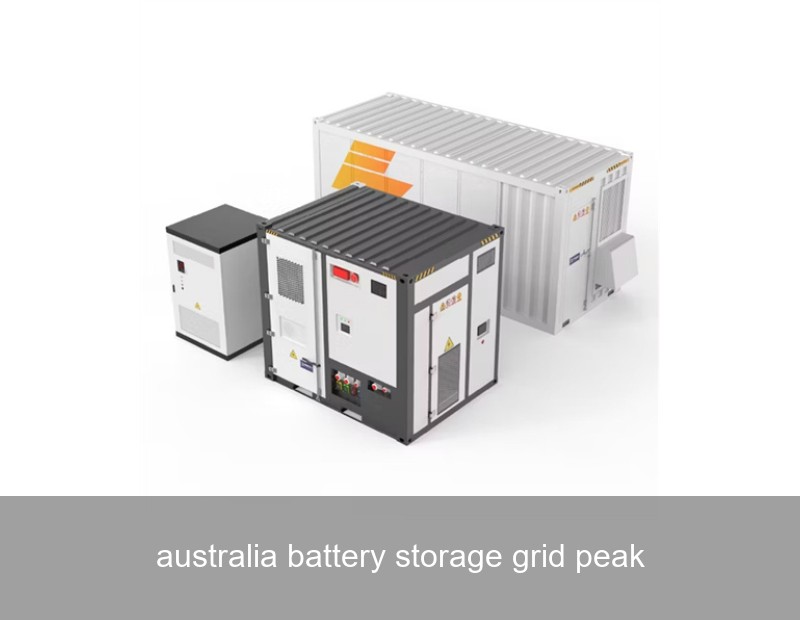
For Utility and Microgrid projects, our containerized Highjoule MegaStack systems provide the scalable, grid-forming capabilities needed for stability. These systems are built with our proprietary cell technology and thermal management, ensuring safety and longevity in harsh Australian conditions. We don't just supply batteries; we provide a complete, intelligent power solution that includes monitoring, control, and ongoing optimization.

Image Source: Unsplash - Representative image of a utility-scale battery storage installation
The Road Ahead: Challenges and Opportunities
The path forward for Australia battery storage is bright but requires careful navigation. Key challenges include evolving market regulations to fully value the fast-response services batteries provide, managing supply chains, and ensuring the highest safety standards across all installations. Continued collaboration between government, market bodies like AEMO, and technology providers is essential.
The opportunity, however, is monumental. By strategically deploying storage at all scales—from the home to the gigawatt-hour grid asset—Australia can cement its position as a global leader in the renewable energy transition. It can build a grid that is not only cleaner but also more robust, decentralized, and consumer-focused.
So, as we look at the horizon, the question isn't whether battery storage will tame the grid peak, but how quickly and intelligently we can scale it. What does the optimal mix of utility-scale and distributed storage look like for your community or business to achieve both resilience and cost savings?
 Inquiry
 Online Chat