


Bateria 50 Kwh How Much? Unpacking the True Value of Your Energy Storage Investment
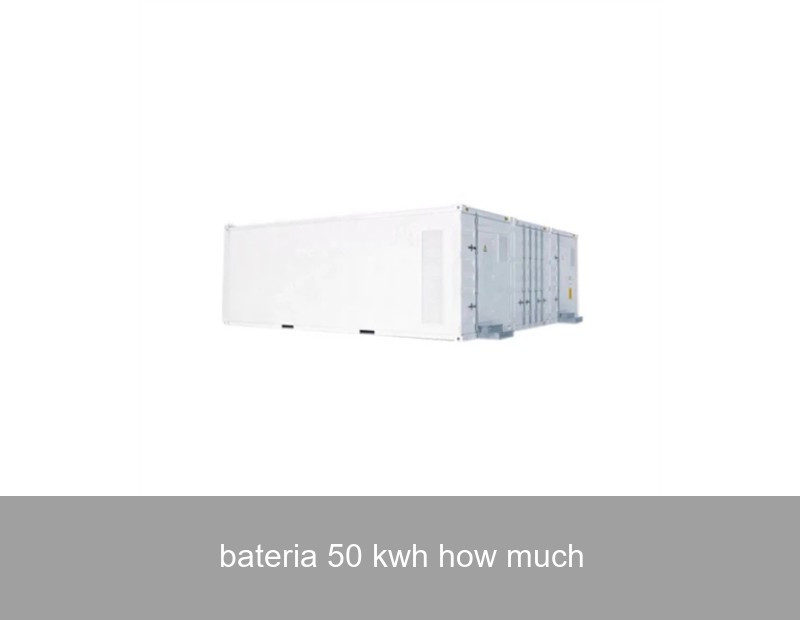
If you're searching for "bateria 50 kwh how much," you're likely at a crucial point in your energy journey. You've recognized the potential of battery storage—for energy independence, backup power, or managing electricity costs—and a 50 kWh system stands as a robust, versatile solution. But let's be honest: that initial search for a simple price can feel like falling down a rabbit hole. Quotes vary wildly, specifications are confusing, and it's hard to know what you're really paying for. Is it just about the kilowatt-hours in a box, or is there more to the story? As a product technology expert at Highjoule, I see this daily. The real question isn't just "how much," but "what value am I getting for my investment?" Let's demystify this together.
Beyond the Price Tag: The Real Cost of a 50 kWh Battery
Think of a 50 kWh battery bank as the energy equivalent of a substantial water tank. It's a significant capacity, capable of powering an average American home for a day or more during an outage, or strategically shaving peak demand charges for a small business. A raw online price for a battery module might grab your attention, but it's merely the entry point. The total installed cost encompasses the battery units themselves, the critical Balance of System (BOS) components like the inverter and battery management system (BMS), installation labor, permitting, and ongoing software intelligence. According to market analyses from sources like the U.S. Department of Energy, while hardware costs are falling, the value of integration, safety, and long-term performance is becoming the true differentiator.

Credit: ThisisEngineering RaEng on Unsplash. Professional installation and integration are key cost and value factors.
Decoding the "Bateria 50 Kwh How Much?" Question
To give you a meaningful frame of reference, let's break down the components. In the European and U.S. markets, a fully installed, high-quality 50 kWh DC-coupled storage system for commercial or large residential use can range significantly. However, focusing solely on the upfront cost per kWh can be misleading. Two critical concepts define your long-term expenditure:
- Levelized Cost of Storage (LCOS): This is the total cost of owning and operating the system over its lifetime, divided by the total energy it will discharge. A cheaper battery with a 5-year lifespan and 80% depth of discharge may have a far worse LCOS than a premium battery with a 15-year lifespan and 90% usable capacity.
- Total Cost of Ownership (TCO): This includes maintenance, potential degradation, and efficiency losses. An inefficient system with round-trip losses of 15% means you're "losing" 7.5 kWh of every 50 kWh cycle, effectively increasing your cost per usable kWh.
So, when you ask "bateria 50 kwh how much?", you should be evaluating quotes based on usable kWh over the system's productive lifetime.
The Highjoule Difference: More Than a Commodity
At Highjoule, founded in 2005, we approach a 50 kWh system not as a commodity product, but as an intelligent energy asset. Our H-Series Commercial & Industrial and scaled Residential Plus solutions are built around this philosophy. What does this mean for your investment?
- Architecture Matters: We use modular, lithium iron phosphate (LFP) chemistry known for its safety, longevity (typically 6,000+ cycles), and stability. This directly translates to a lower LCOS.
- Integrated Intelligence: Our proprietary Adaptive Grid OS software is the brain of the system. It doesn't just store and release energy; it learns your consumption patterns, forecasts weather, and interacts with grid signals (where available) to autonomously optimize for savings or resilience.
- Service as Standard: Our price includes comprehensive remote monitoring, firmware updates, and performance analytics. We ensure your system delivers its promised value year after year, protecting your capital investment.
Therefore, while our initial quote for a tailored 50 kWh solution might align with the premium segment of the market, the value proposition—measured in reliability, longevity, and intelligent ROI—is where we excel.
A Real-World Case: The 50 kWh Battery in Action
Let's move from theory to practice with a concrete example from Germany, a key European market for renewables.
Client: A medium-sized bakery in Bavaria with high, consistent energy consumption for ovens and refrigeration. They had a 80 kWp solar rooftop array but were still facing high grid consumption during early mornings and evenings, missing out on their solar potential.
Challenge: Increase self-consumption of solar power from ~35% to over 70%, and provide backup power for critical cold storage.
Solution: Highjoule deployed a 52 kWh H-Series battery system with a hybrid inverter. The system was configured for time-of-use optimization and seamless backup.
Data & Results (12-month period):
| Metric | Before Installation | After Installation |
|---|---|---|
| Solar Self-Consumption | 35% | 78% |
| Grid Electricity Purchased | ~42,000 kWh | ~18,500 kWh |
| Estimated Annual Savings* | — | €8,900 |
| Backup Runtime for Critical Loads | 0 hours | Up to 14 hours |
*Savings based on local electricity prices and reduced peak charges. Individual results vary.
The bakery's management didn't just buy a "bateria 50 kwh." They invested in an integrated energy management system. The payback period, calculated on hard savings alone, fell within their expected range, while the unquantifiable value of business continuity during a grid outage solidified the ROI.
Key Factors That Influence Your 50 kWh Battery Investment
To help you evaluate proposals, here are the decisive factors that move the needle on both cost and performance:
- Chemistry & Cycle Life: LFP (like Highjoule uses) vs. NMC. LFP offers longer life and inherent safety, impacting long-term value.
- Depth of Discharge (DoD) & Warranty: A battery warrantied for 10 years at 90% DoD and 70% retained capacity is fundamentally different from one warrantied for 5 years at 80% DoD.
- Inverter Integration: DC-coupled, AC-coupled, or hybrid? This affects overall efficiency and cost. Highjoule's DC-coupled designs typically achieve higher round-trip efficiency (~96%).
- Installation Complexity: Site preparation, electrical upgrades, and permitting vary greatly by location and property.
- Software & Grid Services: Can the system participate in virtual power plants or demand response programs? This can generate additional revenue, offsetting costs. Our Adaptive Grid OS is designed for such future-ready functionality.

Credit: American Public Power Association on Unsplash. An integrated system manages energy flow between solar, battery, home, and grid.
Your Next Step: From Inquiry to Intelligent Power
The journey from searching "bateria 50 kwh how much" to having a resilient, money-saving energy system running on your property is about connecting price to purpose. It's about choosing a partner who understands that this is a long-term investment in your operational stability or home comfort.
At Highjoule, we invite you to shift the conversation. Instead of just asking for a price, ask us for a Performance Simulation Report for your specific address. Provide us with your latest utility bill or energy data, and let our engineers model how a 50 kWh—or a perfectly tailored—Highjoule system would perform for you. What specific energy challenge are you hoping to solve with a 50 kWh battery, and how can we design a solution that turns that challenge into your strategic advantage?
 Inquiry
 Online Chat