


Finding the Best Quality Lithium Ion Battery: A Guide for Sustainable Energy Independence
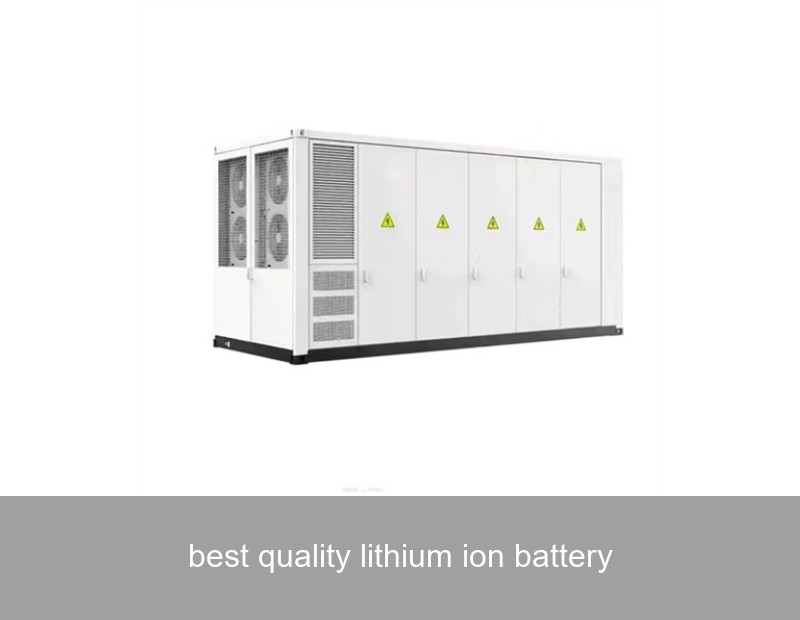
You've decided to take control of your energy future. Whether you're a homeowner looking to maximize solar self-consumption, a business manager aiming to cut peak demand charges, or a community planner designing a resilient microgrid, the heart of your modern energy system is the battery. And not just any battery. The quest for the best quality lithium ion battery is more than a search for a component; it's an investment in reliability, safety, and long-term performance. But with so many options on the market, how do you separate the truly exceptional from the merely adequate? Let's demystify what defines top-tier quality in today's energy storage landscape.
Table of Contents
- The Phenomenon: Why "Quality" is the Non-Negotiable Metric
- The Data Difference: What Metrics Really Matter?
- A Case for Quality: Real-World Performance in Action
- Beyond the Cells: The System Makes the Difference
- The Highjoule Approach: Engineering the Best Quality Lithium Ion Battery Systems
- Future-Proofing Your Investment
The Phenomenon: Why "Quality" is the Non-Negotiable Metric
We've all heard the stories: a solar panel system underperforming because its battery degrades too quickly, or a promising backup power solution failing when needed most. The common culprit? A compromise on core quality. The shift to renewables is unstoppable, but its effectiveness hinges on storage. A low-quality battery doesn't just represent a poor financial return; it can undermine the entire value proposition of your clean energy investment. It's about more than just the initial price per kilowatt-hour. Think of it this way: would you build your dream home on a fragile foundation? Your energy system is no different. The best quality lithium ion battery forms the robust, dependable foundation that allows your solar panels, wind turbines, or grid connection to deliver on their full promise, year after year.
The Data Difference: What Metrics Really Matter?
So, what should you measure? Let's move beyond marketing claims and look at the hard data that defines a premium battery.
- Cycle Life & Degradation Rate: This is paramount. A quality battery isn't defined by its day-one capacity, but by its capacity in year 10. Look for batteries that guarantee a high number of full cycles (e.g., 6,000+ at 80% depth of discharge) while retaining 60-70% of their original capacity. A slower degradation rate directly translates to a lower levelized cost of storage.
- Round-Trip Efficiency (RTE): This measures how much energy you get back versus what you put in. A 95% RTE means you lose only 5% to heat and system overhead. High efficiency means more of your precious solar energy is usable, not wasted.
- Thermal Management & Safety: Lithium-ion chemistry is sensitive to temperature. The best systems feature active liquid or advanced air cooling to maintain cells in their optimal 20-30°C range. This prevents premature aging and is a critical safety feature, as confirmed by fire safety research from institutions like UL.
- Depth of Discharge (DoD): A quality battery allows you to safely use a larger percentage of its nominal capacity (e.g., 90-100% DoD) without accelerating degradation, giving you more usable energy from the same physical footprint.

Image: A well-engineered battery module emphasizes thermal management and robust construction. Source: Unsplash
A Case for Quality: Real-World Performance in Action
Let's translate these metrics into a real scenario. Consider a mid-sized dairy farm in Bavaria, Germany. With high electricity costs and a commitment to sustainability, they installed a 200 kW solar array. Their goal: maximize self-consumption and ensure uninterrupted refrigeration.
The Challenge: Their initial, cost-focused battery system (500 kWh) degraded faster than expected, losing 35% of its capacity within 4 years. This forced them to rely more on the grid during peak evening hours, eroding their savings.
The Solution & Data: In 2021, they replaced it with a high-quality, liquid-cooled battery system from Highjoule. The key performance indicators after 3 years of operation tell the story:
| Metric | Initial Spec | Performance After 3 Years |
|---|---|---|
| Usable Capacity | 500 kWh | 485 kWh (97% retention) |
| Round-Trip Efficiency | 96% | Consistently measured at 95.5% |
| Peak Demand Reduction | Target: 40% | Achieved: 52% |
| Grid Independence | Target: 65% | Achieved: 78% in summer months |
The data is clear. The superior cycle life and minimal degradation of the high-quality system protected the farm's investment, delivering stable, predictable performance that actually improved their financial and operational outcomes. This aligns with studies on long-term storage value, such as those by the National Renewable Energy Laboratory (NREL).
Beyond the Cells: The System Makes the Difference
It's crucial to understand that the best quality lithium ion battery is more than just premium cells from a name-brand supplier. The cells are the heart, but the battery management system (BMS) is the brain, and the thermal management is the circulatory system. A weak BMS can ruin good cells through imbalance, while poor thermal design can silently strangle their lifespan.
- Intelligent Battery Management System (BMS): A top-tier BMS monitors every cell group for voltage, temperature, and current. It ensures perfect balance, prevents operation outside safe limits, and provides precise state-of-charge data.
- Robust Enclosure & Design: The system should be built for its environment—whether it's a dusty warehouse, a humid coastal area, or a residential garage. IP ratings, corrosion resistance, and physical durability matter.
- Grid-Forming Capabilities: For advanced applications, the ability to "form" a grid (black start) and provide stable voltage and frequency without relying on the main grid is a hallmark of a sophisticated, high-quality system.
The Highjoule Approach: Engineering the Best Quality Lithium Ion Battery Systems
At Highjoule, our philosophy since 2005 has been that quality is systemic. We don't just assemble cells; we engineer integrated storage solutions where every component is optimized for longevity and performance. Our HPS Series for commercial and industrial applications is a testament to this.
We start with automotive-grade, LFP (Lithium Iron Phosphate) cells, renowned for their safety and long cycle life. But that's just the beginning. Our proprietary, adaptive liquid cooling system doesn't just react to temperature—it anticipates thermal loads based on usage patterns, keeping cells within a 3°C variance. This alone can double the operational life compared to passively cooled systems. Furthermore, our AI-driven BMS doesn't just protect; it learns. It optimizes charge/discharge patterns based on your unique load profile and tariff structure, actively working to minimize degradation. For residential users, our HomePower line brings this same systems-level engineering into a compact, silent, and safe package, seamlessly integrating with major solar inverters.

Image: Expert monitoring and data analysis are key to maintaining long-term battery health. Source: Unsplash
Future-Proofing Your Investment
The energy landscape is evolving. Today's battery might need to provide backup power, participate in a virtual power plant (VPP) tomorrow, and help stabilize the local grid next year. The best quality lithium ion battery systems are software-upgradable and multi-functional. Can your system's firmware be updated to enable new revenue streams or grid services? Is it compatible with emerging smart home and energy management ecosystems?
Choosing a partner like Highjoule means selecting a platform, not just a product. Our systems are designed with this digital future in mind, ensuring that your investment continues to deliver new value over its entire 15+ year lifespan.
So, what's the first step in your journey to energy resilience?
We invite you to move beyond spec sheets and consider the total ecosystem of performance, safety, and intelligence. What specific energy challenge—be it unpredictable bills, reliability concerns, or a sustainability goal—is driving your search for a superior storage solution, and how can a truly systemic approach transform that challenge into an opportunity?
 Inquiry
 Online Chat