


BMS Battery Communication: The Silent Guardian of Your Energy Storage System
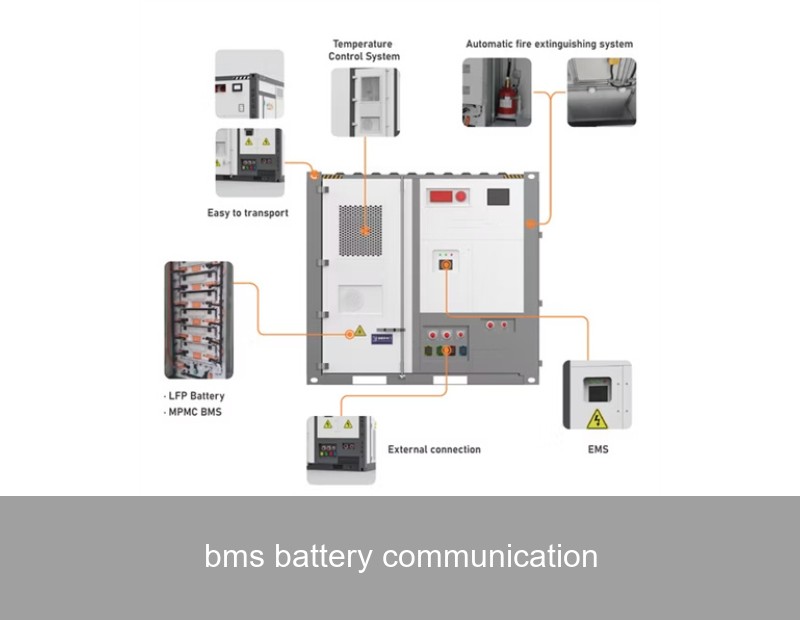
Have you ever wondered what makes a modern battery energy storage system (BESS) safe, efficient, and reliable? While we often focus on the battery cells themselves, the true intelligence lies in the BMS battery communication network. It's the silent, digital nervous system that constantly monitors, protects, and optimizes every aspect of your battery's health and performance. In this article, we'll demystify this critical technology and explain why robust communication is non-negotiable for any serious energy storage application, from residential solar setups to industrial microgrids.
Table of Contents
What is BMS Battery Communication?
At its core, a Battery Management System (BMS) is the brain of a battery pack. But a brain is useless without senses and a voice. BMS battery communication refers to the continuous data exchange between the BMS hardware and the outside world. This happens on two key levels:
- Internal Communication: Within the battery pack, the master BMS controller "talks" to slave modules or cell monitors, collecting vital statistics like voltage, temperature, and current from hundreds of individual cells.
- External Communication: The BMS then communicates this aggregated and processed data to external devices: the inverter, energy management system (EMS), fleet monitoring software, or a user's dashboard.
Think of it like a medical ICU for your battery. The sensors are the monitors on a patient, the internal network is the nurse checking all the vitals, and the external communication is the detailed report sent to the doctor for critical decisions. Without this flow of information, you're operating in the dark.
Why Communication Matters: The Data Tells the Story
The phenomenon is clear: isolated battery systems are a liability. The data underscores this. According to a 2020 study by the National Renewable Energy Laboratory (NREL), effective battery monitoring and communication can reduce degradation-related costs by up to 30% by enabling proactive management. What does this communication prevent or enable?
| Without Robust Communication | With Advanced Communication |
|---|---|
| Thermal runaway risks due to unseen cell overheating. | Precise, cell-level temperature tracking allows for active cooling control. |
| State-of-Charge (SOC) inaccuracy, leading to underutilization or over-discharge. | High-fidelity SOC and State-of-Health (SOH) estimation for optimal cycling. |
| Inability to participate in grid services (frequency regulation, etc.). | Seamless integration with grid operators for revenue-generating services. |
| Reactive, costly maintenance after a failure occurs. | Predictive maintenance alerts, scheduling service before issues escalate. |
The Digital Handshake: CAN Bus, Modbus, and Beyond
For devices to talk, they need a common language and a set of rules. These are communication protocols. In the world of BMS, two are particularly prevalent:
- CAN Bus (Controller Area Network): The automotive industry standard, known for its robustness and reliability in noisy electrical environments. It's the go-to for internal BMS communication and is common in many inverter connections.
- Modbus TCP/IP: A widely adopted industrial protocol that runs over Ethernet. It's often used for higher-level communication between the BESS and the site's SCADA or Energy Management System.
The challenge? Not all systems speak the same dialect. A high-performance BMS must be multilingual. At Highjoule, our H-BMS Pro series is designed with this interoperability in mind. It acts as a universal translator, supporting multiple standard protocols out-of-the-box. This ensures our storage systems can integrate seamlessly into any project ecosystem, whether it's a new residential build or a retrofit on a century-old industrial site.
A Real-World Case: Grid Stability in Northern Germany
Let's move from theory to practice. In the windy region of Schleswig-Holstein, Germany, a local utility faced a growing challenge: integrating vast amounts of intermittent wind power while maintaining strict grid frequency stability. Their solution was a 20 MW / 40 MWh battery storage facility designed to provide primary frequency response (FCR) services.

The critical success factor wasn't just the battery capacity; it was the speed and reliability of BMS battery communication. The BMS had to communicate cell-level data to the central controller, which then had to execute grid operator commands in under a second. The system utilized a layered communication architecture with CAN bus internally and IEC 61850 for grid interfacing.
The Result? In the first 18 months of operation, the facility achieved a 99.8% availability rate for grid service calls. The precise communication allowed for dynamic, cell-aware cycling strategies that minimized degradation while meeting aggressive response targets. This case shows that advanced BMS communication isn't a luxury—it's the backbone of reliable grid-scale storage.
The Highjoule Approach: Intelligent, Open, and Secure
Founded in 2005, Highjoule has built its reputation on not just providing storage hardware, but on delivering intelligent, system-level solutions. We understand that the value of a BESS is unlocked through its connectivity. Our product philosophy centers on three pillars for BMS battery communication:
- Intelligence: Our proprietary algorithms don't just collect data; they analyze it to predict cell imbalance and suggest corrective actions, all communicated clearly to the operator.
- Openness: We avoid vendor lock-in. Our Highjoule Energy Operating System (HEOS) platform uses open API standards, allowing easy integration with third-party solar inverters, building management systems, and all major grid service aggregators in Europe and North America.
- Security: In an era of cyber threats, communication must be secure. We implement end-to-end encryption and secure authentication protocols on all external communication channels, a critical feature for our commercial and industrial clients.
For a homeowner, this means peace of mind through a simple app that shows real-time battery health. For a factory manager, it means the Highjoule system talks directly to the production schedule, charging batteries when energy is cheap and discharging during peak hours, all automatically.
Future Trends: The Path to Smarter Grids
The future of BMS battery communication is moving towards even greater integration and intelligence. We're looking at the adoption of wireless mesh networks within large battery racks to simplify installation. More importantly, standards like IEEE 2030.5 are paving the way for seamless, secure communication between millions of distributed energy resources (DERs) and the utility grid, creating a true Internet of Energy.
At Highjoule, our R&D is actively working on integrating AI-driven analytics into our communication streams. Imagine a BMS that not only reports a slight voltage drift but also cross-references it with historical weather data, predicts a performance trajectory, and automatically adjusts the system's operating parameters to compensate—all while sending a succinct advisory to the maintenance team.
As you consider an energy storage system for your home or business, what will be your first question about how it communicates with the world around it? Will you settle for a silent box, or will you choose a system with a voice that speaks the language of safety, efficiency, and integration?
 Inquiry
 Online Chat