


China's Solar Installations in 2024: A Global Energy Market Catalyst
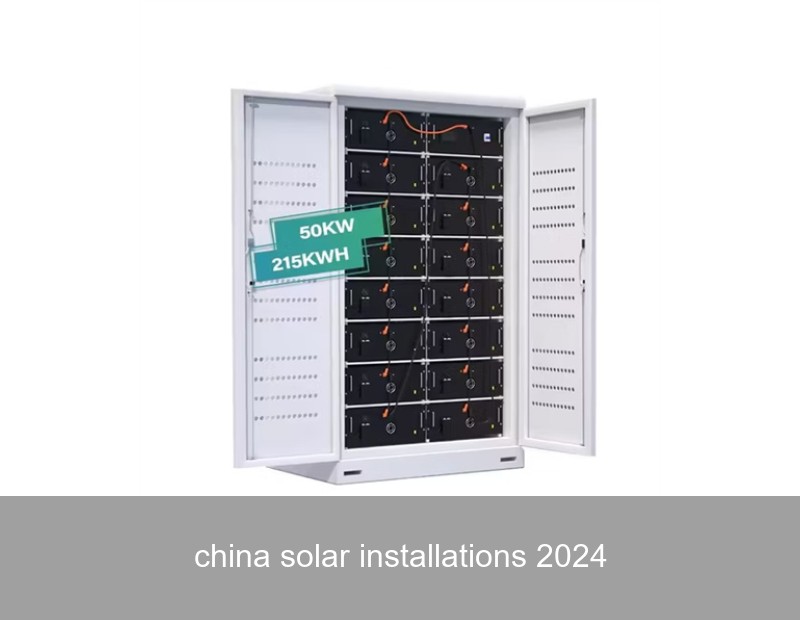
If you're following the renewable energy sector, you've likely seen the headlines about China's staggering solar expansion. The scale of China solar installations 2024 is not just a national story; it's a transformative force reshaping global supply chains, technology costs, and energy strategies worldwide. For businesses and communities in Europe and the U.S., understanding this momentum is key to leveraging the opportunities it creates, particularly in making energy storage more affordable and critical than ever.
Table of Contents
The Unprecedented Scale: 2024 by the Numbers
Let's talk scale. In 2023, China installed more solar capacity than the entire United States has cumulatively. Projections for China solar installations 2024 suggest this trend isn't just continuing—it's accelerating. Analysts from BloombergNEF (BNEF) estimate China could add a staggering 220 to 250 gigawatts (GW) of new solar PV capacity this year alone. To put that in perspective, that's roughly equivalent to installing the entire solar fleet of a major European country every single month.
This isn't happening in a vacuum. It's the result of a perfect storm of aggressive policy support, massive manufacturing scale, and relentless cost reduction. The data tells a clear story: China is fundamentally altering the global energy equation.

Image: Utility-scale solar farms are a dominant feature of the installation boom. (Photo by American Public Power Association on Unsplash)
Driving Forces Behind the Acceleration
Why is this happening now, and at such a pace? Several key factors converge:
- National Policy Mandates: China's "Dual Carbon" goals (peaking emissions by 2030, carbon neutrality by 2060) provide a powerful top-down directive. Provincial governments have specific renewable energy quotas, creating a nationwide push.
- Economic Competitiveness: The levelized cost of energy (LCOE) for solar in China is among the lowest in the world. In many regions, it's now cheaper to build new solar than to operate existing coal plants.
- Manufacturing Dominance: China controls over 80% of the global supply chain for key solar PV components, from polysilicon to modules. This vertical integration enables rapid deployment and continuous cost innovation.
- Distributed Solar Boom: It's not just massive desert farms. Rooftop solar on commercial, industrial, and residential buildings is exploding, driven by favorable net-metering policies and the desire for lower power costs.
Global Ripples: Lower Costs, New Challenges
For energy buyers and project developers in Europe and North America, the implications are profound. The manufacturing scale driving China solar installations 2024 continues to push global module prices downward, making solar projects more financially attractive everywhere. However, this also presents a dual challenge: increased intermittency on the grid and a focus on supply chain diversification.
As solar penetration increases, the sun doesn't always shine when energy demand peaks. This creates a growing need for solutions that can bridge the gap—this is where advanced energy storage systems (ESS) become the indispensable linchpin of a modern, resilient grid.
The Critical Partner: Why Energy Storage is Non-Negotiable
Think of a solar panel as an energy producer that works a strict daylight shift. An energy storage system is the manager that saves that surplus energy for the night shift, for cloudy days, or for moments of peak demand. Without storage, a significant portion of solar's potential is wasted, and grid stability can be compromised.
This is precisely the challenge Highjoule was founded to solve in 2005. As a global leader in advanced energy storage, we don't just see batteries; we see intelligent systems that optimize energy flow. Our solutions, like the Highjoule H-Series Commercial & Industrial (C&I) ESS and the GridMax Utility-Scale Platform, are engineered to seamlessly integrate with massive solar influx. They perform critical functions:
- Energy Time-Shifting: Storing cheap solar energy produced at midday for use during expensive evening peak periods.
- Frequency Regulation: Providing millisecond-response services to stabilize grid frequency, which becomes more volatile with high renewable penetration.
- Backup Power: Ensuring operational continuity for businesses during grid outages.
By pairing high-performance lithium iron phosphate (LFP) battery technology with our proprietary Adaptive Grid AI software, Highjoule systems ensure that the solar power you generate or purchase is reliable, dispatchable, and maximizes your return on investment.
Case Study: Grid Stability Lessons from a German Industrial Park
Let's bring this to life with a real example from Europe. A large industrial park in North Rhine-Westphalia, Germany, hosts several manufacturing facilities with a 15 MW rooftop solar array. By 2023, they were experiencing a classic problem: their solar generation often exceeded their midday load, forcing them to curtail (waste) solar power or strain the local substation by exporting excess.
In early 2024, they deployed a 12 MWh Highjoule H-Series C&I ESS. The results, monitored over a quarter, were striking:
| Metric | Before Highjoule ESS | After Highjoule ESS Deployment |
|---|---|---|
| Solar Self-Consumption | 68% | 94% |
| Peak Grid Draw Reduction | 0% | 42% |
| Value of Curtailed Energy Recaptured | - | €120,000+ per quarter |
| Grid Service Revenue (Frequency) | - | €18,000 per quarter |
This case mirrors the macro challenge posed by massive solar adoption. The solution isn't less solar—it's smarter integration. The industrial park now acts as a stable, grid-supportive asset, a model for how regions can adapt to a high-renewables future. You can explore more real-world data on grid integration challenges from the International Renewable Energy Agency (IRENA).
Image: Advanced C&I storage systems turn solar energy into a reliable 24/7 resource. (Photo by Michael Fousert on Unsplash)
Future-Proofing Your Energy Strategy
The narrative of China solar installations 2024 is ultimately a story about the global energy transition's velocity. It underscores a universal truth: the future of energy is not just about generation, but about intelligent management and storage.
For a municipality planning a microgrid, a factory owner looking to lock in energy costs, or a utility company balancing an increasingly complex grid, the question has evolved. It's no longer "Should we invest in renewables?" but rather "How do we integrate this abundant, intermittent power into a resilient, economical, and stable system?"
Highjoule's expertise lies in answering that exact question. Our portfolio—from residential HomePower solutions to industrial H-Series and large-scale GridMax systems—is designed to provide that critical layer of intelligence and reliability, ensuring that the global surge in solar power translates into tangible energy security and savings for our clients.
An Open Question for Energy Decision-Makers
As solar capacity continues its record-breaking trajectory globally, how is your organization planning to not just source clean energy, but to truly harness and control it? The gap between generation and usable, reliable power is where the next chapter of the energy transition will be written. What role will storage play in your chapter?
For further reading on global solar forecasts that contextualize regional trends, see the IEA Renewables 2023 Report.
 Inquiry
 Online Chat