


CMBLU Energy AG For Sale: A Signal of the Maturing Long-Duration Energy Storage Market
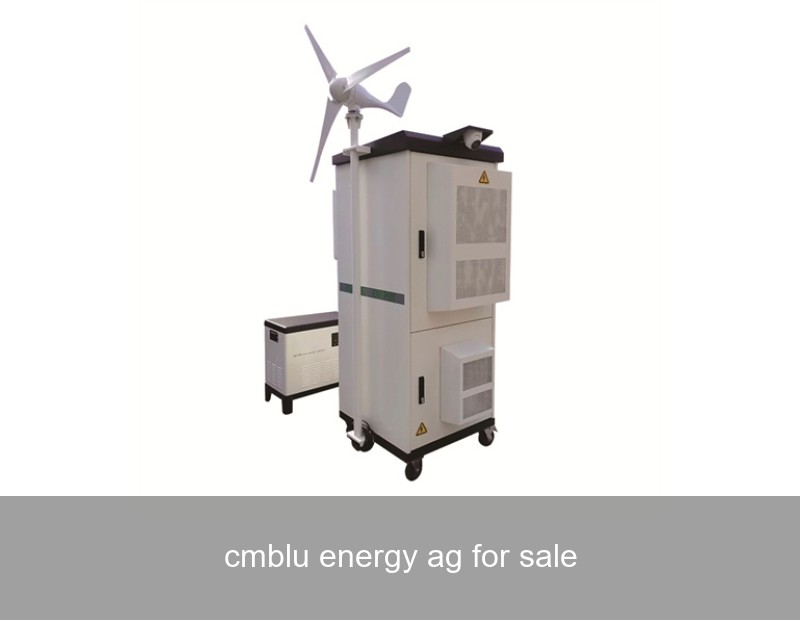
If you've been following the energy transition in Europe, you might have come across news about CMBLU Energy AG for sale. This development is more than just a business headline; it's a telling signpost in the rapidly evolving landscape of long-duration energy storage (LDES). For industry observers, utilities, and businesses seeking energy resilience, this moment offers a perfect opportunity to understand the forces shaping our future grid. The quest to store renewable energy for hours, days, or even seasons is pushing technological boundaries, and while some paths converge, others diverge. At Highjoule, with nearly two decades of experience since 2005, we've witnessed this evolution firsthand, providing intelligent battery energy storage systems (BESS) that address the critical day-to-day balancing needs of grids, businesses, and homes worldwide.
Table of Contents
- The Phenomenon: Why LDES Companies Face Strategic Crossroads
- The Data: The Soaring Demand and the "Valley of Death"
- A Concrete Case: Lessons from a German Industrial Microgrid
- The Expert Insight: Hybridization and Pragmatic Solutions
- Highjoule's Role in a Diversified Storage Ecosystem
- Looking Ahead: What Does Your Energy Future Require?
The Phenomenon: Why LDES Companies Face Strategic Crossroads
The announcement that CMBLU Energy AG is for sale highlights a critical phase in the energy storage industry. CMBLU, known for its pioneering work on organic flow batteries using lignin—a byproduct of the paper industry—represents the innovative, non-lithium frontier of LDES. Their journey to commercialization, however, underscores a universal challenge: scaling novel technology from pilot projects to gigawatt-hour market penetration is capital-intensive and fraught with risk. This "strategic review" is a common juncture where pioneers seek deeper-pocketed partners to bring their vision to fruition. It doesn't negate the need for long-duration storage; rather, it signals market consolidation and the search for viable business models. As the grid integrates more variable wind and solar, the need for storage that lasts beyond the 4-8 hours typical of lithium-ion batteries becomes acute, especially for seasonal arbitrage and weeks-long weather-related dips in renewable generation.
The Data: The Soaring Demand and the "Valley of Death"
Let's look at the numbers. According to the International Renewable Energy Agency (IRENA), to stay on a 1.5°C pathway, the world needs to expand battery energy storage capacity to a staggering 680 GW by 2030. The LDES Council estimates that by 2040, 85-140 TWh of long-duration storage will be required globally. The potential is enormous. Yet, bridging the gap between laboratory breakthrough and bankable, grid-scale project is famously difficult. This is the "valley of death" for many deep-tech startups. Financing, supply chain establishment, and proving Levelized Cost of Storage (LCOS) competitiveness against incumbent technologies like lithium-ion or natural gas peakers are monumental hurdles. The sale of a company like CMBLU is often a move to secure the resources needed to cross that valley.

Credit: Unsplash - The scale of renewable integration demands a mix of storage solutions.
A Concrete Case: Lessons from a German Industrial Microgrid
Consider a real-world scenario from our own experience that illustrates the complementary nature of storage technologies. A large German automotive component manufacturer aimed to achieve 85% energy self-sufficiency using its rooftop solar PV. Their challenge wasn't just nightly consumption; it was multi-day periods of low solar irradiance common in Central European winters.
- Phenomenon: Production could not risk downtime due to grid volatility or cloudy weeks.
- Data & Solution: Highjoule's team designed a hybridized system. A 2 MWh lithium-ion battery storage system (using Highjoule's GridMax Industrial BESS) was deployed to handle daily cycling, peak shaving, and short-term backup. This system manages over 700 full cycles annually with minimal degradation.
- Result: The lithium-ion system covers 90% of the short-duration mismatch, reducing peak demand charges by 30% and providing seamless UPS functionality. For the remaining long-duration gap, the facility opted for a strategic power purchase agreement (PPA) with an off-site wind farm, a more immediate economic solution than installing nascent LDES on-site. This case shows that today's industrial needs are often best met with a layered, pragmatic approach combining proven BESS with smart energy contracts.
The Expert Insight: Hybridization and Pragmatic Solutions
So, what's the key takeaway for a business or utility manager? The future is rarely a single-technology monopoly. The energy storage ecosystem will be diverse. Flow batteries (like those CMBLU developed), compressed air, thermal storage, and advanced lithium-ion chemistries will all have roles. The critical insight is to match the storage technology to the specific application and duration requirement. For most commercial and industrial (C&I) applications, the economic sweet spot currently lies in 2-6 hour storage for demand charge management, solar self-consumption optimization, and frequency regulation—areas where advanced lithium-ion BESS excel in terms of energy density, round-trip efficiency, and proven bankability.
At Highjoule, we focus on perfecting these solutions. Our GridMax Commercial and Industrial BESS platforms are built with smart, AI-driven energy management systems that maximize ROI by stacking revenue streams. They are the workhorses of the immediate transition, solving real economic problems today while the LDES landscape matures.
| Technology | Typical Duration | Primary Strengths | Ideal Use Case |
|---|---|---|---|
| Highjoule Lithium-ion BESS | 2 - 6 hours | High power, fast response, high round-trip efficiency, modular scalability | Peak shaving, solar smoothing, frequency services, C&I backup |
| Flow Batteries (e.g., Vanadium, Organic) | 6+ hours to days | Long cycle life, duration independent of power, deep cycling capability | Renewable firming, weekly/monthly load shifting |
| Pumped Hydro | Hours to days | Very large scale, low marginal cost | Bulk energy management, seasonal storage |
Highjoule's Role in a Diversified Storage Ecosystem
While news about CMBLU Energy AG for sale focuses on one part of the puzzle, companies like Highjoule are actively deploying the other crucial piece. Our mission is to deliver reliable, intelligent, and sustainable storage solutions that are financially viable now. For a European supermarket chain, that might mean a behind-the-meter system to cap energy costs. For a U.S. microgrid developer, it could be a containerized GridMax Community system integrating solar and wind. Our expertise lies in system integration, safety (with advanced thermal management and UL-certified designs), and providing a seamless digital interface for energy asset optimization.
We view the maturation of LDES players not as competition, but as a necessary evolution to build a fully resilient grid. In the future, we envision hybrid systems where our high-power BESS could work in concert with long-duration technologies, each handling the duty cycle they are best suited for.

Credit: Unsplash - Intelligent control systems are key to storage performance.
Looking Ahead: What Does Your Energy Future Require?
The story of CMBLU is a chapter in the larger story of our energy transition. It reminds us that innovation requires patience, capital, and strategic partnerships. For you—whether you're a facility manager tired of volatile energy bills, a utility planner modeling future grid needs, or a community leader seeking energy independence—the question isn't just "which technology will win?"
The more pressing question is: What specific energy challenges are you facing today, and what mix of solutions can you deploy to start saving money and increasing resilience immediately while planning for the long-term? The journey to 100% renewable stability is a mosaic, and the first tile to place is often the one that delivers a clear, quantifiable return.
Are you ready to map out your specific storage needs and explore what a proven, intelligent BESS solution can do for your operations this year?
 Inquiry
 Online Chat