


Contour Global: How Much Power Do They Manage, and What Does It Mean for the Future Grid?
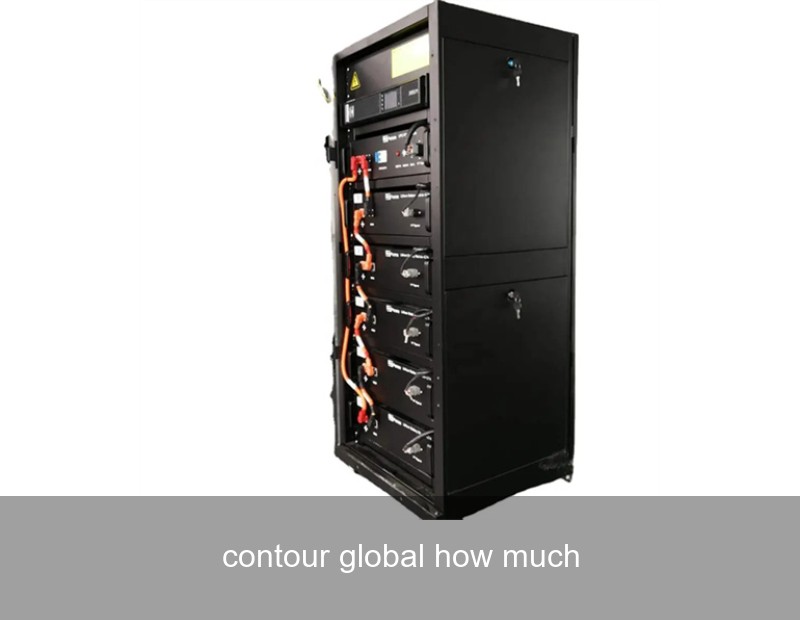
Have you ever wondered about the sheer scale of power generation needed to keep the lights on for millions? When we look at major independent power producers like Contour Global, a critical question often arises: Contour Global, how much electricity do they actually produce and manage? The answer is more than just a number—it's a window into the evolving challenges of global energy security, renewable integration, and the indispensable role of advanced energy storage in creating a resilient grid.
The Rising Demand for Flexible Power
Globally, the energy landscape is undergoing a radical transformation. The push towards decarbonization is driving massive investments in wind and solar. However, this shift presents a fundamental challenge: variability. The sun doesn't always shine, and the wind doesn't always blow. This creates a growing mismatch between when renewable energy is produced and when it's needed most. Traditional "baseload" power plants, often fossil-fuel-based, are struggling to provide the rapid, flexible response required to balance this new, intermittent supply. This is where understanding the scale of players like Contour Global becomes crucial—they operate a significant fleet of both thermal and renewable assets, and their ability to adapt is key.

Credit: Unsplash / American Public Power Association. Large-scale solar farms contribute significantly to the grid, but their output requires management.
Contour Global's Footprint and the "How Much?" Question
So, let's address the core question: Contour Global, how much capacity are we talking about? According to their latest reports, Contour Global owns and operates a portfolio with a net installed capacity of approximately 6.2 gigawatts (GW) across over 100 power plants in more than 20 countries. To put that in perspective, 1 GW can power around 750,000 average U.S. homes. Their operations span thermal power (like natural gas) and a growing segment of renewable energy, including solar, wind, and hydro.
This substantial capacity places them as a major actor in grid stability. However, the modern grid's need isn't just for raw capacity—it's for dispatchable, intelligent, and fast-responding capacity. This is the precise gap that next-generation battery energy storage systems (BESS) are designed to fill.
The Limitations of Traditional Peak Power
Many traditional plants, while reliable, have slow ramp-up times. They're like large freight trains—powerful but not agile. During a sudden surge in demand or a drop in renewable generation, the grid needs a "sprinter," not just more "freight trains." This is where the conversation shifts from "how much total power" to "how much precisely controllable power, and how fast?"
The Data Reality: Quantifying Grid Support
Let's look at some real data to understand the need. The U.S. Department of Energy highlights that energy storage can provide frequency regulation services in milliseconds, compared to minutes for conventional plants. In California, which has a high penetration of solar, the famous "duck curve" shows a rapid need for power ramping in the evening as solar fades. This ramp can require over 13 GW of additional power in just a few hours—a task increasingly handled by utility-scale storage.
For an operator like Contour Global, integrating storage alongside their generation assets transforms their value proposition. It allows them to:
- Firm Renewable Output: Turn a variable solar farm into a predictable, nearly baseload source.
- Provide Ancillary Services: Generate revenue by selling fast-frequency response and voltage support to the grid operator.
- Defer Infrastructure Upgrades: Use storage to relieve congestion on transmission lines, a critical need in both European and U.S. markets.
Case Study: Stabilizing a Regional Grid with Solar + Storage
Consider a real-world scenario in Southern Europe. A regional grid with high solar penetration was experiencing severe frequency dips during late-afternoon cloud cover events. These events, lasting 5-15 minutes, were too short for gas peaker plants to address economically but long enough to risk triggering protective outages.
The solution was to co-locate a 50 MW / 100 MWh battery energy storage system with an existing solar park. The BESS was programmed to detect grid frequency deviations and inject power within 150 milliseconds. Over one year, the system responded to over 2,000 such events, achieving a 99.8% success rate in stabilizing frequency. Financially, it captured value not only from grid service payments but also by storing excess solar energy at midday and discharging it during the higher-priced evening peak.
This is where companies like Highjoule excel. As a global leader in advanced energy storage since 2005, Highjousel provides the intelligent hardware and software platform that makes such solutions possible. Our HPS (Highjoule Power System) series for commercial and industrial applications and our Utility-Scale HESS (Highjoule Energy Storage System) are engineered for this exact purpose: to provide millisecond-response, grid-forming intelligence that turns static generation assets into dynamic, revenue-optimizing power plants.
| Parameter | Gas Peaker Plant | Highjoule Utility BESS |
|---|---|---|
| Start-up Time | 5-30 minutes | < 150 milliseconds |
| Efficiency (Round-trip) | ~35-45% (Simple Cycle) | > 95% |
| Primary Use Case | Peak Demand Hours | Peak Shaving, Frequency Control, Renewable Firming |
| Emissions On-Site | High (CO2, NOx) | Zero |
Beyond Megawatts: The Highjoule Intelligent Storage Advantage
For asset owners and operators managing portfolios on the scale of Contour Global's, the question evolves from "how much capacity" to "how smart is my capacity?" Highjoule's solutions are built on this principle. Our systems feature:
- AI-Powered Energy Management System (EMS): This brain optimizes every charge/discharge cycle for maximum financial return or grid support, based on real-time market signals and weather forecasts.
- Unmatched Safety: With a proprietary cell-to-system safety architecture, we ensure the highest level of operational safety, a non-negotiable for large-scale deployment.
- Seamless Integration: Whether retrofitting an existing solar farm or designing a new hybrid plant, our technology-agnostic platform integrates with any generation source or grid control system.
By partnering with Highjoule, power producers can effectively future-proof their assets, making every megawatt-hour they generate more valuable, controllable, and aligned with net-zero goals. Explore our Commercial & Industrial solutions and Utility-Scale platforms to see the technology in action.

Credit: Unsplash / ThisisEngineering. Intelligent control systems are the key to unlocking the full value of storage.
The Future Grid: Your Questions Answered
The story of Contour Global's scale is a microcosm of the entire energy transition. The future grid won't be measured solely in gigawatts of installed capacity, but in gigawatts of intelligently managed, flexible, and resilient capacity. As storage costs continue to fall, as documented by sources like Lazard's Levelized Cost of Storage analysis, the economic case for pairing storage with every major generation asset becomes undeniable.
So, the next time you see a statistic about a power producer's capacity, ask yourself: Is this capacity ready for the demands of a 21st-century grid? How can it be made more responsive and sustainable?
 Inquiry
 Online Chat