


Understanding the Cost of Solar Batteries for Home: A Smart Investment Guide
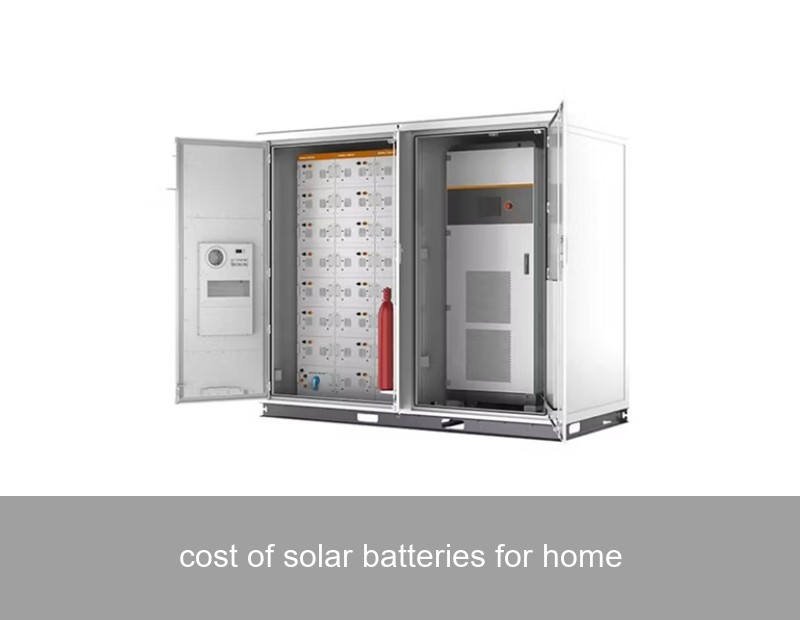
You've got solar panels on your roof, and they're doing a fantastic job slashing your daytime electricity bills. But what about when the sun goes down, or during a grid outage? That's where a home solar battery comes in. It's the missing piece for true energy independence. Yet, the upfront cost of solar batteries for home can feel like a significant hurdle. Is it worth it? Let's break down the numbers, the value, and the long-term benefits to see why this technology is more than just a backup plan—it's a strategic financial and environmental decision.
Table of Contents
- Breaking Down the Cost: More Than Just a Price Tag
- Key Factors Influencing Your Solar Battery Price
- A Real-World Case: The Johnson Family in California
- Beyond Storage: The Highjoule Advantage in Smart Energy Management
- Calculating Your True Return on Investment (ROI)
- Future-Proofing Your Home and Your Wallet
Breaking Down the Cost: More Than Just a Price Tag
When we talk about the cost of solar batteries for home, we're typically looking at a range between $8,000 and $15,000 for a quality system with professional installation, before any incentives. This price primarily reflects the battery's capacity, measured in kilowatt-hours (kWh). Think of it like a fuel tank: a 10 kWh battery can deliver 5 kilowatts of power for 2 hours, enough to run essential home appliances during an outage.
But here's the crucial perspective shift: a solar battery isn't an expense; it's an asset. It transforms your solar array from a daytime discount generator into a 24/7 personal power plant. The real question isn't just "what does it cost?" but "what value does it create?" This value manifests in three key areas: energy bill savings, backup power resilience, and increased self-consumption of your clean solar energy.
Key Factors Influencing Your Solar Battery Price
Several components determine your final investment. Understanding these helps you make an informed choice.
- Battery Capacity & Power: Capacity (kWh) is your energy "bank balance," while power (kW) is how much you can withdraw at once. A battery with high power can start large appliances like air conditioners.
- Chemistry & Longevity: Lithium-ion phosphate (LFP) batteries, like those used in Highjoule's Residential Energy Hub, are now the industry standard for safety and cycle life, often carrying warranties of 10 years or 10,000 cycles.
- System Integration: Is it an AC-coupled or DC-coupled system? DC-coupled systems, where the battery integrates directly with your solar inverter, are often more efficient, capturing more of every sunbeam.
- Installation Complexity: Electrical work, permitting, and whether you're retrofitting to an existing solar system or installing everything together all affect labor costs.
- Smart Features: Advanced energy management software can optimize when to charge (from solar or the grid) and when to discharge, maximizing savings. This intelligence is a core part of the value proposition.

Image Source: Unsplash - A modern, wall-mounted home battery system.
A Real-World Case: The Johnson Family in California
Let's move from theory to practice. Consider the Johnson family in Sacramento, California, a region with high electricity rates and a Time-of-Use (TOU) billing structure.
| Scenario | Without Battery | With Highjoule 13.5kWh Battery |
|---|---|---|
| Solar overproduction at noon | Exported to grid at low rate ($0.08/kWh) | Stored in battery for later use |
| Evening peak demand (4-9 PM) | Purchased from grid at high peak rate ($0.45/kWh) | Powered by stored battery energy ($0.00/kWh cost) |
| Daily Savings | N/A | ~$2.50 - $3.50 per day |
| Annual Savings | N/A | ~$1,200 |
| Backup during PSOS (Public Safety Power Shutoff) | No power for essential loads | Seamless backup for lights, fridge, internet for 24+ hours |
After factoring in the 30% federal investment tax credit (ITC) and other local incentives, the Johnsons' payback period for their Highjoule system dropped to under 8 years. Given the system's 15-year warranty, they are looking at nearly a decade of essentially free backup power and continued savings. This tangible example illustrates how the cost of solar batteries for home is offset by strategic energy arbitrage and priceless peace of mind. For more on TOU rates and their impact, see this explainer from the U.S. Department of Energy.
Beyond Storage: The Highjoule Advantage in Smart Energy Management
At Highjoule, we believe a battery should be the brain of your home energy system, not just a box. Our Residential Energy Hub is engineered with this philosophy. It's not merely about storing energy; it's about intelligently managing it.
Our integrated AI-powered software constantly analyzes weather forecasts, your consumption patterns, and real-time electricity tariffs. It automatically decides the most economical moment to charge or discharge, ensuring you use your self-generated solar power to its maximum potential. This level of optimization is what turns a good investment into a great one, significantly impacting the long-term financial equation of your system's cost.
Furthermore, our systems are designed for scalability. You can start with a single battery module and easily expand capacity as your needs evolve—whether you buy an electric vehicle or add a heat pump. This modular approach protects your initial investment and adapts to your future lifestyle.
Calculating Your True Return on Investment (ROI)
To accurately assess the cost of solar batteries for home, you must calculate the ROI. Here's a simplified framework:
- Upfront Cost: System price + installation - federal/state/local incentives.
- Annual Financial Benefit: (kWh shifted from peak to off-peak rate * price difference) + (reduced grid imports * standard rate).
- Intangible Value: Assign a monetary value to backup power during outages. For a home office or medical equipment, this can be substantial.
- Long-Term Value: Consider the protection against inevitable future electricity rate hikes, which have historically risen about 3% annually in the U.S. (U.S. EIA).

Image Source: Unsplash - A family reviews their home energy data.
Future-Proofing Your Home and Your Wallet
The energy landscape is shifting rapidly. From vehicle-to-grid (V2G) technology to virtual power plants (VPPs), homes with intelligent battery storage are becoming active participants in a cleaner, more resilient grid. By investing now, you're not just buying a product; you're securing a position in the future of energy.
Highjoule is at the forefront of this transition. Our systems are designed to be grid-responsive, with the potential to participate in utility demand-response programs that can actually pay you for allowing your battery to support the community grid during times of extreme stress. This creates an additional revenue stream, further improving your ROI.
So, when you evaluate the cost of solar batteries for home, ask yourself: What is the cost of not having one? The cost of wasted solar energy, the cost of vulnerability during blackouts, and the cost of being passive in the face of rising energy bills? For a deeper dive into home storage technologies, the National Renewable Energy Laboratory (NREL) provides excellent resources.
Ready to See Your Personalized Numbers?
The journey to energy independence starts with a clear picture. What would your specific savings look like given your location, consumption, and local utility rates? How would a Highjoule system be designed to meet your unique energy goals and provide peace of mind for the next decade and beyond?
 Inquiry
 Online Chat