


Do I Need Planning Permission for Solar Panels? A Homeowner's Guide
Thinking about joining the renewable energy revolution and installing solar panels on your roof? It's a fantastic decision for your wallet and the planet. But amidst the excitement, a very practical question often pops up: do I need planning permission for solar panels? For most homeowners in the US and Europe, the answer is a reassuring "no," thanks to something called "permitted development rights." However, there are crucial exceptions you must know. This guide will walk you through the rules, data, and real-world considerations to ensure your solar journey is smooth and compliant.
Table of Contents

Image: A well-integrated solar installation often falls under permitted development rights.
The General Rule: Permitted Development Rights
Let's start with the good news. In both the United Kingdom and most jurisdictions across the United States, solar panel installations on existing homes are typically considered "permitted development." This means they do not require a full planning application, provided they meet certain size and placement criteria. The philosophy here is to encourage low-carbon technologies by reducing bureaucratic hurdles.
In the UK, the government's Householder Technical Guidance states that solar panels on a dwelling house are permitted development, unless:
- They would protrude more than 200mm from the roof or wall surface.
- They would be installed above the highest part of the roof (excluding the chimney).
- The property is in a designated area (e.g., Conservation Area, World Heritage Site).
In the US, regulations vary by state, county, and city, but most have adopted similar "by-right" installation rules for rooftop solar. The key is usually compliance with setback requirements (distance from roof edges) and height restrictions. Always, the golden rule is to check with your local planning authority (UK) or city/county building department (US) before any work begins. A quick call can save you from costly corrections later.
The Data Behind the Solar Surge
This streamlined approach has fueled adoption. In 2023, the UK saw a record increase in solar capacity, with over 190,000 installations, most of which were residential and leveraged permitted development rights. Similarly, in the US, residential solar grew by 13% in 2023, with streamlined permitting in many states being a key growth driver. This isn't just about panels on roofs; it's about a systemic shift towards energy independence.
Key Exceptions Where You DO Need Planning Permission
Now, let's talk about the exceptions. Knowing these will prevent your project from hitting a regulatory wall.
- Listed Buildings: If your home is a listed (historically significant) building, you will almost certainly need listed building consent and likely planning permission. The goal is to preserve historical integrity.
- Designated Areas: Homes in Conservation Areas, National Parks, Areas of Outstanding Natural Beauty (AONBs), or World Heritage Sites often face stricter controls. Panels on a principal wall visible from a highway may require permission.
- Flats/Apartment Buildings: Installing on a flat roof or a building with multiple dwellings usually requires planning permission.
- Ground-Mounted Systems: If you're considering a free-standing solar array in your garden, rules are stricter. In the UK, it's permitted only if it's less than 9 square meters, more than 5m from the house, and not in front of the house. Larger systems need permission.
- Non-Standard Installations: Extremely large or prominent installations that don't meet the "permitted development" size limits will need a formal application.
| Your Situation | Likely Permission Needed? | Primary Reason |
|---|---|---|
| Standard roof on a detached house in a regular area | No (Permitted Development) | Standard installation meets size/placement rules |
| House in a Conservation Area or AONB | Possibly Yes | Protection of area character and aesthetics |
| Listed Building | Almost Certainly Yes | Preservation of historical fabric and significance |
| Ground-mounted system over 9m² (UK) | Yes | Impact on land use and visual amenity |
| Flat/Apartment Building | Yes | Shared ownership and building structure |
Beyond Panels: Planning for a Complete Energy System
Here's where modern energy thinking gets exciting. Solar panels are just one part of the equation. To truly maximize self-consumption and resilience, pairing them with a battery energy storage system (BESS) is becoming the new standard. This is where companies like Highjoule excel. Our intelligent storage solutions, like the Highjoule HomePower series, store your excess solar energy for use at night or during outages, dramatically increasing your energy independence.
And the good news? In most cases, installing a standalone battery storage system inside your home (like in a garage or utility room) does not require planning permission. External battery units may have more restrictions, similar to outbuildings. When you partner with a full-system provider like Highjoule, our technical experts not only design the optimal solar-plus-storage system but also guide you through the local regulatory landscape for all components, ensuring a fully compliant and optimized installation.

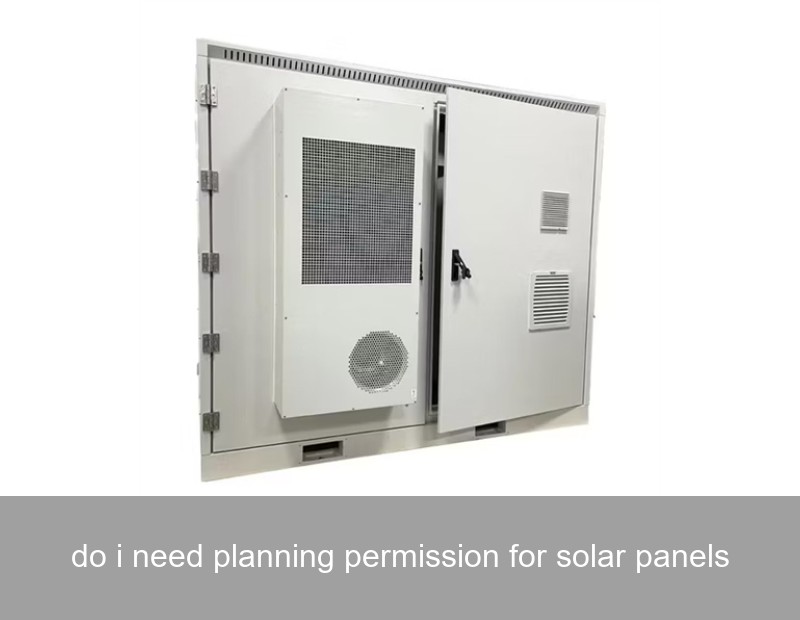
Image: A wall-mounted home battery system, typically installed without needing planning permission.
Real-World Case: A UK Listed Building Challenge
Let's look at a real example from the Cotswolds, a designated AONB in England. A homeowner of a Grade II listed cottage wanted to reduce their carbon footprint and energy bills. The initial assumption was that planning permission would be impossible.
Phenomenon: High energy costs and a desire for sustainability in a historically sensitive property.
Data & Action: The homeowner, working with a specialist installer familiar with heritage properties, submitted a detailed planning application. It included:
- Specific panel models with low-profile, black frames to blend with the roof slate.
- Precise positioning on a rear roof slope not visible from public footpaths.
- A heritage statement explaining the minimal visual impact and the public benefit of renewable energy generation.
- Integration plans for a discreet Highjoule battery system inside the existing outbuilding, avoiding external visual impact.
Insight: The local planning authority granted permission. The key was a well-researched, sensitive application that balanced heritage concerns with environmental benefits. The system now generates 4.2kW of power, meeting 75% of the home's annual electricity needs, with the battery storing excess for evening use. This case proves that even in highly restricted contexts, a thoughtful approach can succeed.
Pro Tips for a Hassle-Free Solar Project
Ready to move forward? Follow this checklist:
- Consult Your Local Authority First: A pre-application inquiry can provide clarity, especially for non-standard properties.
- Choose a Reputable, Knowledgeable Installer: They should handle all aspects of planning, building regulations, and grid connection (like the UK's Feed-in Tariff or Smart Export Guarantee processes). A provider like Highjoule offers end-to-end project management, ensuring compliance at every step.
- Consider the Full System: Think beyond panels. Ask about integrated storage solutions. Highjoule's smart systems not only store energy but can optimize usage based on your habits and local utility rates, providing a truly intelligent home energy platform.
- Documentation is Key: Even for permitted development, keep all specifications, warranties, and the MCS certificate (UK) or equivalent for your records and future home sales.
What About Commercial or Industrial Projects?
The rules for businesses, farms, and industrial sites are different and more complex. Larger-scale solar arrays and storage systems often require full planning applications, environmental impact assessments, and detailed grid connection studies. Highjoule's commercial and microgrid teams specialize in navigating this landscape, delivering turnkey solutions that meet both planning and operational requirements for businesses seeking energy security and sustainability.

Image: Large-scale commercial and industrial solar projects involve a different planning process entirely.
So, while the question "do I need planning permission for solar panels?" has a generally positive answer for most homeowners, the true power lies in asking the next question: "How can I design a complete, intelligent energy system that maximizes my investment and independence, within the rules that apply to my unique home?"
What's the first step you'll take to answer that question for your own home?
 Inquiry
 Online Chat