


ELISA Distributed Energy Storage: The Smart Grid's Local Powerhouse
Imagine your local school, supermarket, or even your neighborhood not just consuming electricity, but actively managing it. This isn't a futuristic dream; it's the reality being shaped by ELISA distributed energy storage systems. As grids worldwide strain under the weight of renewable intermittency and peak demands, a decentralized approach to energy resilience is emerging. Distributed Energy Storage Systems (DESS), like the ELISA architecture, are becoming the critical linchpin, allowing energy to be stored and used exactly where it's generated and needed most. For businesses and communities in Europe and the US, this shift represents unprecedented control over energy costs and sustainability.
Table of Contents
- The Phenomenon: From Centralized Grids to Local Nodes
- The Data: Why Distribution is Winning
- Case Study: A German Industrial Park's Journey
- The ELISA Insight: Intelligence at the Edge
- How Highjoule Powers the Distributed Future
- Is Your Energy Ready to Be Distributed?

Image: Rooftop solar combined with storage is a classic distributed energy application. Source: Unsplash
The Phenomenon: From Centralized Grids to Local Nodes
For over a century, our power model has been largely one-way: massive, centralized power plants send electricity over long, inefficient transmission lines to passive consumers. The rise of solar PV and wind power challenged this model by generating power at the "edge of the grid"—on rooftops and in fields. However, without storage, this power is fleeting. The sun doesn't always shine when we need to run air conditioning, and the wind doesn't always blow during peak evening hours. This mismatch creates a dual problem: renewable energy is sometimes wasted, and grid reliability can be compromised.
Enter distributed storage. Think of it as creating a network of intelligent, local energy reservoirs. Instead of one massive dam (a centralized grid battery), we build hundreds of smart ponds (distributed systems) where water (energy) is collected from local rain (solar/wind) and released precisely when the local garden needs it. This ELISA distributed energy storage philosophy—Embedded, Localized, Intelligent, Storage Architecture—fundamentally rethinks grid participation.
The Data: Why Distribution is Winning
The numbers behind this shift are compelling. According to the U.S. Energy Information Administration (EIA), U.S. battery storage capacity is projected to nearly double in 2024 alone, with a significant portion being behind-the-meter systems. In Europe, the European Association for Storage of Energy (EASE) estimates that to meet its 2030 climate targets, the EU needs a tenfold increase in its energy storage capacity, heavily leaning on distributed solutions.
Let's break down the key advantages with a simple comparison:
| Challenge | Centralized Grid Solution | Distributed (ELISA) Storage Solution |
|---|---|---|
| Peak Demand Charges | Build more "peaker" plants (expensive, carbon-intensive). | Discharge local batteries to shave peak demand, slashing utility bills. |
| Grid Congestion | Reinforce transmission lines (costly, lengthy permits). | Provide local grid services, deferring costly infrastructure upgrades. |
| Renewable Integration | Curtail (waste) excess solar/wind generation. | Store excess local generation for use later, maximizing self-consumption. |
| Resilience | Single point of failure risk. | Islanding capability keeps critical local loads running during outages. |
Case Study: A German Industrial Park's Journey to Resilience
Let's make this concrete. Consider a mid-sized industrial park in Bavaria, Germany. Home to several manufacturing SMEs, the park faced two major issues: volatile energy prices eating into margins and increasing concerns about power quality affecting sensitive machinery. Their 2.5 MW rooftop solar array often produced more power than could be used at noon, while high demand in the early evening drew expensive power from the grid.
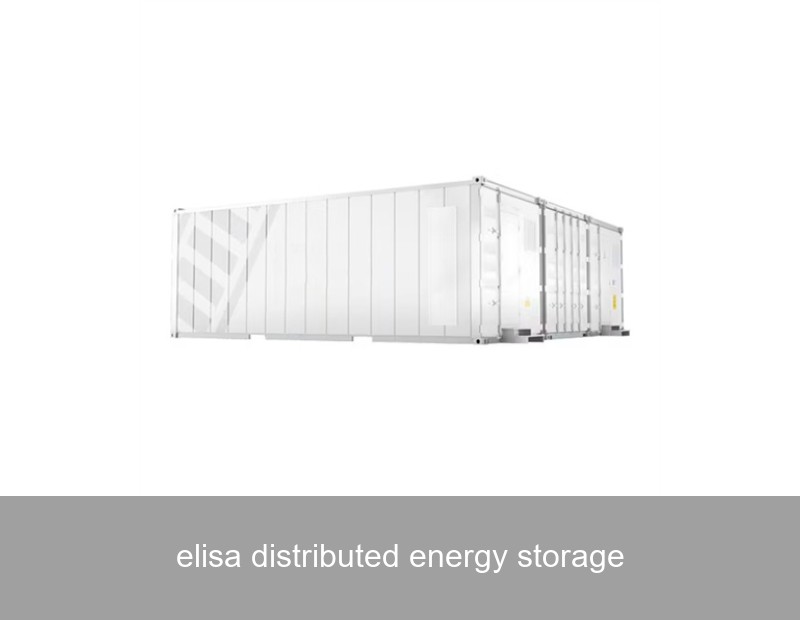
The Solution: The park management deployed a coordinated ELISA distributed energy storage system. Instead of one large central battery, they installed several modular, containerized battery energy storage systems (BESS) at key substations serving different factory blocks. Each system, like Highjoule's H-Cube Commercial, is a self-contained unit with integrated power conversion and advanced management software.
- Cost Savings: By strategically charging from excess solar and discharging during peak periods, the park reduced its peak demand charges by 28% and increased its solar self-consumption from 35% to over 80%.
- Revenue Generation: The aggregated storage capacity participates in the German primary control reserve market, generating a steady ancillary service revenue stream.
- Resilience: During a planned grid outage for maintenance, the largest facility seamlessly islanded, maintaining production of high-value goods—avoiding an estimated €120,000 in downtime losses.
This case exemplifies the ELISA principle: intelligent storage placed where it has the most direct impact on load, generation, and grid constraints.
Image: Engineers monitoring distributed storage performance. Source: Unsplash
The ELISA Insight: Intelligence at the Edge is Non-Negotiable
The true innovation of a modern ELISA distributed energy storage network isn't just the physical placement of batteries. It's the embedded intelligence that allows these dispersed assets to act as a coordinated virtual power plant (VPP) or operate entirely independently. This requires:
- Advanced EMS (Energy Management System): A brain that can forecast local load and generation, optimize for economic objectives (like tariff arbitrage), and respond to grid signals in milliseconds.
- Cybersecurity by Design: Each distributed node is a potential network entry point. Security must be foundational, not an afterthought.
- Modular and Scalable Hardware: Technology that can start small and grow with needs, without complex re-engineering.
This is where the expertise of a seasoned system provider becomes critical. It's the difference between having a box of batteries and having a reliable, revenue-generating grid asset.
How Highjoule Powers the Distributed Future
Since 2005, Highjoule has been at the forefront of making intelligent, distributed storage a practical reality. We understand that a successful ELISA-based strategy hinges on seamless integration and unwavering reliability. Our product suite is engineered for this exact purpose.
For commercial and industrial applications, our H-Cube Commercial and H-Cube Industrial platforms are pre-engineered, all-in-one solutions. They combine high-cycle life LiFePO4 batteries, a bi-directional inverter, thermal management, and our proprietary JouleMind AI EMS into a single, scalable enclosure. This means our customers don't just get storage hardware; they get a platform that continuously learns and optimizes their energy profile for maximum financial return.
For larger microgrid and utility-edge applications, our H-Block Utility systems provide utility-grade performance in a modular format. They are designed for primary frequency response, voltage support, and renewable smoothing, acting as the perfect grid citizen or forming the backbone of a resilient community microgrid.
Our approach is holistic. Highjoule's team provides everything from initial feasibility studies and financial modeling to grid interconnection support, long-term performance monitoring, and maintenance. We partner with developers, EPCs, and end-users across Europe and the U.S. to turn the promise of distributed storage into a measurable, bankable reality.
The Core Components of a Highjoule ELISA System
- JouleMind AI: The cloud-edge intelligence platform that handles forecasting, optimization, and grid service participation.
- Modular Battery Packs: Field-proven, safe LiFePO4 chemistry with independent monitoring and management.
- Integrated Power Conversion System (PCS): High-efficiency conversion that meets grid standards in North America and Europe.
- Cybersecurity Suite: Multi-layered protection for data and control integrity.
Is Your Energy Ready to Be Distributed?
The transition to a decentralized, resilient, and efficient energy system is underway. The technology is proven, the economics are increasingly favorable, and the need for grid support is acute. Whether you're a factory manager tired of volatile energy bills, a renewable developer looking to maximize asset value, or a municipality planning a sustainable future, the question is no longer if distributed storage will play a role, but when and how.
What single energy challenge—be it cost, reliability, or sustainability goals—could an ELISA distributed energy storage strategy solve for you in the next 18 months?
 Inquiry
 Online Chat