


Energy as a Service (EaaS): The Subscription Model Powering a Resilient, Sustainable Future
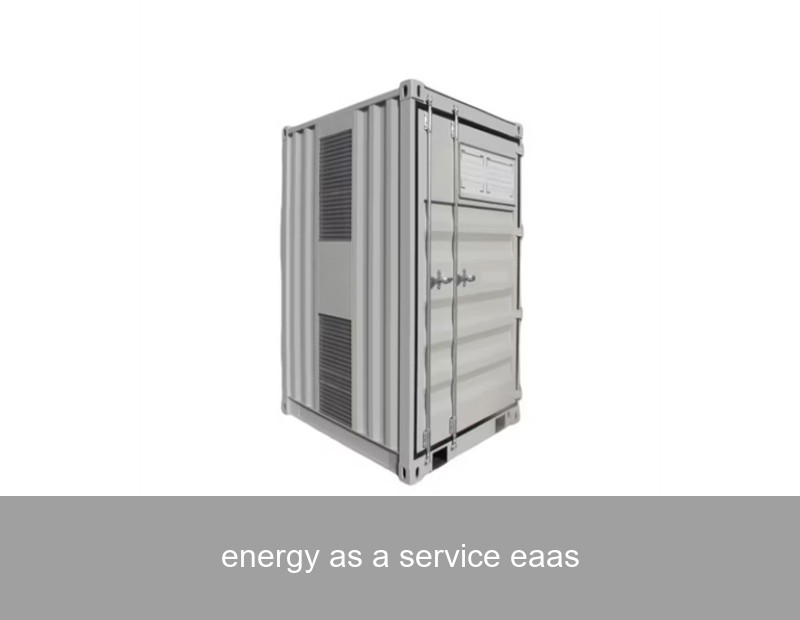
Let's be honest: for most businesses, energy isn't a core competency. It's a complex, capital-intensive, and often volatile cost center. You manage payroll, product development, and customer service—why should you also need to become an expert in kilowatt-hours, demand charges, and battery chemistry? This very dilemma is fueling the rapid rise of Energy as a Service (EaaS), a transformative shift from owning energy assets to simply subscribing to their outcomes. For forward-thinking businesses in Europe and the US, EaaS is emerging as the smart, strategic path to energy resilience, cost predictability, and sustainability goals, without the upfront financial or operational burden.
What is Energy as a Service (EaaS)?
At its heart, Energy as a Service is a business model where a provider like Highjoule delivers a comprehensive energy solution—encompassing design, financing, installation, operation, and maintenance—for a predictable monthly or annual fee. Think of it like moving from buying and maintaining your own power plant to subscribing to a "Netflix for Energy." You pay for the service of reliable, optimized, and often cleaner power, while the provider owns and manages the hardware and software. This model typically bundles several key technologies:
- On-site Solar Generation: Capturing free energy from the sun.
- Advanced Battery Energy Storage Systems (BESS): Storing energy for use when it's most valuable.
- Intelligent Energy Management Software (EMS): The "brain" that optimizes everything in real-time.
- Grid Services Integration: Allowing the system to interact with and support the wider electricity grid.
The promise is simple: guaranteed performance, not just sold equipment.
The Modern Grid Challenge: A Tipping Point
The traditional "take power from the grid, pay the bill" model is showing its age. Three converging phenomena are pushing businesses toward EaaS:
Phenomenon 1: Energy Price Volatility & Demand Charges. Electricity costs are no longer just about consumption (kWh). For commercial and industrial users, demand charges—fees based on your highest 15-30 minute power draw in a billing period—can constitute up to 50% of the bill. A single spike in operation can cost thousands.
Phenomenon 2: Grid Instability and Resilience Demands. From extreme weather events in California and Texas to aging infrastructure in parts of Europe, power outages are a growing operational and financial risk. A 2023 report by the U.S. Department of Energy highlighted that power outages cost the American economy tens of billions annually (source: U.S. DOE). Businesses now need a "Plan B" for power.
Phenomenon 3: The Sustainability Imperative. Corporate ESG (Environmental, Social, and Governance) commitments, regulatory pressures, and consumer expectations are mandating a reduction in carbon footprints. Generating and storing clean energy on-site is a direct path to achieving these goals.
Facing this triad of challenges, the traditional CAPEX approach—outlaying hundreds of thousands for a solar-plus-storage system—is a high-barrier, high-responsibility proposition. This is the gap EaaS perfectly fills.
Deconstructing the EaaS Model: More Than Just a Subscription
So, how does EaaS actually work in practice? It follows a logical, outcome-driven structure:
- Outcome-Based Contract: You and the provider (e.g., Highjoule) agree on specific metrics: a percentage of energy bill savings, a guaranteed level of backup power during outages, or a target for renewable energy consumption.
- Turnkey Solution Deployment: The provider handles everything: site assessment, system design, permitting, installation, and grid interconnection. No multiple vendors, no project management overhead for you.
- Long-Term Performance Management: This is the core of EaaS. Using advanced EMS, the provider's software autonomously makes decisions to maximize your value. Should the battery charge from solar now, discharge to avoid a demand spike, or hold capacity for a potential outage? The system optimizes for your contracted outcomes 24/7.
- Continuous Monitoring & Maintenance: The provider remotely monitors system health, performs preventative maintenance, and ensures peak performance over the 10-20 year agreement, freeing you from technical worries.
| Factor | Traditional Ownership (CAPEX) | Energy as a Service (OPEX) |
|---|---|---|
| Upfront Cost | High capital expenditure | Little to no upfront cost |
| Risk & Performance | Owner bears all technology and performance risk | Provider guarantees performance outcomes |
| Operations & Maintenance | In-house or contracted responsibility | Fully managed by the provider |
| Technology Updates | System may become outdated | Provider often updates software for optimal performance |
| Financial Impact | Asset on balance sheet | Predictable operating expense |
Real-World Impact: A Case Study from California
Let's move from theory to hard data. Consider a mid-sized food processing facility in Fresno, California. Their challenges were classic: high afternoon energy demand coinciding with peak utility rates ("peak shaving"), exposure to grid outages threatening refrigeration losses, and a corporate mandate to increase renewable energy use.
They partnered with an EaaS provider for a solution centered on a 500 kW solar canopy and a 750 kWh / 375 kW containerized battery storage system. The data after the first year of operation is compelling:
- Demand Charge Savings: The intelligent system discharged the battery during daily grid peak periods, reducing the facility's peak demand by an average of 28%. This directly translated to a 22% reduction in their overall monthly energy costs.
- Resilience Achieved: During three brief public safety power shutoff (PSPS) events, the system seamlessly provided critical backup power to refrigeration units for over 4 hours each, preventing an estimated $150,000 in potential product spoilage.
- Sustainability Metrics: The project increased their on-site renewable consumption to 40% of annual load, significantly advancing their Scope 2 emissions reduction goals.
This case, mirrored by many across the US and Europe, demonstrates the multi-faceted ROI of EaaS. It's not just about savings; it's about risk mitigation and value protection. The International Renewable Energy Agency (IRENA) notes the flexibility of such distributed systems is key to modern grids (source: IRENA).

Image: A modern industrial site with integrated solar and battery storage, similar to an EaaS deployment. (Photo credit: Unsplash)
How Highjoule Enables Robust EaaS Solutions
As a global leader in advanced energy storage since 2005, Highjoule is not just an equipment manufacturer; we are the foundational technology partner for EaaS providers and large enterprises building their own EaaS-like programs. Our role is to provide the reliable, intelligent hardware and software backbone that makes guaranteed service models possible.
For EaaS providers deploying solutions in Europe and North America, Highjoule's H-Series commercial & industrial battery systems offer the perfect blend of power, energy density, and safety. Their modular design allows for scalable configurations to meet specific contract requirements, from demand charge management to long-duration backup. More crucially, our JouleOS energy management platform is the intelligence layer. It doesn't just monitor—it autonomously executes complex, value-optimizing strategies in real-time, ensuring the EaaS provider can confidently meet their performance guarantees to the end customer.
Furthermore, for businesses with the capital and desire to own their energy destiny, Highjoule offers a full suite of products and intelligent software, effectively providing the tools to build an "internal EaaS" model for their own operations, with the same focus on outcomes and operational simplicity.
Is Energy as a Service the Right Fit for Your Business?
EaaS isn't a one-size-fits-all, but it's an increasingly compelling option. It's particularly powerful for businesses that:
- Prioritize preserving capital for core business investments.
- Lack in-house energy engineering expertise.
- Face high and volatile demand charges from their utility.
- Operate in regions with unreliable grid power or high outage risks.
- Have ambitious ESG or carbon neutrality targets to meet.
The shift to Energy as a Service represents a broader evolution in how we think about critical infrastructure: from a product to purchase to an outcome to experience. It aligns the incentives of the provider and the customer perfectly—both succeed only when the system performs optimally.
So, as you look at your next energy bill or review your business continuity plan, ask yourself this: Is managing complex energy assets the best use of your capital and focus, or would you prefer to simply subscribe to resilience, savings, and sustainability?
 Inquiry
 Online Chat