


Understanding ESS Battery Cost per kWh: Your Guide to Smart Energy Storage Investment
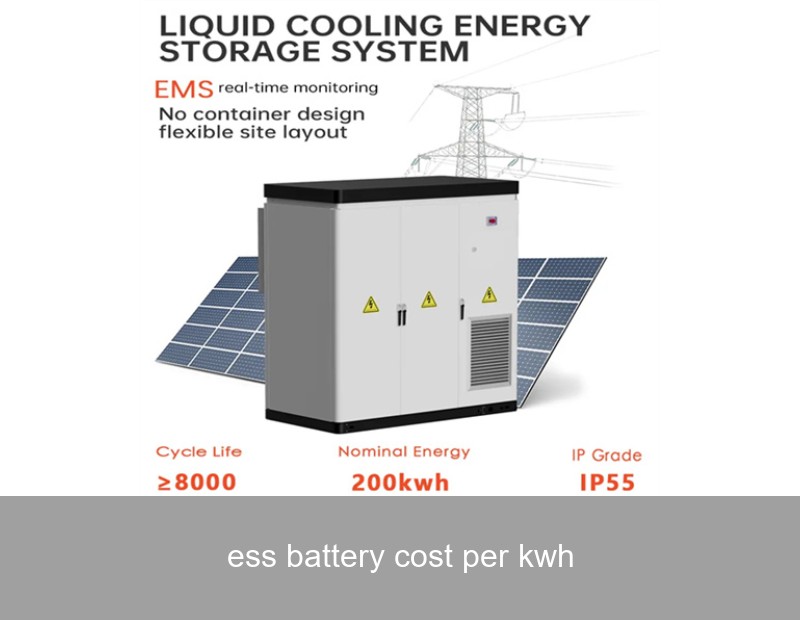
If you're exploring energy storage for your home or business, you've undoubtedly encountered the term "ESS battery cost per kWh." It's the fundamental metric that seems to define the entire conversation. But here's a reality check: focusing solely on that upfront price tag is like buying a car based only on the showroom sticker. The real story of energy storage system (ESS) value is far more nuanced and exciting. As a global leader in advanced storage solutions since 2005, Highjoule has witnessed this evolution firsthand. The relentless decline in ESS battery cost per kWh isn't just a market trend; it's a powerful force reshaping how we generate, manage, and consume electricity globally. Let's dive into what's behind this cost revolution and what it truly means for your energy independence and financial bottom line.
The Price Plunge: What's Driving ESS Battery Cost per kWh Down?
Remember when a gigafactory was a futuristic concept? Today, massive-scale manufacturing is a primary engine behind falling costs. Economies of scale, pioneered by the electric vehicle industry, have directly benefited stationary storage. But it's not just about making more batteries; it's about making better ones. Key drivers include:
- Chemistry Innovations: The shift from early lead-acid to the dominance of Lithium-ion (LFP and NMC) provided higher energy density and longer lifecycles. Continued R&D into solid-state and other post-lithium technologies promises the next leap.
- Manufacturing Efficiency: Automated production lines and improved supply chains for critical materials like lithium and cobalt have reduced waste and sped up output.
- Policy & Market Demand: Supportive policies in regions like the EU (Green Deal) and the U.S. (Inflation Reduction Act) have stimulated demand, giving manufacturers the confidence to invest in scaling production.
This perfect storm of innovation and scale has created a virtuous cycle, making ESS technology accessible to a wider range of applications than ever before.
By the Numbers: Tracking the ESS Battery Cost per kWh Trajectory
Let's put some hard data to the trend. According to analysis by BloombergNEF, the global volume-weighted average price of a battery pack fell by an astonishing 89% in real terms from 2010 to 2023. For stationary storage, the ESS battery cost per kWh for the battery pack itself has followed a similar steep decline.
| Year | Estimated Avg. Battery Pack Cost (per kWh)* | Key Market Influence |
|---|---|---|
| 2015 | $650 - $700 | Early commercial adoption, niche markets |
| 2020 | $137 - $250 | Mass EV production scaling, growing renewable integration needs |
| 2024 (Projection) | $90 - $130 | Manufacturing overcapacity, rise of cost-effective LFP chemistry |
*Note: These are pack-level cost estimates. Total installed system cost includes power conversion (PCS), thermal management, software, and installation. Source: BloombergNEF.
This dramatic drop means the business case for storage has transformed. Payback periods that once seemed decades long are now measured in single-digit years for many applications.

Image: A modern grid-scale battery storage installation. (Credit: American Public Power Association via Unsplash)
Case Study: A California Winery's Strategic Investment
Let's move from global data to a ground-level example. A renowned winery in Napa Valley, California, faced a dual challenge: skyrocketing demand charges from their utility and a commitment to 100% renewable operation. Their peak energy usage during processing spiked their bills dramatically.
The Solution: In 2022, they installed a 500 kWh / 750 kW lithium-ion ESS. The all-in ESS battery cost per kWh for the project was approximately $450/kWh (installed), a figure that included the integrated inverter, advanced management software, and full commissioning.
The Results:
- Demand Charge Reduction: By strategically discharging the battery during operational peaks, they slashed their monthly demand charges by over 60%.
- Solar Optimization: The system stored excess solar generation from their rooftop arrays, used during the evening, increasing self-consumption from 40% to over 85%.
- ROI: The combined savings generated a simple payback period of just under 5 years. For a business with a 100-year legacy, this was a compelling investment in both economic and environmental resilience.
This case illustrates the critical point: the value isn't in the cost per kWh stored, but in the value per kWh discharged at the right time.
Beyond the Sticker Price: The Total Cost of Ownership (TCO) Advantage
This brings us to the most important concept for any savvy buyer: Total Cost of Ownership. The cheapest battery per kWh upfront can become the most expensive asset over 10-15 years. TCO factors in:
- Cycle Life & Degradation: How many full charge/discharge cycles can the battery perform before its capacity drops to 80%? A battery with a 6,000-cycle lifespan vastly outperforms one rated for 3,000 cycles.
- Efficiency: A system with 97% round-trip efficiency loses less energy in the storage process than one at 88%, meaning more of your purchased or self-generated electricity is available for use.
- Warranty & Support: A robust, long-term warranty (e.g., 10+ years) is a direct reflection of the manufacturer's confidence in their product's longevity.
- Software Intelligence: Smart, adaptive software that can optimize for time-of-use rates, weather, and consumption patterns maximizes financial returns.
The Highjoule Approach: Engineering for Value and Longevity
At Highjoule, we engineer our commercial and industrial ESS solutions with TCO as the cornerstone. Our H-Series modular storage systems are built using premium LiFePO4 (LFP) chemistry, renowned for its safety and exceptional cycle life. We don't just sell a battery container; we provide a fully integrated power resilience platform.
Our proprietary Adaptive Core BMS goes beyond basic cell monitoring. It employs AI-driven algorithms to manage cell balancing, thermal loads, and charge profiles in real-time, minimizing degradation. This focus on holistic system health is why our systems often maintain superior capacity retention well beyond standard warranty periods. For residential clients, our HomePower line brings this same philosophy of intelligent, durable design to homeowners seeking energy security and bill savings. When you evaluate ESS battery cost per kWh, we encourage you to ask: "What is the cost of delivered energy over the system's entire lifetime?"

Image: Example of a modern, modular battery system design emphasizing serviceability and thermal management. (Credit: Michael Fousert via Unsplash)
Future Forecast: Where Will ESS Battery Cost per kWh Land?
Experts from the International Renewable Energy Agency (IRENA) project continued, though potentially slower, cost declines through 2030. The next frontier isn't just cheaper cells, but smarter, more integrated systems. Think of "storage-as-a-service" models, where the physical asset's cost is bundled with guaranteed performance. Furthermore, advancements in second-life EV batteries repurposed for stationary storage could create new value streams and cost points.
The conversation is shifting from pure cost to value stacking. Can your ESS provide backup power, arbitrage energy prices, provide grid services, and reduce your carbon footprint? The systems that enable multiple revenue or savings streams will deliver the highest return, even at a slightly higher initial ESS battery cost per kWh.
Ready to Calculate Your Own Scenario?
Every facility's load profile, utility rate structure, and sustainability goals are unique. The transformative drop in storage costs means a project that was not feasible 3 years ago may be a goldmine today. What specific energy challenge—be it demand charges, solar self-consumption, or backup power needs—could a strategically sized and managed ESS solve for your operation? We invite you to share your primary energy objective and let's explore the real numbers together.
 Inquiry
 Online Chat