


Demystifying Flow Battery Price per kWh: A Smart Investor's Guide to Long-Duration Storage
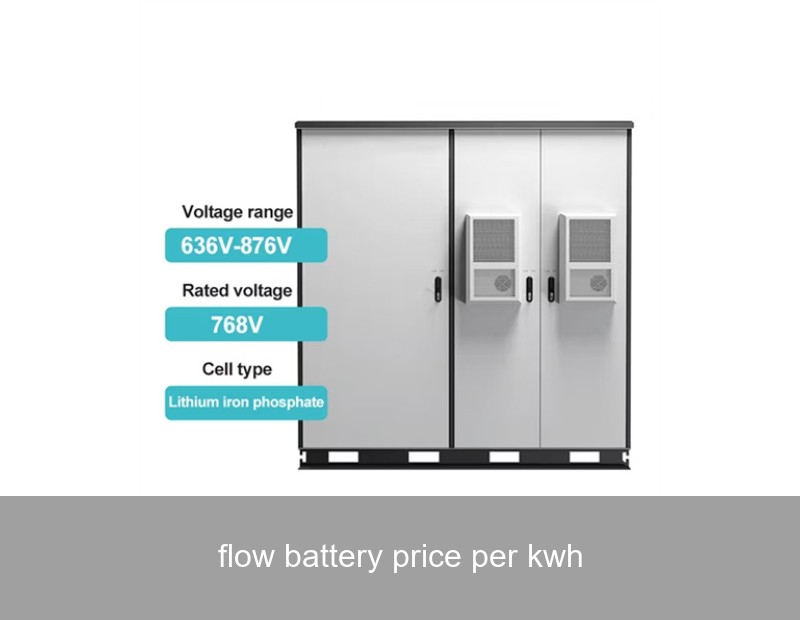
When you're evaluating energy storage for your business, community, or microgrid, the "flow battery price per kWh" is likely one of the first figures you search for. It's a logical starting point, but here's a crucial insight from the field: focusing solely on this upfront cost per kilowatt-hour can lead you to overlook the most compelling value proposition of flow battery technology. As a leading provider of advanced storage solutions, Highjoule often guides clients through a more complete financial picture. The true story of flow battery economics isn't just about the initial purchase price; it's about unparalleled longevity, minimal degradation, and a remarkably low total cost of ownership for long-duration energy storage.
Decoding the "Flow Battery Price per kWh"
Let's break down the numbers. As of 2024, the upfront capital expenditure (capex) for a commercial or utility-scale vanadium flow battery (VFB) system typically ranges from $500 to $800 per kWh of energy capacity. This is often higher than the initial cost of some lithium-ion battery systems. But this is where the comparison needs to deepen. This "per kWh" price primarily reflects the cost of the electrolyte—the liquid energy-storing material—and the sophisticated cell stacks.
To understand this better, it's helpful to distinguish between power (kW) and energy (kWh):
| Component | What It Does | Cost Driver |
|---|---|---|
| Power Stack (kW) | Determines how fast you can charge or discharge. | Cell area, membrane technology. |
| Electrolyte & Tanks (kWh) | Determines how much energy you can store. | Volume of vanadium electrolyte. |
This separation is a unique advantage. To increase your storage duration (from 4 hours to 10 hours, for example), you largely just add more electrolyte, a relatively straightforward and scalable process. This architectural difference is key to understanding the long-term economics.
The Real Game-Changer: Total Cost of Ownership (TCO)
This is where flow batteries shine. Let's consider the factors that make up TCO over a 25-year project life:
- Cycle Life & Degradation: A high-quality VFB can undergo 15,000-20,000+ full cycles with minimal capacity fade. Lithium-ion batteries, in contrast, might see significant degradation after 3,000-5,000 cycles in similar deep-cycle applications. You're not replacing the core asset every 8-10 years.
- Maintenance Costs: Flow batteries have fewer failure points related to energy capacity. The electrolyte is essentially immortal and can be reused indefinitely.
- Safety & Balance of Plant: The non-flammable, aqueous electrolyte reduces risks and often lowers insurance and safety system costs compared to systems requiring extensive fire suppression.
When you amortize the higher initial "flow battery price per kWh" over double or triple the service life, the annual cost becomes highly competitive, often superior, for applications requiring daily, deep cycling.

Image Source: Unsplash. A look at the scalable tank and piping architecture of a flow battery system, where energy capacity (kWh) is decoupled from power (kW).
From Theory to Reality: A Vermont Microgrid Case Study
Let's ground this discussion with a real-world example. The Panther Microgrid in Vermont, USA, provides a clear illustration. This project, which pairs a 550 kW solar array with a 1 MWh / 250 kW vanadium flow battery, was designed to provide resilient, renewable power to a critical community facility.
The Data-Driven Outcome: Analysis over its operational life has shown a levelized cost of storage (LCOS) that becomes increasingly favorable over time. While the initial investment was notable, the system's ability to perform daily, full-depth cycles without degradation means its effective "cost per cycle" plummets year after year. It reliably delivers 4+ hours of storage daily, a duty cycle that would rapidly wear down many other technologies. The project highlights how the flow battery price per kWh, when viewed through the LCOS lens, validates its use for demanding, cyclical applications. You can read more about LCOS methodologies from the International Renewable Energy Agency (IRENA).
How Highjoule is Making Flow Batteries More Accessible
At Highjoule, our mission is to accelerate the adoption of sustainable storage by directly tackling the cost and performance equation. Founded in 2005, we've spent nearly two decades refining flow battery technology to deliver better value for our commercial, industrial, and microgrid clients.
Our H-Joule V-Series flow battery systems incorporate several key innovations aimed at optimizing the lifetime cost per kWh:
- Advanced Membrane Technology: We utilize proprietary membranes that increase efficiency (reducing round-trip energy losses) and extend stack life, directly lowering long-term operational costs.
- Intelligent Energy Management Software: Our AI-driven platform, Highjoule Nexus™, doesn't just control the battery. It optimizes every charge and discharge cycle for maximum financial return—whether through energy arbitrage, peak shaving, or grid services—ensuring the asset pays back faster.
- Modular & Scalable Design: Our containerized solutions allow for painless field expansion. You can start with a system tailored to today's needs and cost-effectively add more energy capacity (kWh) as demand grows, protecting your initial investment.
We see ourselves not just as hardware providers, but as long-term partners in our clients' energy resilience. Our team works closely with project developers to model TCO and LCOS from the outset, ensuring the financial case is as solid as the engineering.
The Future of Flow Battery Price per kWh
The cost trajectory is promising. As deployment scales—driven by the global need for long-duration storage to integrate renewables—manufacturing efficiencies are being realized. Industry analysts project a continued decline in the upfront flow battery price per kWh. The U.S. Department of Energy's Long Duration Storage Shot initiative, for example, aims to reduce the cost of 10+ hour systems by 90% within a decade. You can explore their targets on the DOE's official page.
Furthermore, innovations in electrolyte chemistry, including iron-based and organic flow batteries, hold the potential for even lower material costs while maintaining the core benefits of the technology.

Image Source: Unsplash. The future grid requires long-duration storage solutions to balance the intermittent nature of wind and solar power.
Is a Flow Battery the Right Investment for Your Energy Needs?
So, when does the compelling TCO of a flow battery justify the initial price point? Consider a Highjoule flow battery if your project involves:
- Daily, deep-cycle operations (4+ hours of storage discharge daily).
- Projects with a long-term horizon (15-25 years) where longevity is paramount.
- Critical infrastructure where safety and non-flammability are top priorities.
- Plans for future scalability, where decoupling power and energy offers a clear path.
The conversation is shifting from a simplistic focus on upfront "flow battery price per kWh" to a more strategic discussion about "cost per cycle over the system's lifetime." This is the framework that reveals the true strength of flow battery technology.
What specific long-duration storage challenge is your organization or community looking to solve in the next five years, and how might a total-cost-of-ownership perspective change your technology evaluation?
 Inquiry
 Online Chat