


Goldberg Power: How Much Can It Truly Save Your Business?
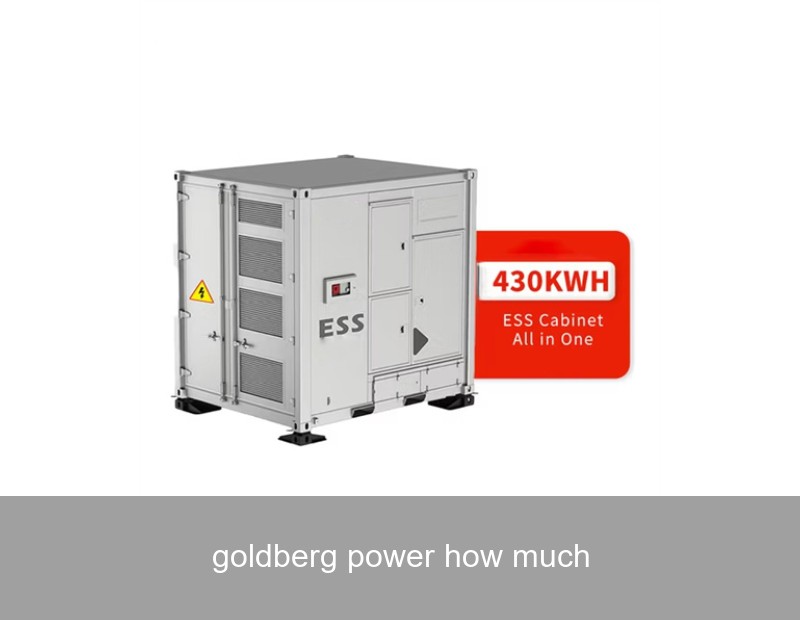
If you're a facility manager, business owner, or energy consultant in Europe or the US, you've likely heard the term "Goldberg Power." It's not a new energy drink, but it might just be the jolt your operations need. In essence, it refers to the significant, often hidden, financial and operational power (or savings) unlocked by integrating gold-standard energy storage and management systems. The burning question on everyone's mind is: Goldberg Power, how much value can it actually deliver? Let's move beyond the buzzword and dive into the tangible data, real-world cases, and the technology that makes it possible.
Table of Contents
The Phenomenon: More Than Just Backup Power
For years, battery storage was seen as a luxury—an expensive insurance policy for critical infrastructure. Today, that perception is obsolete. The convergence of volatile energy markets, ambitious sustainability goals, and advanced battery chemistry has created a perfect storm. Modern Goldberg Power systems are active financial assets. They intelligently interact with the grid, your renewable sources, and your consumption patterns. The phenomenon isn't just about having power; it's about wielding it strategically to cut costs, generate revenue, and bolster resilience.
Consider this: your facility draws power from the grid. Utility rates aren't flat; they spike during periods of high demand (4-9 PM for many). Without storage, you're at the mercy of these peaks. A Goldberg Power setup, however, allows you to "avoid" these peaks by discharging stored energy when rates are highest. This is called peak shaving. But that's just the first layer of value.
The Data Crunching: Quantifying the "Goldberg" Effect
So, how much are we really talking about? Let's break down the primary value streams:
| Value Stream | Mechanism | Potential Impact |
|---|---|---|
| Demand Charge Reduction | Shaving peak power draws from the grid. | Can reduce this portion of the electricity bill by 20-40%. |
| Energy Arbitrage | Storing energy when cheap (night/off-peak), using it when expensive. | Optimizes time-of-use rates, especially effective in regions like California or Germany. |
| Backup Power & Resilience | Providing seamless power during grid outages. | Avoids downtime costs, which can exceed $10,000 per hour for manufacturing. |
| Renewable Integration | Storing excess solar/wind for use when the sun isn't shining or wind isn't blowing. | Can increase self-consumption of solar from ~30% to 70%+. |
According to a 2023 NREL report, commercial and industrial battery storage systems can achieve attractive payback periods, with the exact timeline heavily dependent on local utility structures and incentive programs. The key is an intelligent control system that maximizes these value streams simultaneously.
Case Study: A European Manufacturing Plant's Journey
Let's make this concrete. A mid-sized automotive parts manufacturer in Bavaria, Germany, faced two challenges: skyrocketing strompreis (electricity prices) and pressure from their parent company to reduce carbon footprint. They had a 500 kW rooftop solar array, but much of its midday generation was exported to the grid at a low feed-in tariff.
Their solution was a tailored Goldberg Power system. They installed a 360 kWh battery energy storage system (BESS) coupled with an advanced energy management system (EMS). Here's what happened in the first year of operation:
- Demand Charge Savings: Reduced peak grid draw by 28%, saving over €18,000 annually.
- Solar Self-Consumption: Increased from 35% to 82%, effectively maximizing their on-site solar investment.
- Grid Services Revenue: By participating in a local grid stability program (a form of frequency response), the system generated an additional €4,500 in revenue.
- Total Annual Financial Benefit: ~€25,000. With available German federal (KfW) and state subsidies, the projected payback period was under 6 years.

This case is a textbook example of Goldberg Power in action. It wasn't just one thing; it was the synergistic combination of multiple value streams that created a compelling return on investment.
The Highjoule Advantage: Engineering Your Goldberg Power
Unlocking this level of value requires more than just buying batteries off a shelf. It demands a system designed for intelligence, durability, and safety. This is where Highjoule's expertise comes into play. Since 2005, we've evolved from a component provider to a global leader in complete, smart storage solutions.
Our approach to delivering your Goldberg Power is built on three pillars:
- The Highjoule H-Series Commercial BESS: Our flagship product is built with lithium iron phosphate (LFP) chemistry, renowned for its safety, long life (typically over 6,000 cycles), and stability. It's a modular, scalable system designed for easy integration into both new and existing commercial/industrial sites.
- Athena Smart EMS: The true brain of the operation. This proprietary software doesn't just react; it predicts. Using weather forecasts, load profiles, and real-time market data (where applicable), Athena optimizes every charge and discharge cycle to prioritize your financial and operational goals. Is your goal to minimize demand charges, maximize green consumption, or prepare for a storm? Athena executes the strategy.
- Full Lifecycle Service: From initial site assessment and financial modeling to installation, grid connection support, and 24/7 remote monitoring, Highjoule partners with you for the long term. We ensure your system performs at its goldberg best year after year.
For a deeper dive into the safety standards we adhere to, organizations like the Energy Storage News provide ongoing industry coverage and benchmarks.
Future-Proofing with Intelligent Storage
The energy landscape is shifting under our feet. Electrification of transport and heat is increasing demand, while grid infrastructure in many parts of Europe and the US is aging. A Goldberg Power system from Highjoule isn't just a solution for today's problems; it's an investment in resilience for tomorrow's uncertainties.
Imagine a future where your facility can act as a virtual power plant (VPP), aggregating with others to support the grid during extreme stress and getting paid handsomely for it. Or a scenario where you add electric vehicle fleet charging without triggering a costly grid upgrade. Our systems are designed with this software-upgradable future in mind.

Your Goldberg Power Calculation
The question, "Goldberg Power, how much?" doesn't have a one-size-fits-all answer. For the Bavarian manufacturer, it was €25,000 a year and newfound energy independence. For a California data center, it might be millions saved in demand charges and avoided downtime. For a school district, it could be guaranteed power for community shelters and slashed operating costs.
The first step is a conversation. What are your top three energy pain points? Is it the monthly bill volatility, sustainability targets, or fear of operational disruption? What would achieving your own "Goldberg Power" mean for the future of your business or community?
 Inquiry
 Online Chat