


Green Dipity and Solar Energy: When Serendipity Meets Sustainable Power
Have you ever experienced a moment of "green dipity"? That unexpected, fortunate discovery that leads you to a more sustainable lifestyle? For many homeowners and businesses, solar energy is precisely that—a happy accident of choosing a cleaner power source that unlocks surprising benefits: energy independence, significant cost savings, and a tangible contribution to a healthier planet. This article explores the journey from adopting solar power to maximizing its potential, and how modern technology is turning these moments of green serendipity into a reliable, intelligent energy strategy.
Table of Contents
- The Green Dipity Phenomenon
- The Data Reality: Solar's Rise and the Intermittency Challenge
- The Missing Link: Energy Storage as the Enabler
- Case Study: From Solar Panels to a Resilient Microgrid in California
- Highjoule's Intelligent Solutions: Engineering Reliability into Green Dipity
- Future Trends: The Grid of Tomorrow
- Your Green Energy Journey
The Green Dipity Phenomenon
The initial motivation for installing solar panels is often straightforward: reduce electricity bills or lower one's carbon footprint. But the true "green dipity" moment often comes later. It's the first time your home remains powered during a neighborhood outage, thanks to your solar system. It's the realization that you're not just saving money, but also generating a tangible asset. It's the peace of mind knowing your energy source is clean, local, and increasingly under your control. This positive surprise is the emotional core driving the renewable revolution, moving it from a niche choice to a mainstream desire for resilience and self-sufficiency.

Image: The modern solar-powered home embodies the initial step toward energy independence. Source: Unsplash
The Data Reality: Solar's Rise and the Intermittency Challenge
The numbers speak volumes. According to the International Energy Agency (IEA), renewable capacity additions grew by almost 50% in 2023, with solar PV accounting for three-quarters of this expansion. In the U.S., the Solar Energy Industries Association (SEIA) reports that solar now powers over 5% of the nation's electricity and is the fastest-growing energy source. Europe continues to be a leader, with countries like Spain, Germany, and the Netherlands aggressively expanding their solar fleets.
But here's where the simple story meets complexity. Solar generation is inherently intermittent—it produces power when the sun shines, which often doesn't align perfectly with when we need to use electricity. This creates a mismatch:
- The Duck Curve: In markets with high solar penetration, net energy demand plummets during midday (solar peak) and then spikes sharply in the evening as the sun sets and people return home. This creates a steep ramp-up challenge for grid operators.
- Grid Congestion & Curtailment: At times of extremely high solar output, local grids can become congested, leading to solar energy being wasted or "curtailed" because there's nowhere for it to go.
- Limited Self-Consumption: Without a way to store excess energy, a typical homeowner might only use 30-50% of their solar generation directly, exporting the rest to the grid at a lower price than they buy it back at night.
This reality means that to truly harness the full potential of your solar investment and experience continuous "green dipity," you need a key component: intelligent energy storage.
The Missing Link: Energy Storage as the Enabler
Battery Energy Storage Systems (BESS) are the catalyst that transforms a solar installation from a partial solution into a comprehensive energy asset. Think of it as capturing your personal "sunshine in a box" to use on demand. The benefits are multifaceted:
| Benefit | Impact for Homeowners & Businesses |
|---|---|
| Increased Self-Consumption | Store daytime solar excess to power your home in the evening, boosting direct usage to 70% or more. |
| Backup Power & Resilience | Maintain critical loads during grid outages, ensuring safety and continuity. |
| Energy Bill Optimization | Use stored energy during peak rate periods (Time-of-Use rates) to avoid expensive grid electricity. |
| Grid Services & Revenue | In some markets, aggregated storage can provide grid stability services, creating a potential revenue stream. |
Case Study: From Solar Panels to a Resilient Microgrid in California
Let's look at a real-world example. A medium-sized winery in Napa Valley, California, installed a 250 kW solar array to offset its high energy costs for cooling and production. While it reduced bills, they still faced significant demand charges and vulnerability to Public Safety Power Shutoffs (PSPS) during wildfire season—events that could ruin an entire vintage.
Their "green dipity" moment was engineered. They integrated a Highjoule HiveStack C&I 500 battery storage system with a capacity of 500 kWh. The results over one year were compelling:
- Energy Cost Reduction: By strategically discharging the battery during peak grid demand periods, they slashed their demand charges by 40%.
- 100% Resilience: During a 36-hour PSPS event, the system seamlessly islanded, forming a microgrid that kept critical refrigeration and facility operations running without interruption. The estimated value of saved inventory? Over $200,000.
- Solar Utilization: Their on-site consumption of solar generation jumped from 48% to 92%, maximizing their return on the solar investment.
This case illustrates that with the right technology, the serendipitous benefits of solar are not left to chance; they are designed, measured, and guaranteed.
Highjoule's Intelligent Solutions: Engineering Reliability into Green Dipity
At Highjoule, we've spent nearly two decades moving beyond the hope of "green dipity" to delivering engineered energy certainty. Our philosophy is that storage must be smart, safe, and seamlessly integrated. For our customers in Europe and North America, this means systems designed for their specific needs.
For residential clients, our HomePower series is more than just a battery. It's an intelligent energy manager. Its AI-driven software learns your consumption patterns, weather forecasts, and utility rate schedules to autonomously optimize when to store solar energy, power your home, or even sell back to the grid at the most profitable times. The sleek, modular design allows for scalable capacity, growing with your family's needs.

Image: The heart of a modern energy storage system. Source: Unsplash
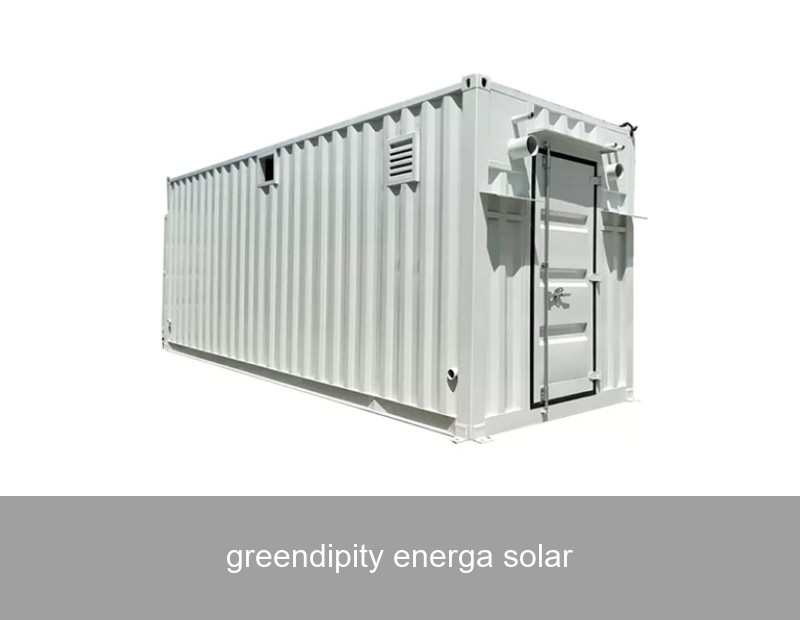
For commercial and industrial (C&I) applications, our HiveStack series provides a robust, containerized or skid-mounted solution. It's built with our proprietary cell-level monitoring and advanced thermal management, ensuring longevity and safety. The integrated platform allows facility managers to set clear goals: "Minimize my demand charges," "Ensure my data center never goes down," or "Participate in the frequency regulation market." HiveStack executes accordingly.
Our approach to microgrids is where all this expertise converges. We design systems that can seamlessly integrate solar, wind, existing generators, and multiple storage units into a single, resilient grid that can operate independently or in connection with the main utility. This is the ultimate realization of energy independence, a concept detailed in research by the National Renewable Energy Laboratory (NREL).
Future Trends: The Grid of Tomorrow
The journey doesn't stop at individual buildings. The future is bidirectional and interconnected. Vehicle-to-Grid (V2G) technology will allow your EV to act as a mobile storage unit. Virtual Power Plants (VPPs)—aggregations of thousands of home batteries like Highjoule's—will provide critical grid stability services, turning distributed resources into a unified, flexible power plant. This evolution, supported by policies like the EU's Green Deal and the U.S. Inflation Reduction Act, is creating a new energy paradigm where every prosumer is an active participant in a cleaner, more resilient grid.
Your Green Energy Journey
The initial step toward solar energy might be driven by economics or ecology, but the lasting value is found in the empowered, resilient system it becomes. The question is no longer just "Should I get solar?" but "How do I design a solar-plus-storage system that turns intermittent generation into 24/7 clean power, tailored precisely to my goals for savings, security, and sustainability?"
What would true energy independence look like for your home or business, and what's the first barrier you'd like to overcome to get there?
 Inquiry
 Online Chat