


How Much Massive Battery Storage Do We Really Need for a Renewable Future?
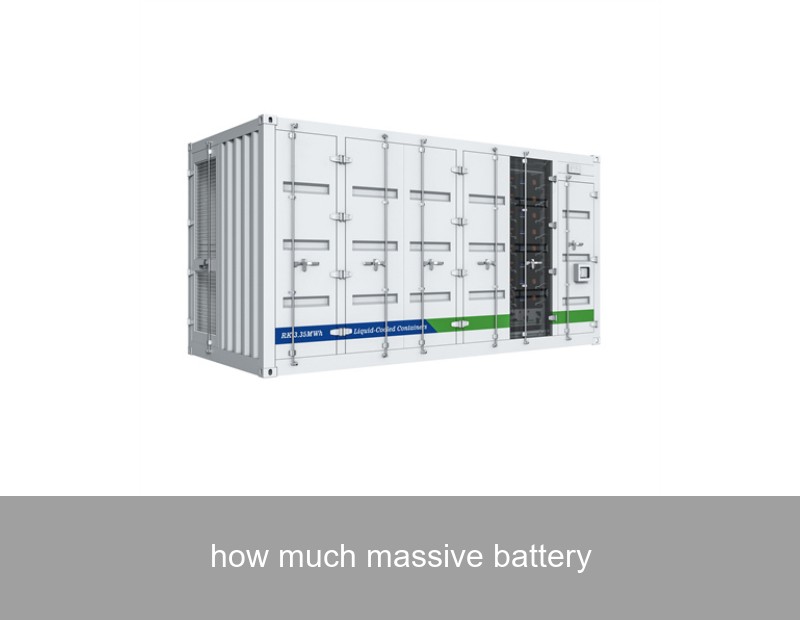
As the world pivots decisively towards wind and solar power, a critical question emerges from boardrooms, grid operators, and policymakers alike: how much massive battery storage is actually required to back up this green revolution? It's not just about having batteries; it's about having the right capacity, in the right places, with the right intelligence to turn intermittent sunshine and wind into a firm, reliable 24/7 power source. Let's unpack the scale of the challenge and the solutions shaping our energy landscape.
Table of Contents
- The Challenge: Renewable Intermittency Isn't a Flaw, It's a Design Problem
- By the Numbers: Quantifying the "Massive" in Battery Storage
- Case in Point: California's Grid and the Duck Curve
- Beyond Raw Capacity: The Intelligence Behind the Megawatts
- Highjoule's Approach: Building Smarter, Not Just Larger, Storage Ecosystems
- The Evolving Need: What's Next for Grid-Scale Storage?
The Challenge: Renewable Intermittency Isn't a Flaw, It's a Design Problem
Think of the modern grid like a symphony orchestra. Traditional power plants (coal, gas, nuclear) are the steady, predictable bass section. Renewables are the brilliant but improvisational soloists—incredible when playing, but silent at night or on calm days. The grid conductor needs a way to ensure the music never stops. This is where massive battery storage systems, known as Battery Energy Storage Systems (BESS), step in as the essential backup ensemble, storing energy during the soloists' performances and releasing it during their breaks.
The phenomenon is clear: without storage, we either waste surplus renewable energy or risk blackouts. The data, as we'll see, points to a staggering need for storage build-out.
By the Numbers: Quantifying the "Massive" in Battery Storage
So, how much are we talking about? Global projections are illuminating. According to the International Energy Agency (IEA), to hit net-zero emissions by 2050, the world will need around 3,200 gigawatts (GW) of grid-scale battery storage capacity. To put that in perspective, the entire U.S. utility-scale electricity generation capacity from all sources in 2023 was about 1,300 GW. We need to build the equivalent of more than two entire U.S. power grids—but in storage form.

Source: IEA Net Zero Roadmap 2023 (Projected growth in grid-scale battery storage capacity)
Let's break down the key drivers for this scale:
- Renewable Integration: For a grid powered by 80% renewables, studies suggest storage capacity must be 20-30% of the peak demand, providing not just hours but potentially days of backup.
- Grid Stability: Batteries provide critical "ancillary services"—like frequency regulation—reacting in milliseconds to keep the grid's voltage and frequency stable, a task fossil fuel plants are too slow to handle perfectly.
- Deferring Infrastructure Upgrades: Strategically placed storage can delay the need for costly new transmission lines or peaker plant construction by managing local congestion.
Case in Point: California's Grid and the Duck Curve
No discussion of massive battery storage is complete without looking at California, a global leader in both solar adoption and storage deployment. The state faces the infamous "Duck Curve"—a deep midday dip in net demand due to high solar output, followed by a steep evening ramp-up as the sun sets and people return home.
California's solution? Aggressive storage mandates and deployment. The state has set a target of 52 GW of long-duration storage by 2045. The results are already tangible. In 2023, battery storage played a pivotal role in keeping the grid stable during heatwaves. On one critical evening in September 2023, batteries discharged a record 6.7 GW of power to the grid—equivalent to the output of six large nuclear reactors, instantly meeting over 10% of the state's total electricity demand at that moment. This real-world case proves that storage is no longer a pilot technology; it's a grid-scale workhorse.
Beyond Raw Capacity: The Intelligence Behind the Megawatts
It's tempting to focus only on gigawatt-hours (GWh) of capacity. However, the true value of a massive battery storage system lies in its brain, not just its brawn. A high-performing BESS requires sophisticated energy management software (EMS) that can perform real-time arbitrage (buying cheap power, selling it when expensive), provide grid services, and predict system performance and degradation. The hardware—the battery cells, thermal management, and power conversion systems—must be engineered for safety, longevity, and efficiency under demanding daily cycles.
Highjoule's Approach: Building Smarter, Not Just Larger, Storage Ecosystems
At Highjoule, with nearly two decades of experience since 2005, we understand that answering "how much massive battery storage" is needed is only the first step. The next, more crucial question is: *What kind of storage?* Our mission is to deliver intelligent, efficient, and sustainable storage solutions that maximize value for every megawatt installed.
For our commercial and industrial (C&I) and utility partners, we don't just supply containerized BESS units. We provide integrated systems powered by our JouleMind AI Platform. This proprietary software optimizes every charge-discharge cycle for maximum financial return and grid support, extending asset life and ensuring safety. Our systems are designed with a modular architecture, allowing for scalable deployments that can start at a few megawatt-hours and expand into the hundreds, future-proofing our clients' investments.
Whether it's for a manufacturing plant seeking to cap its energy costs, a solar farm developer needing to firm its output, or a utility building a virtual power plant (VPP), Highjoule's technology ensures the storage asset is a dynamic, revenue-generating grid citizen, not just a passive battery bank.
The Evolving Need: What's Next for Grid-Scale Storage?
The demand for storage is evolving from short-duration (2-4 hours) to mid- and long-duration storage (LDES) (8+ hours to multiple days). This shift is driven by the need to cover multi-day weather events with low renewable generation. Innovations in flow batteries, compressed air, and other non-lithium technologies are emerging, but advanced lithium-ion systems with smart management, like those Highjoule provides, will remain the cornerstone of the storage build-out for the foreseeable future due to their rapid cost decline and proven performance.
The conversation is moving from "how much massive battery storage" to "how smart" and "how integrated" that storage can be. The grids of tomorrow will be defined by their digital orchestration of diverse distributed resources.
As you contemplate your organization's or community's energy resilience and sustainability goals, consider this: Is your storage strategy focused merely on capacity, or is it designed to intelligently adapt to the market and grid signals of tomorrow? We invite you to explore how a smarter storage approach can transform your energy economics. What's the first challenge you'd want a massive battery storage system to solve for you?
 Inquiry
 Online Chat