


How Much Solar Panels in the US? The Surprising Data and What It Means for Your Energy Future
You've probably seen more and more rooftops glinting with blue-black panels in your neighborhood. It sparks a natural question: just how much solar panels in the US are there, and is this trend powerful enough to make a real dent in our energy bills and carbon footprint? The answer is a resounding yes, and the numbers are more impressive than you might think. We're not just talking about a niche hobby for eco-conscious homeowners; this is a full-scale energy transformation. But understanding the sheer scale of solar adoption is only the first step. The real magic—and the key to maximizing your investment—lies in what you do with that abundant, clean energy once it's on your roof. Let's dive into the data, the stories, and the smart technology that makes it all work seamlessly.
Table of Contents
- The Solar Boom by the Numbers
- Beyond the Panel Count: The Critical Role of Energy Storage
- Case Study: A California Business Beats Grid Uncertainty
- Calculating Your Solar & Storage Needs
- The Highjoule Advantage: Intelligent Storage for a Solar-Powered Life
- Your Energy Future: A Question of Control
The Solar Boom by the Numbers
The growth of solar in the United States isn't just steady; it's exponential. Think of it this way: back in 2010, the total installed solar capacity across the entire country was about 2.6 gigawatts (GW)—enough to power roughly half a million homes. Fast forward to today, and the landscape is utterly transformed. According to the Solar Energy Industries Association (SEIA), the U.S. has now installed over 200 GW of solar capacity. That's a staggering increase of more than 7,500% in just over a decade!
To put that in perspective, 200 GW can power approximately 36 million average American homes. And the momentum isn't slowing. The industry is adding thousands of megawatts every quarter, driven by federal policies like the Inflation Reduction Act, falling equipment costs, and skyrocketing consumer and utility demand. But here's the phenomenon that often gets overlooked: this massive influx of variable solar generation is changing the dynamics of our local grids. It creates a beautiful problem—an abundance of clean energy during sunny midday hours, and a rapid drop-off as the sun sets, just when families come home and demand peaks.

Image Source: Unsplash - Representative image of US solar farm growth.
Beyond the Panel Count: The Critical Role of Energy Storage
So, we have millions of panels generating terawatt-hours of clean electricity. The logical next question is: where does all that power go? This is where the conversation shifts from simply counting panels to optimizing energy use. Relying solely on solar panels means you're often exporting excess energy to the grid for minimal credits, only to buy back expensive power in the evening. This is the fundamental limitation of a solar-only system.
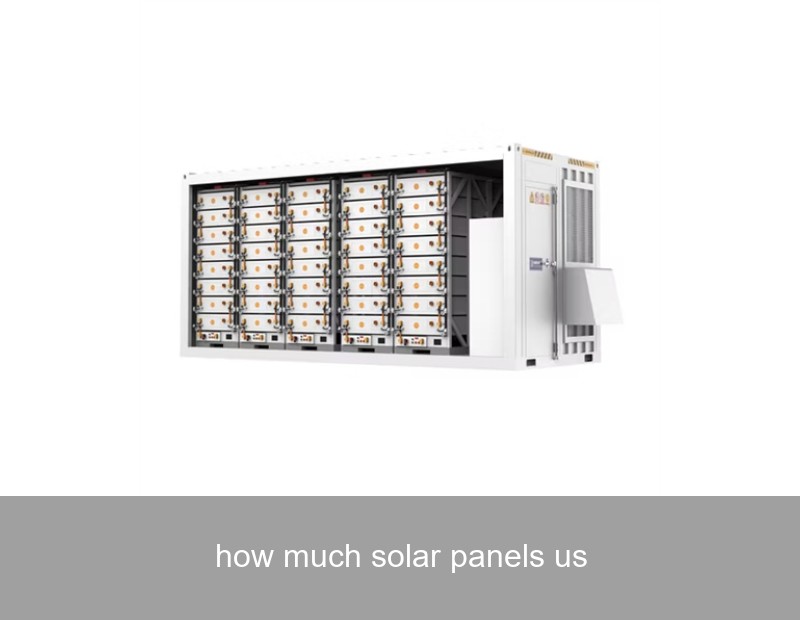
The data is clear: to truly harness the potential of "how much solar panels in the US" are generating, energy storage is the indispensable counterpart. A battery storage system, like those developed by Highjoule, captures your solar surplus and stores it for when you need it most—during peak rate periods, grid outages, or at night. This transforms your solar array from a partial solution into a comprehensive, resilient, and cost-maximizing power station for your home or business.
Why Storage is No Longer Optional
- Maximizes Self-Consumption: Use your sunshine, day and night, reducing reliance on the utility grid.
- Provides Backup Power: Keeps essential loads running during grid failures, a growing concern across both the US and Europe.
- Stabilizes the Grid: Widespread storage helps balance supply and demand, making the entire electrical network more robust.
- Improves Economics: By avoiding peak-time electricity purchases, the payback period for your entire solar + storage system shortens significantly.
Case Study: A California Business Beats Grid Uncertainty
Let's look at a real-world example. A mid-sized craft brewery in San Diego, California, had invested in a 100 kW rooftop solar array. While it reduced their daytime operational costs, they were still vulnerable to the state's Public Safety Power Shutoffs (PSPS) and Time-of-Use (TOU) rates that made evening refrigeration prohibitively expensive. They were generating plenty of solar but couldn't access it on their own terms.
Their solution was integrating a Highjoule HES Series Commercial Energy Storage System. The results were quantifiable:
| Metric | Before Highjoule Storage | After Highjoule Storage |
|---|---|---|
| Grid Electricity Import (Peak Hours) | ~70% of evening needs | < 10% |
| Solar Self-Consumption Rate | ~35% | > 90% |
| Estimated Annual Savings | $18,000 (solar only) | $34,000 (solar + storage) |
| Backup Power for Critical Loads | 0 hours | Up to 18 hours |
This case, mirrored by thousands of businesses and homeowners, underscores that the value of solar is unlocked not just by generation, but by intelligent storage and management.
Calculating Your Solar & Storage Needs
So, how do you translate the national data into a plan for your property? "How much solar panels in the US" is a macro question; your micro question is, "How much solar and storage do *I* need?" It depends on a few key factors:
- Energy Consumption: Review your past year's utility bills (measured in kilowatt-hours, kWh).
- Roof Space & Sun Exposure: A south-facing, unshaded roof is ideal.
- Local Climate & Incentives: Solar yield varies by region, but so do available tax credits and rebates.
- Your Primary Goals: Is it maximum bill savings, backup resilience, or reducing carbon footprint?
A good starting point is using the National Renewable Energy Laboratory's (NREL) PVWatts Calculator to estimate solar production for your address. But remember, this tool calculates production, not optimization. For that, you need a storage strategy.

Image Source: Unsplash - Modern home with integrated solar and EV charging.
The Highjoule Advantage: Intelligent Storage for a Solar-Powered Life
This is where Highjoule's expertise, honed since 2005, becomes crucial. We don't just sell batteries; we provide intelligent, integrated Battery Energy Storage Systems (BESS) designed to make your solar investment work harder. Our systems are built on three core pillars:
1. Uncompromising Safety & Durability
Our proprietary battery management system (BMS) and cell-to-pack technology ensure superior thermal management and long cycle life, giving you peace of mind for decades.
2. Advanced Energy Intelligence
The Highjoule system isn't passive. Our AI-driven energy management platform learns your usage patterns, weather forecasts, and utility rate schedules. It automatically decides when to store solar energy, when to power your home, and when to dispatch power back to the grid if it's financially beneficial—all without you lifting a finger.
3. Scalability for Any Application
From our HER Series for residential applications to our robust HES Series for commercial and industrial sites and large-scale Microgrid Solutions, Highjoule provides a scalable path. Whether you're a homeowner wanting backup power or a factory manager aiming for grid independence, our technology integrates seamlessly with new or existing solar arrays.
By choosing Highjoule, you're not just adding a battery; you're adding a smart energy partner that ensures every kilowatt-hour of your solar production is used in the most efficient and economical way possible.
Your Energy Future: A Question of Control
The data on "how much solar panels in the US" tells a story of incredible growth and potential. But the next chapter of that story is being written by those who pair their panels with intelligent storage. It's a shift from being a passive consumer to an active manager of your energy ecosystem. With grid volatility and extreme weather events on the rise, can you afford to let your valuable solar energy go to waste or remain vulnerable to outages?
What would it mean for your home or business to have uninterrupted, clean power, and to finally see your electricity bill become predictable and minimal? The technology to make that a reality is here today. We invite you to explore what a customized Highjoule energy storage solution could look like for your specific needs.
 Inquiry
 Online Chat