


How Much Solar Battery Storage Do You Really Need? A Data-Driven Guide
So, you've decided to harness the sun's power with solar panels. That's fantastic! But now you're facing the next, and perhaps more puzzling, question: how much solar battery capacity is right for your home? It's the modern equivalent of "how long is a piece of string?"—seemingly simple, but the answer is uniquely personal. Getting it right means achieving true energy independence, maximizing your savings, and building a resilient power system. Get it wrong, and you might be left in the dark or overspend on capacity you'll never use. Let's demystify this crucial decision together, using real data and practical steps.
What Really Determines "How Much" Solar Battery You Need?
The size of your solar battery system isn't a one-size-fits-all number. It's a carefully calculated balance between your energy consumption, your solar production, and your specific goals. Think of it like sizing a rainwater tank: it depends on how much water you use, how much rain you catch, and whether you want to get through a short dry spell or a prolonged drought.
- Your Daily Energy Consumption (kWh): This is your starting point. How much electricity does your household consume in a typical 24-hour period? You can find this on your utility bill.
- Your "Critical Loads": What do you want to power during a grid outage? The refrigerator, some lights, your Wi-Fi, and a few outlets? Or do you need to run your entire home, including air conditioning and an electric vehicle charger? This defines your backup requirement.
- Your Solar Panel System Size: How much excess solar energy are you generating during the day that can be stored for later use? A larger solar array can fill a larger battery more quickly.
- Your Energy Independence Goal: Are you looking for backup power only, to maximize self-consumption of your solar energy, or to achieve near-total grid independence?

Image Source: Unsplash
The Key Metrics: kWh, kW, and Depth of Discharge
Before we calculate, let's clarify the units. This is where many get confused.
| Term | What It Means | The Simple Analogy |
|---|---|---|
| Kilowatt-hour (kWh) | A unit of energy storage capacity. It tells you "how much" electricity is in the battery. | The size of your fuel tank in gallons or liters. |
| Kilowatt (kW) | A unit of power. It tells you how much electricity the battery can deliver at any one moment. | The width of the fuel hose. A wider hose (higher kW) fills or empties the tank faster. |
| Depth of Discharge (DoD) | The percentage of the battery's capacity you can safely use. A 10kWh battery with 90% DoD gives you 9kWh of usable energy. | Never running your car's fuel tank completely dry to protect the engine. |
For example, a Highjoule ResiPower 10 system might have a 13.5 kWh total capacity with a 90% DoD, giving you 12.15 kWh of usable energy, and it can deliver a continuous power output of 5 kW—enough to run most critical home appliances simultaneously.
A Step-by-Step Guide to Calculate Your Needs
Let's walk through a simplified calculation. Imagine a home in California or Spain with the following profile:
- Identify Daily Usage: Your utility bill shows an average of 30 kWh per day.
- Define Backup Loads: You list your critical loads (fridge, lights, modem, TV, furnace fan). They total about 2 kW of simultaneous power and consume roughly 15 kWh over 24 hours.
- Determine Autonomy Goal: You want to cover these critical loads for one full day without sun or grid. So, you need at least 15 kWh of usable storage.
- Account for DoD and Efficiency: To get 15 kWh usable, you need a battery with a total capacity of: 15 kWh / 0.90 (DoD) / 0.95 (inverter efficiency) ≈ 17.5 kWh total capacity.
This suggests a system like two stacked Highjoule ResiPower 10 units or one of our larger Commercial Energy Pods for a small business. But remember, this is a static calculation. A smart system like Highjoule's, with AI-driven energy management, dynamically shifts loads and optimizes charging based on weather forecasts and usage patterns, effectively stretching your battery's capability.
Real-World Case Study: A German Family's Journey to 85% Self-Sufficiency
Let's look at real data from a project in Bavaria, Germany. The Müller family lives in a detached home. Their goal was to maximize self-consumption of solar power and have reliable backup.
- Household Data: 4 persons, annual consumption 4,800 kWh (approx. 13 kWh/day). Solar Array: 8 kWp rooftop system. Challenge: They were exporting over 60% of their solar generation to the grid in summer, buying expensive power at night. Solution: Highjoule installed a single ResiPower 10 system (12.15 kWh usable) with our Smart Energy Hub gateway. Results (12-month data):
- Self-consumption rate increased from 35% to 85%.
- Grid electricity purchases reduced by 78%.
- During a 16-hour grid outage, the system seamlessly powered all critical loads, and the battery state of charge only dropped to 40% by the time grid returned.
"The system paid for itself faster than we calculated, thanks to the intelligent software that learns our habits," said Mr. Müller. This case shows that matching battery capacity to your typical daily surplus, not just your worst-case scenario, is a key to economic efficiency. You can explore more about energy storage trends from authoritative sources like the International Renewable Energy Agency (IRENA) or the U.S. Department of Energy's Solar Energy Technologies Office.

Image Source: Unsplash
Beyond the Basics: Smart Features That Maximize Your Battery
Today's leading battery systems do more than just store kWh. The software is the secret sauce. When evaluating "how much" battery, consider if it has:
- Time-Based Control: Can it automatically charge from the grid during low-cost, off-peak hours to discharge during expensive peak times? This "arbitrage" can add significant savings.
- Solar Self-Prioritization: Does it ensure your stored solar power is used first before drawing any grid power?
- Grid Services Ready: In some markets, like parts of the USA, utilities may pay you for the ability to use your battery fleet for grid stability. Highjoule's GridSync technology enables this future revenue stream.
Highjoule's Tailored Solutions: Precision in Every Kilowatt-Hour
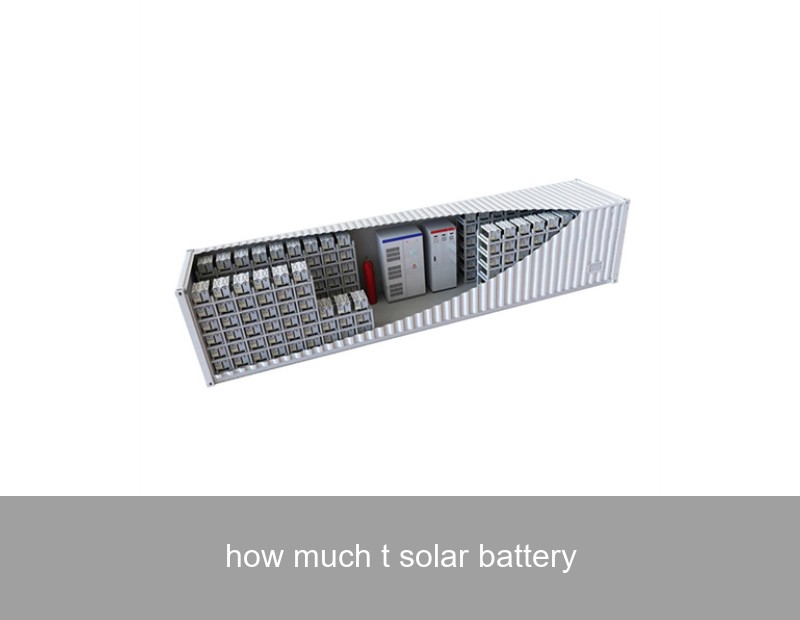
At Highjoule, we understand that the question "how much solar battery" is the beginning of a conversation. Since 2005, we've moved beyond generic packages to deliver intelligent, integrated systems. For residential clients, our ResiPower Series offers modular units from 5 to 20 kWh of usable storage, which can be combined for larger needs. For commercial and industrial applications, our C&I Energy Platform provides containerized solutions from 100 kWh to multiple megawatt-hours, designed for peak shaving, demand charge reduction, and renewable integration.
Our proprietary Energy Management System (EMS) acts as the brain, constantly analyzing weather data, electricity tariffs, and your consumption patterns. It doesn't just react; it predicts. This means your physically installed battery capacity works harder and smarter, often delivering the equivalent performance of a larger, "dumber" system.
Future-Proofing Your Investment
Your energy needs will evolve. Perhaps you'll buy an electric vehicle, add a heat pump, or expand your home. When considering capacity, ask about modularity. Can you easily add more battery modules later? Highjoule's systems are designed with this in mind, allowing you to start with what you need today and scale up as your life and energy goals change.
So, the next step isn't just picking a number from a chart. It's about understanding your own energy story. What does a day in your home's energy life look like? What are you truly hoping to achieve—resilience, savings, or both? We invite you to share your biggest energy challenge with us. What's the one appliance or circumstance that makes you most concerned about power, and how would solving that change your daily life?
 Inquiry
 Online Chat