


How Much Does a 2000W Solar Kit Cost? A Complete Breakdown for 2024
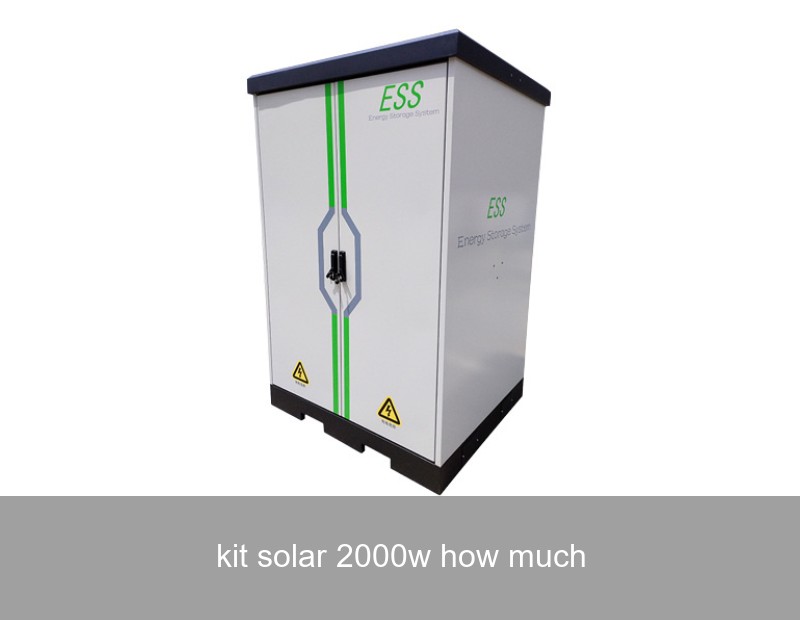
Thinking about harnessing the sun's power for your home, cabin, or workshop? A 2000-watt (2kW) solar kit is one of the most popular entry points into renewable energy, offering a great balance between power output, physical footprint, and investment. But the question on everyone's mind is: kit solar 2000w how much does it actually cost? The answer isn't a single number. The final price tag of a 2000W solar panel kit is a puzzle where pieces like component quality, battery storage, and professional installation dramatically change the picture. Let's demystify the costs and explore how modern, intelligent systems from providers like Highjoule maximize the value of every watt.
Table of Contents
- The Direct Answer: 2000W Solar Kit Price Range
- Breaking Down the Cost: More Than Just Panels
- The Game-Changer: Adding Battery Storage
- Professional Installation vs. DIY: A Critical Cost Factor
- A Real-World Case: Off-Grid Living in Southern Spain Looking Beyond Price: The Highjoule Value Proposition
- Making Your Decision: Key Questions to Ask
The Direct Answer: 2000W Solar Kit Price Range
To give you a ballpark figure, a basic 2000W solar panel kit without batteries, suitable for DIY off-grid setups like RVs or tiny homes, can start from $1,500 to $3,000. This typically includes the panels, a charge controller, and basic wiring. However, for a complete, grid-tied or hybrid system for a permanent home—including high-efficiency panels, a modern inverter, mounting hardware, and full electrical components—the kit cost alone ranges from $3,000 to $6,000. Remember, this is before batteries, permits, and installation labor. A fully installed, battery-backed 2kW system can realistically range from $8,000 to $15,000+, heavily influenced by your location and choices.
Breaking Down the Cost: More Than Just Panels
Understanding the components clarifies the price spectrum. A quality 2000W kit is an ecosystem.
- Solar Panels (The Generators): Monocrystalline panels (higher efficiency, better for limited space) cost 10-20% more than polycrystalline. For 2000W, you might need 5-6 panels.
- Inverter (The Brain): This converts DC solar power to usable AC power. A basic string inverter is most affordable. For roofs with partial shading, microinverters or power optimizers (adding $0.10-$0.15 per watt) maximize output but increase cost.
- Mounting & Racking (The Foundation): Roof mounts, ground mounts, or ballasted systems vary in price and complexity.
- Balance of System (BOS): Wiring, disconnects, junction boxes, and monitoring systems. Never underestimate these critical safety components.
The Game-Changer: Adding Battery Storage
This is where the modern energy revolution happens. A battery storage system, like those offered by Highjoule, unlocks true energy independence. It stores excess daytime production for use at night, during outages, or when grid prices peak. Adding a battery can easily double your system's upfront cost but transforms its functionality.
Consider Highjoule's HES Series (Home Energy Storage) solutions. These aren't just simple battery banks; they are integrated, intelligent systems. Their modular lithium-ion phosphate (LiFePO4) batteries are scalable, safe, and managed by an AI-driven energy management system. This software learns your consumption patterns, optimizes charging/discharging based on weather forecasts and tariff rates, and seamlessly integrates with your solar panels and the grid. The value isn't just in storage—it's in intelligent control that maximizes self-consumption and can provide backup power during grid failures.

Image source: Unsplash (Photographer: Andreas Gücklhorn). A modern home setup with solar panels and a wall-mounted battery unit.
Professional Installation vs. DIY: A Critical Cost Factor
Installation labor in the US and Europe typically adds $1,000 to $3,000 to a 2kW system (without batteries). While DIY seems attractive for cost savings, grid-tied systems involve high-voltage DC and AC electricity, strict building codes, and interconnection permits with your utility. A professional installer ensures safety, compliance, warranty validity, and optimal performance. For systems with battery storage, professional integration is highly recommended.
A Real-World Case: Off-Grid Living in Southern Spain
Let's look at real data. A family in Andalucía, Spain, wanted a reliable off-grid power supply for their year-round home. Their primary goal was 100% energy autonomy without sacrificing modern comforts.
- System Size: 2.2kW solar array (6 high-efficiency panels).
- Storage: A 14.4kWh Highjoule HES modular battery system.
- Inverter: Highjoule hybrid inverter/charger (5kW).
- Total Installed Cost (2023): Approximately €11,500.
- Outcome: The system covers their daily consumption of ~10-12kWh, even in winter. The intelligent management prioritizes solar charging and schedules high-load appliances (like washing machines) for sunny periods. The family has eliminated a noisy generator and reports zero power interruptions for over 18 months. According to IEA reports, the levelized cost of electricity (LCOE) from such small-scale solar+storage systems in sun-rich regions is now highly competitive with retail grid prices.
Looking Beyond Price: The Highjoule Value Proposition
When evaluating "kit solar 2000w how much," consider long-term value, not just upfront cost. As a global leader since 2005, Highjoule focuses on intelligent, efficient, and sustainable solutions that deliver a better return over the system's 20+ year life.
Our commercial and residential systems are built with:
| Feature | Benefit | Impact on Your Investment |
|---|---|---|
| Advanced Battery Chemistry (LiFePO4) | Longer cycle life (6000+ cycles), superior safety, and stability. | Lower cost per cycle, longer warranty (often 10+ years), peace of mind. |
| AI-Powered Energy Management | Dynamically optimizes energy flow between solar, battery, grid, and loads. | Can increase self-consumption by up to 30%, significantly reducing bills. |
| Scalable & Modular Design | Start with what you need, expand battery capacity or solar later. | Protects your initial investment and allows for flexible budgeting. |
| Global Service & Monitoring | Remote system diagnostics and performance tracking via a user-friendly app. | Ensures your system operates at peak performance, maximizing ROI. |

Image source: Unsplash (Photographer: American Public Power Association). Smart monitoring is key to maximizing solar investment.
Making Your Decision: Key Questions to Ask
Before getting fixated on a price, ask yourself and potential suppliers these questions:
- Is this for grid-tied backup, full off-grid, or bill reduction?
- What is my average daily energy consumption (in kWh)?
- Does the quoted price include all hardware, design, permits, and installation?
- What is the warranty on key components (panels, inverter, battery)?
- How does the system's software manage and optimize my energy?
- Can the system be easily expanded in the future?
For a detailed look at calculating your home's specific solar potential, the NREL PVWatts Calculator is an excellent, free resource.
Your Energy Future Starts with a Conversation
The journey to energy independence is exciting. While the initial cost of a 2000W solar kit is a crucial factor, the true measure is the value it delivers for decades. With the right technology partner, your system becomes more than an expense—it's a resilient, intelligent asset that powers your life and protects your budget. What energy challenge—be it rising bills, unreliable grid power, or a desire for sustainability—is motivating you to look at solar today?
 Inquiry
 Online Chat