


Finding the Right NPG12 100Ah Supplier: A Guide to Powering Your Energy Independence
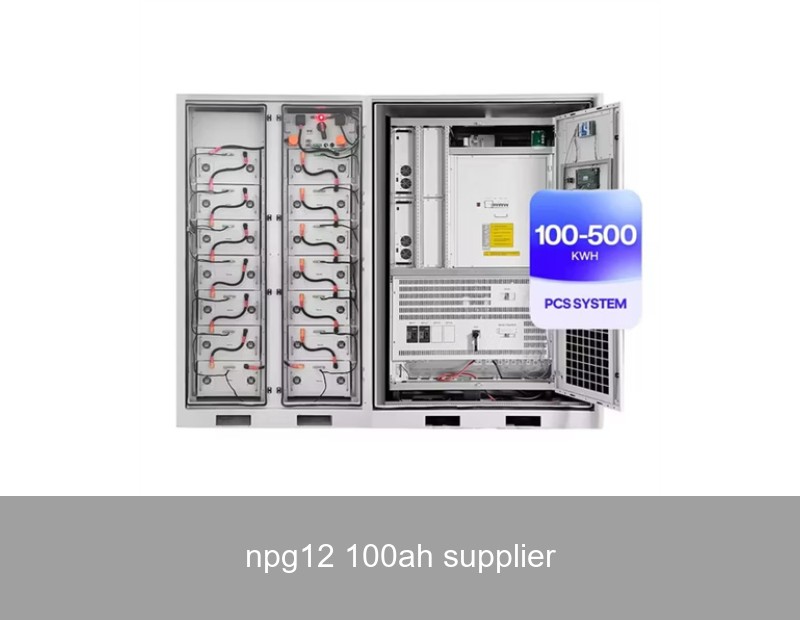
Have you ever calculated how much backup power your home or business truly needs during an outage? Or wondered if your off-grid cabin's battery bank is sized correctly for those long winter nights? The heart of any reliable energy storage system is the battery itself, and the quest for a robust, long-lasting solution often leads to a specific component: the NPG12 100Ah battery. But sourcing this key piece isn't just about finding a vendor; it's about partnering with a knowledgeable NPG12 100Ah supplier who understands the critical role this battery plays in your overall system's safety, efficiency, and lifespan. This article will illuminate the path to choosing the right partner, ensuring your investment delivers dependable power for years to come.
Table of Contents
- Understanding the NPG12 100Ah Battery
- Why Your Choice of Supplier Matters More Than You Think
- Key Criteria for Evaluating an NPG12 100Ah Supplier
- Case Study: Ensuring Grid Stability in a German Microgrid
- Looking Beyond the Battery: The System Integration Advantage
- Making Your Decision: Questions to Ask Your Potential Supplier
Understanding the NPG12 100Ah Battery
The "NPG12" typically refers to a specific series or form factor of a valve-regulated lead-acid (VRLA) battery, often in an Absorbent Glass Mat (AGM) design. The "100Ah" denotes its capacity: it can theoretically deliver 5 amps for 20 hours, or 100 amps for 1 hour, before being depleted. These batteries are prized for their maintenance-free operation, sealed design (no acid spills), and good deep-cycle capabilities. They are commonly used in:
- Uninterruptible Power Supplies (UPS) for data centers and offices.
- Backup power for residential and commercial solar+storage systems.
- Marine and recreational vehicle (RV) applications.
- Wheelchairs and medical mobility devices.
However, not all NPG12 100Ah batteries are created equal. Differences in plate composition, electrolyte purity, and manufacturing quality control can lead to significant variations in performance, cycle life, and safety.
Why Your Choice of Supplier Matters More Than You Think
Here's a common scenario: a business owner purchases NPG12 batteries from the lowest-cost online supplier for their office's backup power system. Initially, all seems well. But after 18 months, the batteries start failing prematurely, unable to hold a charge during a critical grid outage. The financial loss from downtime far outweighs the initial savings. This illustrates the core issue: a supplier is more than a logistics provider. A reputable NPG12 100Ah supplier acts as a technical partner. They source from tier-1 manufacturers with proven quality, provide accurate technical data and warranties, and offer support before and after the sale. They ensure the battery is not just a commodity, but a certified, reliable component.
Key Criteria for Evaluating an NPG12 100Ah Supplier
When vetting potential suppliers, consider this checklist:
- Certifications & Compliance: Do the batteries carry relevant international certifications (e.g., UL, CE, IEC)? This is non-negotiable for safety and insurance, especially in the US and EU markets.
- Technical Transparency: Can they provide detailed spec sheets with real performance data on cycle life at various depths of discharge (DoD), charge acceptance rates, and operating temperature ranges?
- Supply Chain & Warranty: Do they have stable inventory and a clear, actionable warranty process? A 3-5 year warranty is standard for quality AGM batteries.
- Technical Support: Do they have engineers or experts who can advise on proper charging profiles, system configuration, and maintenance to maximize battery life?
Choosing based on these factors mitigates risk and protects your long-term investment.
Case Study: Ensuring Grid Stability in a German Microgrid
Let's look at a real-world application where the choice of battery supplier was critical. A small municipality in Bavaria, Germany, developed a community microgrid integrating local solar PV and a backup generator. The system required a bank of high-capacity, reliable batteries for short-term frequency regulation and bridging power during generator start-up.
The project engineers didn't just source "100Ah batteries." They partnered with Highjoule as their system provider. Highjoule's expertise was crucial in specifying the exact battery type—including units with an NPG12-100Ah form factor—that were compatible with their advanced inverter/charger and energy management system (EMS). Highjoule sourced certified batteries from a trusted manufacturer and handled the entire system integration.
The Result: The microgrid has been operational for over 4 years. The battery bank, monitored and managed by Highjoule's intelligent EMS, has maintained over 92% of its original capacity, far exceeding baseline expectations. This performance is directly linked to the synergy between high-quality components and expert system design. The local utility now uses this project as a reference case for decentralized energy stability.

Image: A modern battery energy storage system (BESS) installation. Credit: Unsplash
Looking Beyond the Battery: The System Integration Advantage
This leads to a vital insight: the most successful energy projects focus on system performance, not just component procurement. This is where a partner like Highjoule redefines the value proposition. As a global leader in advanced储能系统 since 2005, Highjoule doesn't just supply batteries; we deliver intelligent, integrated power solutions.
For a client seeking NPG12 100Ah batteries, we would first analyze the entire application: Is this for a residential solar backup, a critical industrial UPS, or part of a larger微电网? Our product lines, such as the Highjoule H-Series Commercial ESS or the ResilientHome residential unit, are built with compatible, high-grade battery cells (including AGM and advanced lithium options) that are meticulously tested and integrated with our own power conversion and software. Our EMS ensures each battery operates within its ideal parameters, preventing premature failure and extracting maximum value.
By providing a single point of responsibility for design, hardware, software, and support, we eliminate the compatibility guesswork and performance gaps that occur when sourcing components piecemeal from different suppliers.
| Consideration | Traditional Component Sourcing | Highjoule Integrated System |
|---|---|---|
| Compatibility | Risk of mismatch between battery, inverter, and software. | Pre-engineered, tested, and guaranteed compatibility. |
| Performance Optimization | Battery operates on generic settings, reducing lifespan. | Proprietary EMS tailors charging/discharging to exact battery specs. |
| Warranty & Support | Multiple vendors, potential for blame-shifting. | Single warranty and dedicated technical support for the entire system. |
| Total Cost of Ownership | Lower upfront cost, higher risk of early replacement & downtime. | Higher initial investment, optimized for longevity and reliability. |
Making Your Decision: Questions to Ask Your Potential Supplier
Armed with this knowledge, your conversation with any NPG12 100Ah supplier should evolve. Move beyond price and availability. Ask:
- "Can you provide the full test report from the manufacturer for this specific batch of NPG12 batteries?"
- "How does your technical support team help me configure the correct charging voltage for my existing inverter?"
- "If I'm planning to scale this system in two years, how will you ensure battery bank compatibility?"
- "For my application of [describe your use case], what is the expected cycle life at 50% Depth of Discharge, and how is that validated?"
The answers will quickly separate commodity brokers from true energy solution partners.
Ready to Power Your Next Step?
The journey to energy resilience is more than a purchase order; it's a strategic partnership. Whether your project requires specific components like the NPG12 100Ah or a fully engineered turnkey storage solution, the right partner makes all the difference. What's the one critical performance metric for your energy storage system that would make you choose an integrated solution over a standalone component?
 Inquiry
 Online Chat