


100-Watt Solar Panels: The Compact Powerhouse for Modern Energy Independence
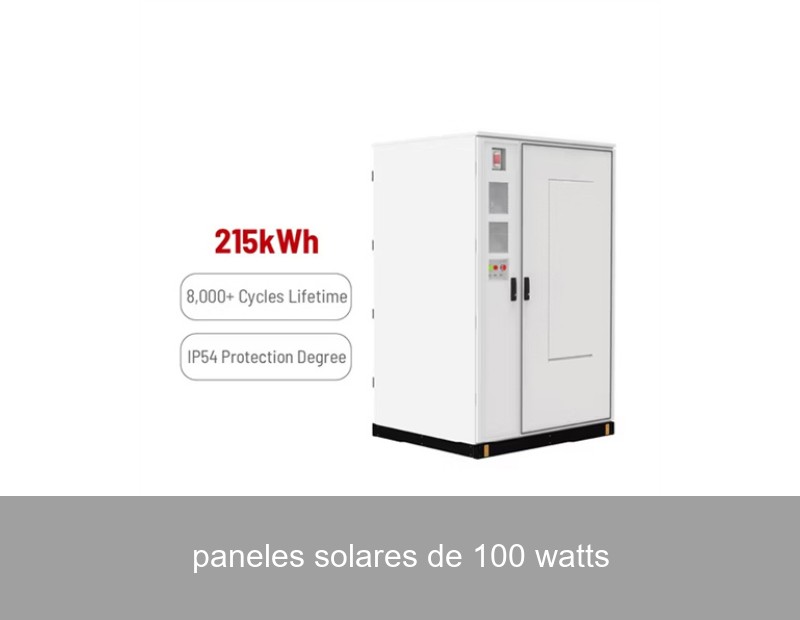
You've probably seen them on boat cabins, RV roofs, or powering a backyard shed: the humble 100-watt solar panel. But what exactly can a paneles solares de 100 watts do in today's world of expanding energy needs? Far from being a niche product, these compact modules are becoming a fundamental building block for scalable, resilient, and intelligent power systems. As energy prices fluctuate and the desire for self-sufficiency grows, understanding how to effectively deploy these units is key. For over 18 years, Highjoule has been at the forefront of integrating such renewable assets into robust storage solutions, ensuring that every watt generated is captured, managed, and used intelligently.
Table of Contents
- What is a 100-Watt Solar Panel Really Capable Of?
- Beyond the Basics: The Critical Role of Energy Storage
- Building a System: It's More Than Just Panels
- The Highjoule Advantage: Intelligence Meets Durability
- Future Trends: Modularity and Smart Management
What is a 100-Watt Solar Panel Really Capable Of?
Let's demystify the "100-watt" label. Under ideal laboratory conditions—bright, direct sunlight at a specific angle—the panel will generate 100 watts of electrical power. In the real world, factors like geographic location, season, shading, and panel angle affect output. On average, a 100W panel in sunny Southern Europe or California might produce between 300 to 500 watt-hours (Wh) of energy per day. That’s enough to:
- Charge a laptop 2-3 times.
- Run an efficient DC refrigerator for several hours.
- Power LED lighting for a small cabin all evening.
- Keep a bank of security cameras and a Wi-Fi router online.
The true power of a paneles solares de 100 watts lies in its modularity. You're not limited to one. They can be connected in series or parallel to form arrays that match your exact energy requirements, making them incredibly versatile for scaling a system.
Beyond the Basics: The Critical Role of Energy Storage
Here’s the pivotal insight: solar panels generate power when the sun shines, but we often need it when it doesn’t. This mismatch is the single biggest challenge in renewable adoption. A panel without storage is like a reservoir with a hole in the bottom. This is where Battery Energy Storage Systems (BESS) become non-negotiable. They capture the surplus energy produced during peak sun hours for use at night or during cloudy periods, transforming a intermittent source into a reliable one.
For systems built around 100-watt panels, the choice of storage is paramount. A small, poorly designed battery can be damaged by irregular charging, while an oversized one is an inefficient investment. The key is a balanced, intelligent system where charge controllers, inverters, and batteries communicate seamlessly.
Case Study: Off-Grid Hospitality in the Spanish Sierra
Consider "Finca Alpujarra," a remote eco-lodge in Granada, Spain. Their challenge was to power three guest bungalows without the cost of running grid lines through mountainous terrain. Their solution was a modular solar array using 24 x 100W panels (2.4kW total), chosen for easy transport and installation on varied roof angles.
The critical component, however, was the storage. They paired the array with a Highjoule H2-Stack modular lithium-ion battery system, with a total capacity of 15kWh. The system's integrated energy management software (EMS) prioritizes charging the batteries, directly powering DC loads, and managing AC output via an inverter.
| Metric | Data |
|---|---|
| Daily Energy Generation | 8-12 kWh |
| Lodge Self-Sufficiency | 92% |
| Generator Backup Use | Reduced by 85% |
| ROI Period | Estimated 4.2 years |
This case illustrates that 100-watt panels, when combined with professional-grade storage and management, can power not just small devices, but entire commercial operations reliably. The lodge manager noted, "The Highjoule system's monitoring lets us see the contribution of every solar string, making maintenance and guest education simple."

Image: Modular solar installations, similar to the case study, are ideal for complex rooftops. (Photo by American Public Power Association on Unsplash)
Building a System: It's More Than Just Panels
So, what do you need to make a 100-watt panel system work effectively?
- The Solar Panel(s): The 100W generator. Monocrystalline panels are typically preferred for higher efficiency in space-constrained setups.
- Charge Controller: This protects your batteries by regulating the voltage and current from the panel. Maximum Power Point Tracking (MPPT) controllers, like those integrated into Highjoule systems, can increase energy harvest by up to 30% compared to older technologies.
- Battery Storage: The heart of an off-grid or backup system. Lithium-ion batteries (LiFePO4) are the standard for their longevity, depth of discharge, and safety.
- Inverter: Converts the DC electricity from the panels and batteries into AC electricity for standard household appliances.
- Energy Management System (EMS): The "brain." A smart EMS, such as Highjoule's Sentinel EMS Platform, optimizes energy flow, provides performance data, and can even enable grid services in some configurations.
The Highjoule Advantage: Intelligence Meets Durability
At Highjoule, we see paneles solares de 100 watts and similar modules as the perfect entry point for scalable energy independence. Our role is to provide the sophisticated backbone that makes their output truly valuable. Our H-Series residential and commercial battery systems are designed with modularity in mind, allowing customers to start with a capacity that matches a small solar array and expand it as their needs grow—whether adding more panels or more battery capacity.
Our systems are built for global markets, with certifications for safety and performance in both the EU and North America. More importantly, the Sentinel EMS software provides users with unparalleled visibility and control. You can track the real-time output of your solar array, schedule battery usage to capitalize on time-of-day electricity rates (a major benefit in Europe and California), and ensure your system automatically switches to backup power during an outage.

Image: Modern, wall-mounted home energy storage systems enable clean power day and night. (Photo by Andreas Gücklhorn on Unsplash)
Future Trends: Modularity and Smart Management
The future of solar is not just about larger, more efficient panels; it's about smarter, more integrated systems. The concept of modular "solar tiles" or plug-and-play systems, often starting in the 100W-equivalent range, is gaining traction. These systems demand even more advanced storage and management to balance multiple, distributed generation points. Furthermore, with the rise of virtual power plants (VPPs), aggregated home systems with storage can provide grid stability, turning individual producers into active grid participants.
For the consumer, this means the humble 100-watt panel is no longer just for camping. It can be the first node in a comprehensive home energy system that reduces bills, provides security, and contributes to a more resilient grid. The technology is here. The question is, how will you structure your energy ecosystem to make the most of it?
What specific energy independence goal—be it backup power for essential loads, completely off-grid living, or reducing your carbon footprint—could you start designing today with a modular, scalable approach?
 Inquiry
 Online Chat