


Harnessing the Sun: The Rise and Future of Paneles Solares del Peru
Imagine a country where the sun doesn't just shine—it dominates. In the high-altitude plains of the Andes and the vast coastal deserts, Peru is blessed with one of the highest solar irradiance levels on the planet. For businesses, communities, and industries across the nation, paneles solares del Peru (Peru's solar panels) are more than just an alternative; they are becoming the cornerstone of a resilient and independent energy future. But capturing this raw abundance is only half the story. The true revolution lies in storing that energy for when it's needed most. This is where advanced solar technology meets intelligent energy storage, creating a synergy that is transforming how Peru powers its growth.
The Phenomenon: Why Peru is a Solar Powerhouse
Peru's geographical and climatic conditions create a perfect storm for solar energy. The Atacama Desert, which stretches into southern Peru, is the driest place on Earth, meaning fewer clouds and more direct sunlight. Furthermore, many regions are at high altitudes, where the atmosphere is thinner, allowing for stronger solar radiation. This isn't just a mild advantage; it's a staggering natural resource. For mining operations in the south, agricultural exporters on the coast, and remote communities in the Andes, this solar potential translates directly into economic opportunity and energy security, reducing a heavy reliance on volatile fossil fuel imports and fragile grid infrastructure.
The Data: Solar Potential and Market Growth
The numbers speak volumes. According to Peru's Ministry of Energy and Mines, the country's solar energy potential is estimated at a massive 25,000 GW. To put that in perspective, Peru's total installed electricity capacity (from all sources) was just over 15 GW in 2022. The market is responding. Non-conventional renewable energy, led by solar, has seen consistent growth. A International Renewable Energy Agency (IRENA) report highlights that Peru has steadily increased its solar PV capacity, with both large-scale plants and distributed generation (like rooftop solar) contributing significantly.
| Metric | Data / Figure | Implication |
|---|---|---|
| Average Solar Radiation (South Coast) | 5.5 - 6.0 kWh/m²/day | Among the highest in the world, ideal for PV generation. |
| Solar PV Installed Capacity (2023 approx.) | Over 400 MW (utility-scale) | Rapid growth from a near-zero base a decade ago. |
| Key Driver Sectors | Mining, Agriculture, Tourism, Remote Communities | High daytime energy demand aligns perfectly with solar production. |
The Core Challenge: From Sunlight to Stable Power
Here's the catch that every solar developer and user faces: the sun sets right when evening energy demand often peaks. This creates the "duck curve" phenomenon—a steep ramp-up in demand for other power sources as solar fades. For a Peruvian factory running night shifts or a hotel needing power 24/7, solar panels alone are insufficient. Grid instability in remote areas can also jeopardize operations. The critical question becomes: How do you capture the daytime surplus and deploy it on demand? The answer is no longer a mystery; it's a technological imperative: coupling paneles solares with advanced battery energy storage systems (BESS).

Image: Desert regions in Peru offer ideal conditions for utility-scale solar farms. Credit: Unsplash.
The Modern Solution: Intelligent Solar + Storage Systems
This is where the energy landscape is being redefined. Modern solar installations are no longer just arrays of panels. They are integrated, smart energy systems. A Battery Energy Storage System acts as the heart of this setup, performing several crucial functions:
- Energy Time-Shifting: Storing cheap, abundant solar energy from midday for use during expensive peak evening hours.
- Grid Stabilization: Providing instantaneous frequency response and voltage support, crucial for weak or isolated grids.
- Backup Power: Ensuring continuity of operations during grid outages, acting as an uninterruptible power supply (UPS) for entire facilities.
- Maximizing Self-Consumption: Allowing homes and businesses to use a much higher percentage of the solar energy they produce, increasing ROI.
Case Study: Powering a Peruvian Agro-Exporter in Ica
Consider a real-world example from Peru's vital agricultural export sector. A leading asparagus and grape exporter in the Ica region faced two major problems: extremely high electricity costs from running 24/7 cold storage facilities, and the risk of spoilage due to unreliable grid power. Their existing 500 kW rooftop solar array covered about 60% of their daytime load but did nothing at night.
The Solution: They integrated a 1 MWh containerized battery storage system alongside their solar farm. The Results:
- Energy Cost Reduction: By charging the batteries with excess solar and discharging during peak tariff hours (6 pm - 11 pm), they reduced their overall energy bill by an additional 35%.
- 100% Backup for Critical Loads: The system is configured to keep all cold storage units online indefinitely during a blackout, eliminating spoilage risk.
- ROI: The combined solar + storage system achieved a payback period of under 5 years, thanks to high local electricity tariffs and avoided losses.
This case, documented in part by Peru's Ministry of Energy and Mines reports on successful renewable integrations, exemplifies the transformative power of pairing paneles solares del Peru with modern storage.
Technology in Focus: The Highjoule Advantage
As a global leader in advanced energy storage since 2005, Highjoule understands that projects in diverse environments like Peru require robust, intelligent, and adaptable solutions. Our systems are engineered to maximize the value of solar investments in commercial, industrial, and microgrid applications.
For partners deploying paneles solares del Peru, Highjoule offers:
- High-Density Lithium-Ion Battery Systems: Our modular BESS units, like the HJ Cube, offer superior energy density and cycle life, perfect for daily cycling in solar applications.
- Advanced Energy Management System (EMS): The brain of the operation. Our EMS uses AI-driven forecasting (of both solar yield and energy demand) to autonomously optimize charge/discharge cycles, ensuring every kilowatt-hour of solar energy is used at its highest economic value.
- All-Climate Resilience: Engineered to perform reliably in both the extreme heat of the coastal desert and the cold temperatures of the Andean highlands, ensuring system longevity and performance.
- Grid-Forming Capability: For truly off-grid microgrids, our inverters can "form" a stable grid from scratch, allowing communities or mines to run entirely on solar + storage without a diesel generator.

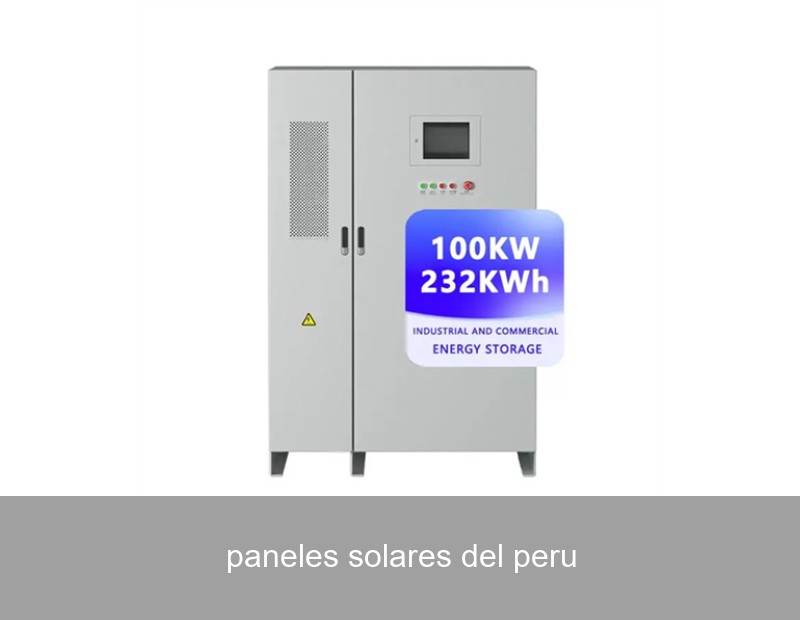
Image: A modular, containerized BESS unit, similar to Highjoule's HJ Cube, allows for scalable deployment. Credit: Unsplash.
The Future of Solar in Peru and Beyond
The trajectory for paneles solares del Peru is incredibly bright, but its full potential is unlocked only with storage. As battery costs continue to decline and smart software becomes more sophisticated, we will see an acceleration of solar-storage hybrids. This isn't just about economics; it's about empowering sustainable development, reducing carbon footprints for export industries, and bringing reliable power to the last mile.
The global lessons are clear, as seen in markets like the U.S. Department of Energy's solar initiatives and Europe's push for energy independence. The future is integrated, intelligent, and resilient. For a mine in Moquegua, a hotel in Cusco, or a water treatment plant in Piura, the question is no longer "Should we go solar?" but rather "How can we design a solar-plus-storage system that guarantees our energy security and profitability for the next 20 years?"
What unique energy challenge does your operation in Peru or similar high-potential market face, and how could an intelligent storage solution transform your bottom line and operational resilience?
 Inquiry
 Online Chat