


Power Backup Systems in Kenya: A Critical Pillar for Growth and Resilience
Imagine running a thriving business, a critical hospital, or simply trying to study at home in Kenya, only for the lights to flicker and die. This isn't just an inconvenience; it's a daily economic and social reality for many. The quest for reliable power backup systems in Kenya has moved from a luxury to an absolute necessity. This article delves into why Kenya, a nation buzzing with entrepreneurial energy and technological adoption, is at the forefront of adopting advanced energy storage solutions to combat power instability and unlock its full potential.
Table of Contents
- The Kenyan Power Reality: More Than Just Outages
- The Data: Quantifying the Cost of Unreliable Power
- The Evolution of Backup Power: From Generators to Intelligent Systems
- A Real-World Case: Securing a Nairobi Manufacturing Hub
- Highjoule's Role: Providing Smart, Sustainable Power Backup for Kenya
- The Future of Power Backup in Kenya: Integrated Microgrids
The Kenyan Power Reality: More Than Just Outages
While Kenya's national grid has expanded significantly, challenges remain. Intermittent supply, voltage fluctuations ("sags" and "surges"), and localized outages can disrupt operations without warning. For a growing business, this means halted production lines, spoiled inventory, and lost revenue. For a family, it means disrupted communication, education, and safety. The traditional response—the diesel generator—is a loud, polluting, and increasingly expensive stopgap. The market is now demanding cleaner, quieter, and more intelligent power backup systems in Kenya that provide not just emergency power, but also energy management and cost savings.
The Data: Quantifying the Cost of Unreliable Power
The impact is measurable. According to World Bank enterprise surveys, firms in Sub-Saharan Africa experience an average of 8.3 power outages per month, with significant financial losses. In Kenya specifically, sectors like manufacturing, agri-processing, and ICT are particularly vulnerable. A single voltage surge can destroy sensitive equipment worth thousands of dollars. Furthermore, the operational cost of running diesel generators is staggering when you factor in fuel, maintenance, and environmental compliance. This creates a compelling financial argument for investing in modern battery energy storage systems (BESS) as the core of a power backup system.
| Factor | Diesel Generator | Solar-Integrated Battery System (e.g., Highjoule) |
|---|---|---|
| Fuel Cost | High & Volatile | Sunlight (Free) / Grid Charging |
| Operational Noise | Very High | Silent |
| Emissions | High (CO2, Particulates) | Zero at Point of Use |
| Response Time | Seconds to Minutes | Milliseconds |
| Maintenance | Frequent & Mechanical | Minimal, Remote Monitoring |
| Long-term ROI | Low (Ongoing Cost) | High (Cost Savings & Protection) |

Image Source: Unsplash (Representative image of commercial solar installation)
The Evolution of Backup Power: From Generators to Intelligent Systems
Today's power backup systems in Kenya are leaps ahead. They are built around lithium-ion batteries, which are more efficient, longer-lasting, and require less maintenance than older lead-acid types. The real intelligence, however, comes from the power conversion system (PCS) and energy management software. These systems don't just wait for an outage; they actively manage energy flow. They can be programmed to:
- Seamlessly transition to backup power in milliseconds, preventing any disruption.
- Integrate with solar PV, storing excess solar energy during the day for use at night or during outages.
- Perform peak shaving: using stored energy during times of high grid tariff rates to reduce electricity bills.
- Provide grid services like frequency regulation in more advanced setups.
This transforms a simple backup into a strategic energy asset.
A Real-World Case: Securing a Nairobi Manufacturing Hub
Let's look at a concrete example. A medium-sized textile factory in Nairobi's Industrial Area faced frequent, short-duration outages and damaging voltage spikes. These events were ruining sensitive motor drives and dyeing machines, leading to over $15,000 annually in equipment repairs and production downtime. Their 150kVA diesel generator cost over $28,000 per year in fuel and maintenance.
Their solution was a turnkey power backup system centered on a 200kWh/100kW lithium-ion battery storage unit, integrated with their existing rooftop solar and a smart inverter system. The system was designed to provide critical backup for 4-5 hours, handle instantaneous power surges, and automatically manage solar self-consumption. Since installation 18 months ago, the factory has reported:
- Zero production downtime due to grid outages.
- A 30% reduction in their monthly grid energy bill through solar storage and peak shaving.
- Elimination of generator fuel costs, saving the full $28,000 annually.
- Projected ROI on the battery system in under 5 years.
This case, documented in part by the Sustainable Energy for All initiative, highlights the multi-faceted value proposition of modern storage.
Highjoule's Role: Providing Smart, Sustainable Power Backup for Kenya
As a global leader in advanced energy storage since 2005, Highjoule understands these challenges intimately. Our solutions for the Kenyan market are not just imported products; they are tailored systems designed for local conditions, including high ambient temperatures and specific grid characteristics. We provide end-to-end support, from initial energy audit and system design to installation, commissioning, and remote monitoring.
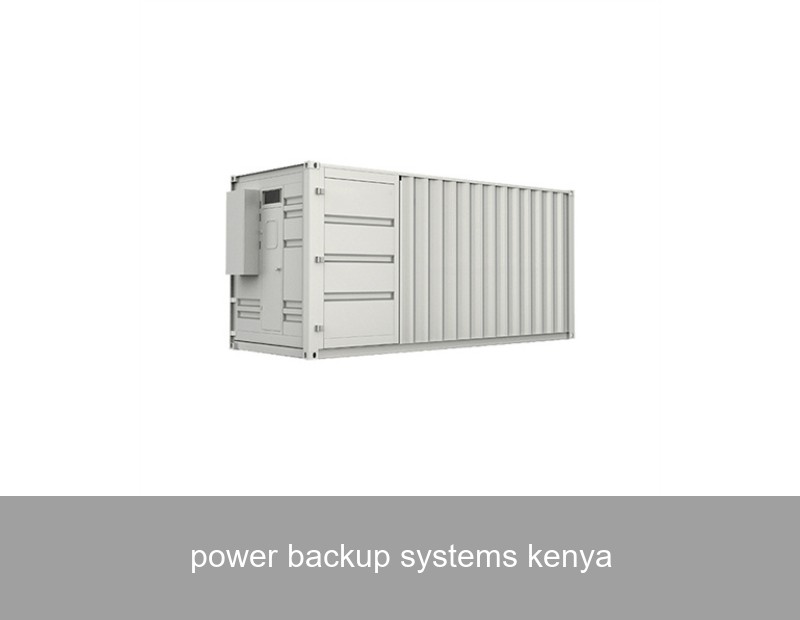
For commercial and industrial clients seeking robust power backup systems in Kenya, Highjoule's H-Series Commercial ESS is a prime example. It's a containerized or modular battery storage solution that offers:
- Ultra-Fast Grid Response: Seamless backup switching to keep operations running.
- Solar+Storage Optimization: Advanced software to maximize the use of on-site renewable generation.
- Demand Charge Management: Automatically discharges battery during peak tariff periods, cutting utility costs significantly.
- Remote 24/7 Monitoring: Our team can proactively manage system health and performance from our global network operations centers.
For larger, more complex needs like university campuses, hospitals, or entire industrial parks, Highjoule designs and deploys turnkey microgrid solutions. These integrate multiple generation sources (solar, wind, gensets) with large-scale storage and intelligent controls to create a self-sufficient, resilient energy island that can operate independently from the national grid when needed.

Image Source: Unsplash (Representative image of a modern battery storage system)
The Future of Power Backup in Kenya: Integrated Microgrids
The trajectory is clear. The future of power backup systems in Kenya lies in integrated, renewable-powered microgrids and distributed energy resources. The declining cost of solar PV and batteries, coupled with innovative business models, is making these systems accessible not just to large corporations but also to SMEs, agricultural cooperatives, and residential communities. Kenya's abundant solar resource makes it an ideal candidate for this transition. Research from institutions like the International Renewable Energy Agency (IRENA) consistently points to solar and storage as key to Africa's sustainable energy future.
These systems do more than provide backup; they empower communities, enable business growth, and build national economic resilience. They represent a shift from passive consumption to active, intelligent energy management.
Your Energy Resilience Starts with a Question
Is your business, institution, or community simply reacting to the next power outage, or are you building a strategic plan for energy independence and cost control? What would a 100% reliable, lower-cost power supply make possible for your operations in Kenya?
 Inquiry
 Online Chat