


Puerto Rico Solar Energy: Powering Resilience and Independence
Imagine your home or business consistently having power, even when the grid goes dark. For many in Puerto Rico, this isn't just a convenience—it's a necessity born from experience. The island's journey toward Puerto Rico solar energy independence is one of the most compelling stories in renewable energy today. It's a movement driven by sun-drenched potential and a critical need for resilience. But what does it take to transform abundant sunlight into reliable, 24/7 power? The answer lies not just in the solar panels you see, but in the sophisticated energy storage systems working behind the scenes. This is where the true revolution is happening.
Introduction: More Sun, More Power, More Resilience
Puerto Rico receives an average of over 2,800 hours of sunshine per year, a resource far more reliable than its historically fragile centralized grid. After the devastation of Hurricane Maria in 2017, which left some areas without power for nearly a year, the conversation shifted permanently. The goal was no longer just cleaner energy, but energy sovereignty and security. Communities, businesses, and homeowners began to see solar panels coupled with battery storage not as an alternative, but as a primary solution. This shift represents a global lesson: modern renewable systems are about intelligent management and storage, ensuring power is available precisely when and where it's needed most.
The Puerto Rico Solar Energy Imperative: A Story of Resilience
The push for solar in Puerto Rico is a textbook example of the PAS (Problem-Agitate-Solution) framework in action.
- Problem: A centralized, aging grid vulnerable to extreme weather events, leading to frequent and prolonged outages. High electricity costs, often double those on the U.S. mainland, further strain households and businesses.
- Agitate: The traumatic aftermath of Hurricanes Maria and Fiona made the systemic vulnerability undeniable. The economic and human cost of grid failure became a daily reality, highlighting the urgent need for a decentralized approach.
- Solution: Widespread adoption of distributed solar-plus-storage systems. These systems allow homes, businesses, and entire communities to generate their own power, store excess energy, and create "islands" of power during wider grid outages. This model turns consumers into proactive "prosumers," in control of their energy destiny.

Image Source: Unsplash. Rooftop solar is a cornerstone of Puerto Rico's energy resilience.
From Rooftops to Microgrids: The Data Behind the Boom
The numbers tell a powerful story. According to the Solar Energy Industries Association (SEIA), Puerto Rico's solar market has experienced explosive growth. From virtually no significant storage-coupled systems before 2017, the island now boasts one of the highest per-capita rates of solar-plus-storage adoption in the United States. A key driver is the Puerto Rico Energy Public Policy Act (Act 17), which mandates 100% renewable energy by 2050. More immediately, programs like the Federal Emergency Management Agency's (FEMA) $9.4 billion in funding for grid reconstruction are actively prioritizing renewable microgrids and resilience projects. This isn't a niche trend; it's a fundamental restructuring of the island's energy architecture.
| Metric | Data / Status | Implication |
|---|---|---|
| Solar Installed Capacity (2023) | Over 400 MW (Residential, Commercial, & Utility) | Exceeds pre-Maria capacity by over 300% |
| Key Policy Goal | 40% Renewable Energy by 2025; 100% by 2050 | Clear, legislated roadmap for investment |
| Residential Adoption Rate | One of the fastest-growing in the U.S. territories | Grassroots movement for energy security |
| FEMA Grid Resilience Funding | $9.4+ Billion | Unprecedented opportunity for renewable integration |
A Case Study in Resilience: The Town of Adjuntas
Perhaps no example is more inspiring than the community of Adjuntas, high in Puerto Rico's central mountains. After Hurricane Maria, this town was isolated for months. In response, the nonprofit Casa Pueblo, in collaboration with academics and private partners, launched the "Adjuntas Pueblo Solar" project. Their goal was ambitious: to create a community-owned solar microgrid that could power critical businesses during a blackout.
The result? A 35-kilowatt solar array coupled with 85 kilowatt-hours of battery storage now powers a plaza containing a pharmacy, a restaurant, a coffee shop, and an ice cream parlor. During Hurricane Fiona in 2022, while the central grid failed again, this solar microgrid kept the lights on and refrigerators running. The pharmacy was able to provide vital medicines, and the plaza became a beacon of hope and normalcy. Data from the system showed it operated autonomously for over 10 consecutive days, proving the technical and social viability of the model. You can read more about this pioneering project through research from MIT News.
The Intelligent Heart of the System: Beyond Just Panels
This is where the conversation gets technical, but stick with me—it's crucial. The solar panels are the workhorses, but the battery energy storage system (BESS) is the intelligent brain and heart. A modern BESS does much more than just store DC power from panels. It must:
- Manage Ingress: Intelligently prioritize charging from solar, the grid (when available/cheap), or generators.
- Ensure Safety: Operate flawlessly in tropical heat and humidity with advanced thermal management.
- Provide Seamless Backup: Switch to backup power in milliseconds (<20ms) during an outage, a feature known as uninterruptible power supply (UPS).
- Optimize Economics: Perform time-of-use arbitrage—storing solar energy when it's abundant and using it during peak, expensive grid hours.
This requires not just robust battery cells (like Lithium Iron Phosphate, or LFP, known for safety and longevity), but sophisticated power conversion systems (PCS) and energy management software (EMS) that make thousands of decisions per second.

Image Source: Unsplash. A modern Battery Energy Storage System (BESS) is the core of a resilient solar setup.
Highjoule's Role in Building a Sustainable Puerto Rico
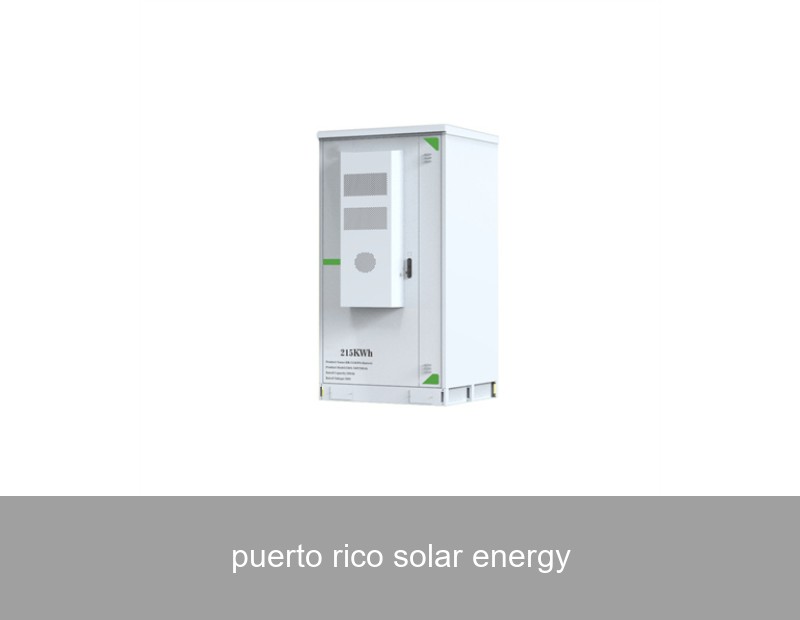
At Highjoule, we've been engineering solutions for these exact challenges since 2005. Our experience across European, North American, and island grids has taught us that reliability is non-negotiable. For the Puerto Rico solar energy market, our HPS Series Commercial & Industrial (C&I) energy storage systems are particularly relevant. These all-in-one, containerized solutions integrate LFP batteries, a bi-directional PCS, climate control, and a fire suppression system into a single, robust unit. They are designed for easy deployment and can be scaled to support anything from a large hospital or manufacturing plant to a community microgrid like the one in Adjuntas.
Our systems feature advanced EMS software that can be configured for maximizing self-consumption, peak shaving, or providing grid-forming services—essential for stabilizing microgrids. For residential and small business applications, our HomePower line offers the same core intelligence in a compact format, providing whole-home backup and utility bill savings. We don't just sell hardware; we provide a complete, intelligent power solution tailored to the unique climate and grid challenges of tropical islands.
The Future is Bright: What's Next for Island Energy?
The trajectory is clear. Puerto Rico is becoming a global laboratory for a decentralized, renewable-powered future. The next phase will involve connecting individual solar-plus-storage systems into virtual power plants (VPPs), where thousands of distributed systems can act as a single, flexible resource to support the main grid. This requires even more sophisticated communication and control, a frontier Highjoule is actively developing with our grid-interactive controls.
But the big question, the one that applies to any community seeking energy independence, is this: How do we move from individual resilience to collective, community-wide strength? The technology exists. The economic models are being proven every day in places like Adjuntas. The challenge now is scaling the will, the investment, and the collaboration to light up every community, not just with solar power, but with the power of certainty and security.
What would a resilient, solar-powered future look like for your community?
 Inquiry
 Online Chat