


Quanto Custa 20 Placas de Energia Solar? A Complete Investment Breakdown
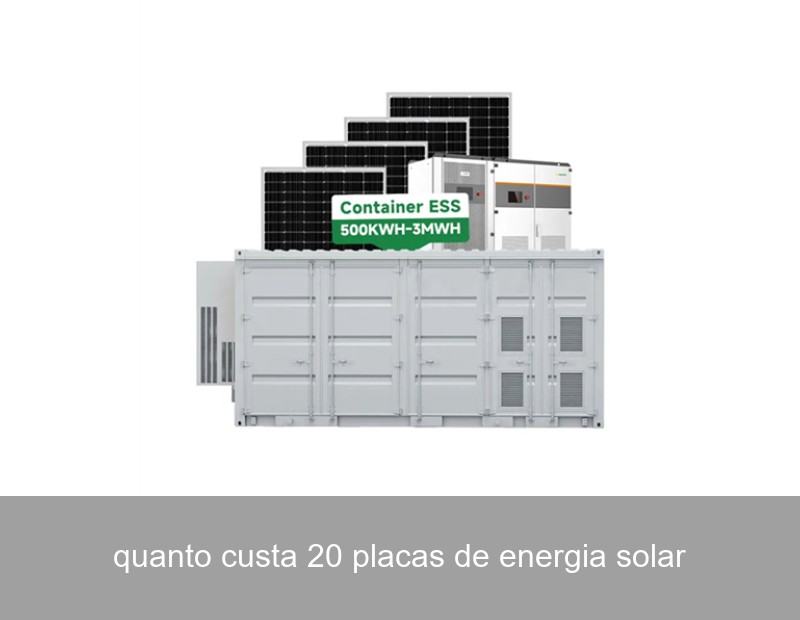
If you're asking "quanto custa 20 placas de energia solar?" (how much do 20 solar panels cost?), you're already thinking on the right scale. A 20-panel system represents a significant step towards energy independence, typically suitable for a medium-to-large home or a small business. But the sticker price of the panels themselves is just the beginning. The true cost—and value—of a solar installation encompasses equipment quality, intelligent energy management, and long-term performance. As a global leader in advanced energy storage since 2005, Highjoule understands that your solar investment is about total system intelligence, not just panels on a roof. Let's break down the real factors behind the cost of a 20-panel solar array and what you should expect for your investment in Europe or the US.
Table of Contents
- The Real Cost Components of a 20-Panel Solar System
- Price Range: From Basic Setup to Intelligent Energy Hub
- Case Study: A Real-World Example from Portugal
- Looking Beyond the Panels: The Critical Role of Storage and Management
- The Highjoule Solution: Integrating Intelligence with Your Solar Array
- Maximizing Your Return: Key Factors That Impact ROI
The Real Cost Components of a 20-Panel Solar System
When professionals quote a solar installation, they are calculating a turnkey solution. For a system with around 20 panels (often a 7-9 kW system depending on panel wattage), the cost is a sum of several interconnected parts:
- Solar Panels (Modules): This is the "quanto custa 20 placas" core. Panel prices vary by technology (monocrystalline is premium), efficiency, and brand.
- Inverter(s): The brain of your PV system, converting DC to AC power. You might choose a single string inverter or microinverters for each panel.
- Mounting System & Hardware: The racking that securely attaches your panels to the roof, designed for your specific roof type and local weather conditions.
- Energy Storage System (Battery): This is no longer an optional extra for a robust system. A battery, like Highjoule's H-Cube residential storage system, stores excess solar energy for use at night or during outages, dramatically increasing self-consumption.
- Energy Management System (EMS): Intelligent software that optimizes when to use, store, or even sell back energy. This is where true savings are unlocked.
- Balance of System (BOS): Wiring, conduits, switches, and safety equipment.
- Installation Labor & Permits: Costs for certified installers, electrical work, and navigating local permitting and grid connection processes.
Ignoring the storage and management components is like buying a high-performance car but skipping the engine control unit. You might have the parts, but you won't get the optimal performance.
Price Range: From Basic Setup to Intelligent Energy Hub
So, let's talk numbers. For a 20-panel solar system, pre-incentive prices can vary widely based on component quality and system complexity.
| System Type | Typical Capacity | Estimated Price Range (Pre-Incentive) | Key Components Included |
|---|---|---|---|
| Basic Grid-Tied | 7-8 kW | $16,000 - $22,000 | Panels, string inverter, mounting, installation |
| Advanced with Microinverters | 8-9 kW | $20,000 - $28,000 | High-efficiency panels, microinverters, detailed monitoring |
| Intelligent System with Storage | 8 kW PV + 10-15 kWh Storage | $28,000 - $38,000+ | Premium panels, hybrid inverter, battery (e.g., Highjoule H-Cube), advanced EMS |
Remember, these are gross estimates. The final "quanto custa" for your home depends on your location, roof complexity, and chosen technology. The key takeaway? The system with integrated storage represents a higher initial investment but delivers significantly greater long-term value and resilience.
Key Market Differences: Europe vs. United States
The market dynamics for solar in Europe and the US differ, impacting the "custo" (cost) and value proposition.
- Europe: With historically higher electricity prices (especially after recent geopolitical events), the payback period can be faster. Countries like Germany, Spain, and Portugal have strong net metering or self-consumption policies. The focus is heavily on maximizing self-consumption to avoid high grid rates. This makes adding a battery like Highjoule's H-Cube a financially savvy decision from day one.
- United States: The market is driven by the federal Investment Tax Credit (ITC), which currently offers a 30% tax credit on the total installed system cost, including storage. This makes the step up to an intelligent storage system much more affordable. Additionally, utility rates and net metering policies vary drastically by state, making local expertise crucial.

Image: A modern home solar plus storage installation. Source: Unsplash
Case Study: A Real-World Example from Portugal
Let's make this concrete. Consider a real-world scenario for a family home in Lisbon, Portugal.
- System Size: 20 x 450W monocrystalline panels (9 kWp total)
- Key Addition: A Highjoule H-Cube battery system with 13.5 kWh usable capacity.
- Goal: Achieve near-total energy independence and hedge against rising grid prices.
- Pre-Incentive Cost: Approximately €32,000 (fully installed).
- Portuguese Incentives: The "Fundo Ambiental" program offered a €2,300 rebate on the storage system.
- Net Cost: Roughly €29,700.
- Annual Savings/Value: The system is designed to cover over 85% of the home's annual energy consumption. By avoiding grid electricity at ~€0.28/kWh and selling small surpluses, the system saves about €2,400 in its first year. This translates to a payback period of around 12-13 years on the net investment, after which electricity is virtually free for the lifespan of the system (25+ years for panels). More importantly, it provides uninterrupted power during occasional grid outages.
This case shows that the answer to "quanto custa" is not just a number, but an equation involving incentives, local energy prices, and the added value of resilience.
Looking Beyond the Panels: The Critical Role of Storage and Management
Solar panels only produce when the sun shines. Without storage, you're often exporting excess afternoon energy at a low rate and buying back expensive power in the evening. According to the U.S. Department of Energy, pairing storage with solar is key to grid stability and maximizing the value of renewable energy. An intelligent battery system allows you to use your own solar energy on demand, turning your system from a simple generator into a personal energy asset.
The Highjoule Solution: Integrating Intelligence with Your Solar Array
This is where Highjoule's expertise transforms your investment. When you choose a system that includes Highjoule technology, you're not just buying hardware; you're acquiring an intelligent energy ecosystem.
- Highjoule H-Cube Residential Storage: A scalable, wall-mounted lithium iron phosphate (LiFePO4) battery system known for its safety, longevity (over 6000 cycles), and seamless integration. It's the cornerstone for maximizing self-consumption.
- AI-Powered Energy Management: Our systems go beyond simple charge/discharge. They learn your household patterns, consider weather forecasts, and even adapt to variable electricity tariffs (common in Europe) to autonomously optimize your energy flow for maximum savings.
- Grid Services & Future-Proofing: For microgrid and certain commercial applications, our larger-scale H-Power battery energy storage systems (BESS) can provide backup power and grid stabilization services. Our technology is designed to be scalable and adaptable to future energy market developments.
By integrating Highjoule's storage and management with your 20-panel solar array, you effectively build a personal microgrid that controls costs and enhances reliability.

Image: A modern, compact home energy storage unit integrated into a garage. Source: Unsplash
Maximizing Your Return: Key Factors That Impact ROI
To ensure your investment pays off, focus on these factors:
- Quality of Components: Higher-efficiency panels and a durable, cycle-resistant battery (like LiFePO4 chemistry) will perform better for longer.
- Professional System Design & Installation: Proper sizing, shading analysis, and correct electrical work are non-negotiable for safety and performance. Highjoule works with a certified network of installers across Europe and the US.
- Intelligent Software: The "brain" of your system is what squeezes every kilowatt-hour of value from your investment.
- Understanding Incentives: From the US ITC to local European grants and favorable VAT rates on solar+storage systems, incentives can reduce your net cost by 30% or more. A good provider will help you navigate these.
- Your Local Utility's Policy: The rules for net metering, time-of-use rates, and export tariffs directly impact your savings model. You can review how policies are evolving in markets like California, a leading solar state.
So, when you ask "quanto custa 20 placas de energia solar?", the most meaningful answer we can give is: it's the first step in a conversation about your long-term energy independence and financial savings. What is the specific energy challenge you are hoping to solve for your home or business—is it reducing unpredictable bills, achieving backup power, or simply taking a definitive step towards a sustainable future?
 Inquiry
 Online Chat