


Why Renewable Energy Investors Are Betting Big on Advanced Energy Storage
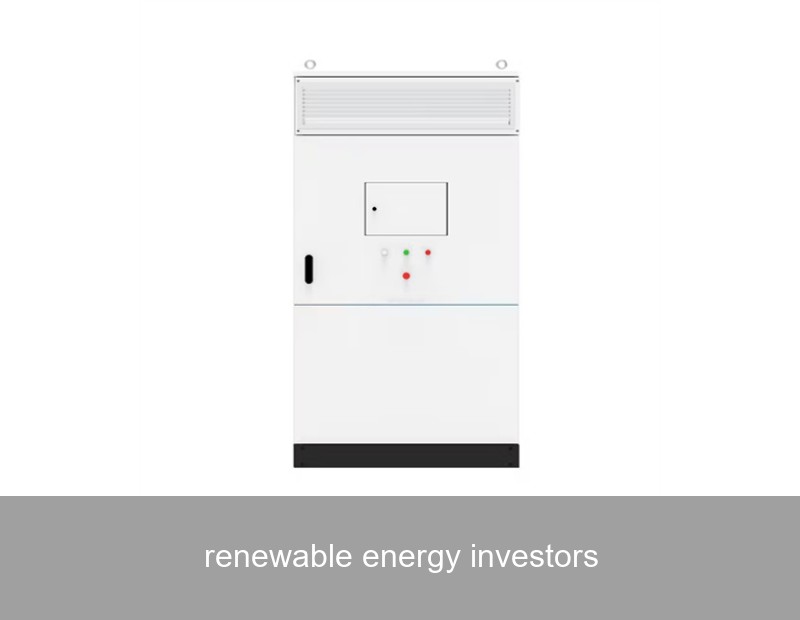
If you're a renewable energy investor, you've witnessed the meteoric rise of solar and wind. But recently, your focus—and the market's—has shifted. The conversation is no longer just about generation; it's about intelligence, flexibility, and reliability. The smart money is now flowing into the critical enabler: advanced energy storage systems. This isn't just a supporting technology; it's the cornerstone that transforms intermittent renewables into a firm, dispatchable, and highly profitable power source. Let's explore why energy storage is the most compelling frontier for today's renewable energy investors.
The Phenomenon: From Intermittency to Grid Intelligence
The fundamental challenge for renewable energy investors is well-known: the sun sets, and the wind calms. This intermittency creates a mismatch between supply and demand, leading to price volatility, grid instability, and even curtailment—where renewable energy is wasted because it can't be used. This is a direct hit to project revenues and ROI.
Enter the modern Battery Energy Storage System (BESS). Think of it not just as a big battery, but as a dynamic financial and grid asset. It performs a high-speed ballet of energy arbitrage, frequency regulation, and capacity firming. It stores cheap, abundant renewable energy and discharges it during peak, high-price periods. This capability, known as "time-shifting," is revolutionizing the value proposition of solar and wind farms.

Image Source: Unsplash - A visual representation of a hybrid renewable plus storage project.
Companies like Highjoule are at the forefront of this shift. Since 2005, Highjoule has evolved from a component provider to a global leader in delivering intelligent, integrated storage solutions. For investors, this means partnering with a provider whose systems are designed to maximize asset value through sophisticated energy management software that seamlessly connects to multiple revenue streams, from wholesale markets to grid services.
The Data: A Market Poised for Exponential Growth
The numbers tell a powerful story. According to BloombergNEF, global energy storage installations are set to multiply exponentially, reaching terawatt-hour scale by 2030. In the U.S. alone, the Inflation Reduction Act (IRA) has created unprecedented investment tax credits (ITCs) for standalone storage, fundamentally improving project economics. Europe, driven by REPowerEU and energy security imperatives, is seeing record-breaking deployment targets.
Consider this: a solar farm with co-located storage can see a 20-40% increase in its capacity factor and significantly smoother revenue generation. The levelized cost of storage (LCOS) has fallen by over 60% in the last decade, a trend that continues with advancements in battery chemistry and system integration. For renewable energy investors, this isn't a niche play; it's becoming a standard clause in the project finance model.
Case Study: A German Industrial Park's Transformation
Let's look at a real-world example. A major automotive manufacturing park in Bavaria, Germany, faced high grid demand charges and volatile energy prices. Their existing 10 MW rooftop solar array often produced more power than could be used during midday, missing the evening peak.
The solution was a turnkey 6 MWh Highjoule BESS integrated with the solar plant and the park's energy management system. Here’s the impact after one year of operation:
| Metric | Before Highjoule BESS | After Highjoule BESS |
|---|---|---|
| Grid Peak Demand | 8.2 MW | 5.1 MW (38% reduction) |
| Solar Self-Consumption | ~65% | ~95% |
| Revenue from Frequency Regulation | €0 | €210,000 annually |
| Overall Energy Cost Savings | Baseline | €480,000 annually |
This project, financed by a consortium of infrastructure investors, achieved a payback period of under 5 years. It showcases the multi-revenue stream potential: demand charge reduction, energy arbitrage, and ancillary services. Highjoule's role extended beyond hardware, providing the long-term performance monitoring and software updates crucial for sustaining these returns over the system's 15+ year lifespan.
Key Investment Avenues in the Storage Ecosystem
For the renewable energy investor, opportunities abound across the spectrum:
- Project Development & Ownership: Direct equity investment in storage-plus-renewable projects. The stabilized, diversified cash flow is attractive to pension funds and institutional investors.
- Technology & Manufacturing: Investing in companies developing next-generation batteries (e.g., solid-state, flow batteries) or superior power conversion systems.
- Software & Analytics: The "brain" of the storage system. Platforms that optimize dispatch across multiple markets are becoming high-margin, scalable businesses.
- Service Providers: Companies that offer Energy-as-a-Service (EaaS). This is where Highjoule excels for commercial and industrial (C&I) clients, offering a no-capex model where Highjoule owns and operates the system, and the client pays for the energy savings—a low-risk entry point for property funds and industrial operators.
Highjoule's portfolio serves these avenues directly. Their GridMax Utility system is designed for large-scale renewable integration and grid support, a prime asset for infrastructure funds. Meanwhile, their PowerStack Commercial solution is a modular, scalable BESS perfect for C&I portfolios, enabling investors to roll out standardized, revenue-generating assets across multiple sites.
Mitigating Risks: Technology and Market Considerations
Prudent investment requires risk awareness. Key considerations include:
- Technology Evolution: Lithium-ion dominates, but chemistry matters. LFP (Lithium Iron Phosphate) batteries, a core technology in Highjoule's systems, offer longer lifespan, superior safety, and are free of cobalt-related supply chain concerns—a critical factor for ESG-focused funds.
- Regulatory Landscape: Markets like the UK's National Grid or PJM in the US have established mechanisms for storage. Staying ahead of policy changes is vital.
- Supply Chain & Safety: Partnering with established providers with robust quality control and UL-certified systems is non-negotiable. Highjoule's vertically integrated manufacturing and rigorous testing protocols mitigate operational and reputational risk.
For deeper insights into global storage market forecasts, investors often refer to authoritative sources like the International Energy Agency (IEA) or Wood Mackenzie's annual storage reports.

Image Source: Unsplash - Centralized control and monitoring is key to managing storage assets.
The Future Grid and Your Role
We are moving towards a decentralized, digital, and resilient grid. In this future, every storage asset is a node contributing to stability. Virtual Power Plants (VPPs)—aggregating thousands of distributed systems—are already being traded on energy markets. This creates a new asset class for renewable energy investors.
Highjoule's Vortex™ Energy Management Platform is built for this future, enabling the aggregation of fleets of storage systems to participate in these programs, unlocking additional, scalable revenue without requiring new physical infrastructure.
The question is no longer if storage will be integral, but how and where to position your capital for optimal return and impact. As you evaluate your next renewable energy investment, are you looking at generation in isolation, or are you building the intelligent, flexible power plant of the 21st century?
What specific grid service market in your target region—be it frequency response in the UK, CAISO's energy arbitrage in California, or primary reserve in Germany—presents the most compelling near-term opportunity for a storage-backed investment?
 Inquiry
 Online Chat