


The Solar 1MW Energy Storage Cabinet: The Cornerstone of Modern Renewable Power
a vast solar farm basking in the midday sun, generating a massive surplus of clean electricity. Now, imagine that same facility as the sun sets, its power output plummeting to zero just as regional demand peaks. This mismatch between solar generation and energy consumption is the fundamental challenge of our renewable energy transition. The solution? A technological cornerstone known as the solar 1MW energy storage cabinet. This isn't just a large battery; it's a sophisticated, grid-scale power plant in a modular container, designed to capture, hold, and dispatch solar energy precisely when and where it's needed most.
For commercial, industrial, and utility stakeholders, deploying a 1MW system represents a strategic leap from simply consuming green energy to actively managing and optimizing it. These systems are the critical link that transforms intermittent solar resources into a reliable, dispatchable asset. As a Senior Product Technology Expert at Highjoule, I've seen firsthand how this technology is reshaping energy economics and grid resilience across Europe and North America. Let's delve into why the 1MW cabinet has become the benchmark for serious solar energy storage.
Beyond Backup: The Multi-Faceted Role of a 1MW Solar Storage Cabinet
The value proposition of a solar 1MW energy storage cabinet extends far beyond simple backup power. Its true power lies in its versatility and the financial and operational benefits it unlocks across multiple fronts.
- Arbitrage & Revenue Generation: The system charges from cheap or excess solar generation during the day and discharges during expensive peak evening hours. In markets like California's CAISO or Germany, this price differential can be substantial, creating a significant revenue stream.
- Grid Services & Stability: A 1MW cabinet can provide essential services to the grid, such as frequency regulation. By responding in milliseconds to minute fluctuations in grid frequency, these systems help maintain the 60Hz (or 50Hz in Europe) standard, a service for which grid operators pay. According to a National Renewable Energy Laboratory (NREL) report, the need for such flexibility is growing exponentially with renewable penetration.
- Peak Shaving & Demand Charge Reduction: For factories, data centers, or large commercial buildings, utility bills often include "demand charges" based on the highest 15-minute power draw in a month. A 1MW storage system can seamlessly discharge to "shave" these peaks, leading to dramatic cost savings, sometimes reducing that portion of the bill by 30% or more.
- Renewable Firming: It smooths out the natural variability of solar generation (e.g., from passing clouds), delivering a firm, predictable output to the grid or facility, making solar power behave more like a traditional power plant.

Image: A solar farm integrated with containerized battery storage, similar to a 1MW energy storage cabinet system. (Source: Unsplash)
Anatomy of a 1MW Cabinet: What's Inside the Powerhouse?
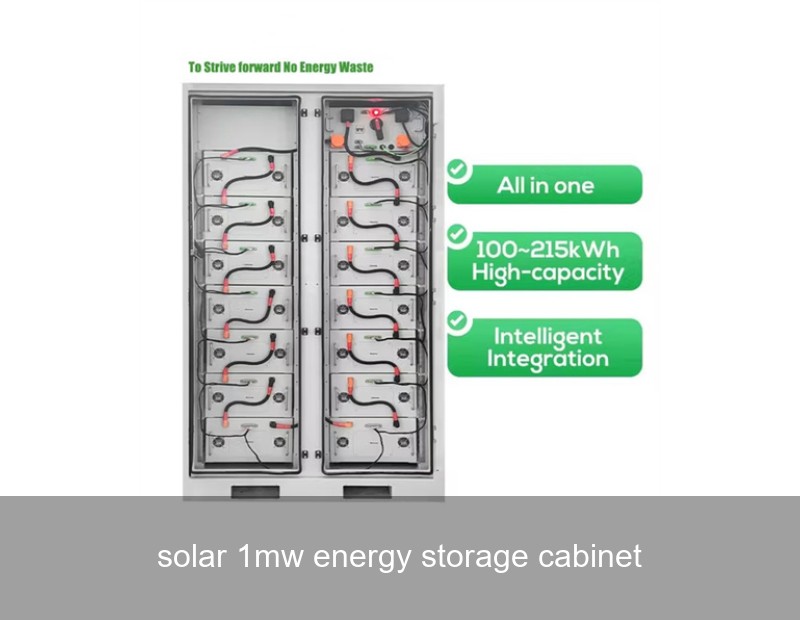
While often referred to as a "cabinet," a 1MW energy storage solution is typically a containerized or skid-mounted system. Let's break down its core components:
| Component | Function | Highjoule's Emphasis |
|---|---|---|
| Battery Racks (Li-ion NMC/LFP) | The core energy storage medium. Lithium Iron Phosphate (LFP) chemistry is increasingly preferred for its safety, longevity, and stability. | We utilize automotive-grade, UL-certified LFP cells for optimal cycle life and thermal safety, ensuring our cabinets meet the strictest international standards. |
| Power Conversion System (PCS) | The "brain" of power flow. This bi-directional inverter converts DC battery power to AC grid power and vice versa. | Our integrated PCS features advanced grid-forming capabilities, allowing the system to support microgrids and provide black-start functionality. |
| Battery Management System (BMS) | Continuously monitors cell voltage, temperature, and state of charge to ensure safety, balance, and longevity. | Highjoule's proprietary BMS employs predictive algorithms to prevent cell degradation, maximizing the system's operational lifespan. |
| Thermal Management | A critical safety system. Maintains optimal operating temperature for battery cells via liquid or air cooling. | Our cabinets feature an intelligent, liquid-based thermal management system that minimizes energy consumption for cooling while maintaining perfect cell conditions in climates from Arizona to Norway. |
| Energy Management System (EMS) | The top-level control software that decides when to charge or discharge based on market signals, weather forecasts, and site consumption. | The Highjoule OptiGrid AI platform is our cloud-based EMS. It autonomously optimizes dispatch strategies to maximize ROI, whether for arbitrage, peak shaving, or grid services. |
Case Study: A Real-World Powerhouse in Action
Let's move from theory to practice with a concrete example from Southern Europe. A mid-sized manufacturing plant in Spain, with a 2.5MW rooftop solar array, faced two issues: their solar production often exceeded their afternoon consumption (leading to curtailed energy), and they faced steep demand charges from a sharp evening power draw.
In 2023, they partnered with Highjoule to deploy a solar 1MW energy storage cabinet system configured with 2MWh of storage capacity (2 hours of discharge at full power). Here’s the impact, measured over one year:
- Self-Consumption Boost: Solar energy self-consumption increased from 68% to over 94%, drastically reducing grid import.
- Demand Charge Savings: By discharging the cabinet during their evening operational peak, they reduced their monthly peak demand by an average of 850kW. This translated to an annual savings of €72,000 on demand charges alone.
- Revenue from Grid Services: During weekends and plant holidays, the system participates in the Spanish grid's secondary frequency regulation market via the Highjoule OptiGrid AI platform, generating an additional €15,000 in annual revenue.
The project's payback period was calculated at under 6 years, with a clear 20+ year lifespan for the core components. This case exemplifies the multi-revenue stream model that modern 1MW energy storage enables.
Highjoule's Approach: Engineering for Performance and Longevity
At Highjoule, our philosophy is that a solar energy storage cabinet is a long-term infrastructure investment, not a commodity. Since 2005, we've engineered our systems with this principle in mind. Our 1MW+ solutions, like the HJ Megastack Series, are built for utility and large C&I applications.
What sets our approach apart is holistic integration. We don't just assemble components; we co-design the battery modules, BMS, PCS, and cooling systems to work in perfect harmony. This results in higher round-trip efficiency (often exceeding 92%) and dramatically reduced parasitic losses from thermal management. Furthermore, our systems are designed for future scalability. Starting with a 1MW/2MWh configuration? You can often add additional power and energy cabinets later as your needs evolve, protected by our scalable architecture and unified EMS.
Safety is non-negotiable. Our cabinets undergo rigorous testing beyond certification standards, including propagation testing and seismic certification for diverse geographies. This commitment to safety and quality is why our systems are trusted by partners from grid operators to industrial leaders seeking dependable, long-term storage assets.

Image: A technician monitoring a large-scale battery energy storage system interior. (Source: Unsplash)
The Future of Grid Stability Starts with Your Decision
The transition to a renewables-dominated grid is not a question of "if" but "how." The solar 1MW energy storage cabinet is proving to be one of the most pragmatic "how" solutions available today. It bridges the gap between clean energy ambition and operational reality, turning solar power from a variable resource into a strategic, revenue-generating asset.
For a facility manager, it's about taking control of energy costs and resilience. For a utility or developer, it's about providing essential stability and deferring costly grid upgrades. The technology is mature, the economics are compelling, and the need is clear.
Is your organization ready to explore how a tailored 1MW storage solution could transform your energy profile, lock in long-term savings, and contribute to a more stable grid? What is the single biggest energy challenge you're facing that a dispatchable power resource could solve?
 Inquiry
 Online Chat