


Solar Energies: How Much Power Can You Really Generate and Use?
So, you're thinking about solar panels. It's a smart move. But a crucial question quickly pops up: solar energies, how much? How much electricity will they actually produce? More importantly, how much of that clean power can your home or business use in real-time? The answer isn't just a number on a spec sheet. It's a dynamic equation involving sunlight, your energy habits, and a critical, often overlooked component: storage. Let's break down the real metrics of solar potential and how to maximize your return on every sunbeam.
Table of Contents
- The Phenomenon: From Sunlight to Socket
- The Data: Understanding "How Much" in Real Numbers
- The Storage Gap: Why Production ≠ Consumption
- Case Study: A German Bakery's Recipe for Energy Independence
- The Solution: Intelligent Storage for True Energy Autonomy
- How Highjoule Turns Solar Potential into Reliable Power
- Your Energy, Your Control: What's Your Next Step?
The Phenomenon: From Sunlight to Socket
Imagine your rooftop solar array as a sophisticated farm. Instead of crops, it harvests photons. The amount it "yields" depends on several factors: your geographic location (solar irradiance), roof angle and shading, panel efficiency, and, of course, the weather. While a system's peak power rating (e.g., 10 kW) is a useful benchmark, the real measure is annual energy output in kilowatt-hours (kWh). For instance, that same 10 kW system might produce 12,000 kWh in sunny Arizona but only 8,500 kWh in Germany. This variability is the first layer of the "how much" puzzle.

Image Source: Unsplash. A typical residential solar installation. The key question is how much of its output is directly usable.
The Data: Understanding "How Much" in Real Numbers
Let's get practical. According to the U.S. Department of Energy, the average American home consumes about 10,600 kWh per year. A properly sized residential solar system can often meet 70-90% of this demand. But here's the catch: solar production peaks in the middle of the day, while home energy consumption typically spikes in the early morning and evening. This creates a fundamental mismatch.
| Time of Day | Solar Production | Home Consumption | Result |
|---|---|---|---|
| 6-9 AM | Low/Rising | High (Wake-up, appliances) | Draw from Grid |
| 10 AM - 3 PM | Peak | Low (Home often empty) | Excess to Grid (Low Feed-in Tariff) |
| 6-10 PM | None | High (Cooking, lighting, TV) | Draw from Grid |
Without a way to capture the midday surplus, you're exporting valuable energy at low rates only to buy it back at high rates later. This dramatically impacts the financial and practical "how much" you benefit from your solar investment.
The Storage Gap: Why Production ≠ Consumption
This mismatch leads us to the core insight: Your solar system's true value is not measured by what it produces, but by what you can consume on your own terms. The goal is to maximize self-consumption – using your solar energy directly. This is where Battery Energy Storage Systems (BESS) become the game-changer. They bridge the temporal gap between production and demand, turning excess daytime generation into a reliable evening power source.
Key Benefits of Adding Storage:
- Increased Self-Consumption: Use 50-80%+ of your solar energy directly, slashing grid dependence.
- Backup Power: Maintain critical loads during grid outages, a growing concern in many regions.
- Grid Services: In some markets, advanced systems can participate in grid-balancing programs for additional revenue.
- Energy Bill Optimization: Avoid peak-time electricity charges by discharging stored energy.
Case Study: A German Bakery's Recipe for Energy Independence
Let's look at a real-world example from Bavaria, Germany. Bäckerei Schmidt (name changed for privacy) is a medium-sized artisan bakery with high energy demands for ovens, refrigeration, and lighting. Their 50 kWp rooftop solar system produced ample energy, but their operational schedule—starting production at 4 AM—meant they were buying most of their power from the grid at premium rates while exporting solar power at midday.
The Challenge: High grid consumption during early morning peaks, low self-consumption of solar energy.
The Solution: Installation of a integrated solar + storage system featuring a Highjoule HISE 50 commercial storage unit with 60 kWh capacity and intelligent energy management software.
The Data-Driven Outcome (12-month analysis):
- Self-Consumption Rate: Increased from 35% to 82%.
- Grid Energy Draw: Reduced by 68%.
- Energy Cost Savings: €8,400 annually, despite Germany's variable weather.
- ROI Period: Projected at under 7 years, with a system lifespan of 15+ years.
This case clearly shows that the question "solar energies, how much" was fundamentally transformed for the bakery. It was no longer about raw production kWh, but about how much they could control and utilize. The storage system turned their solar array from a partial solution into the cornerstone of their energy strategy.

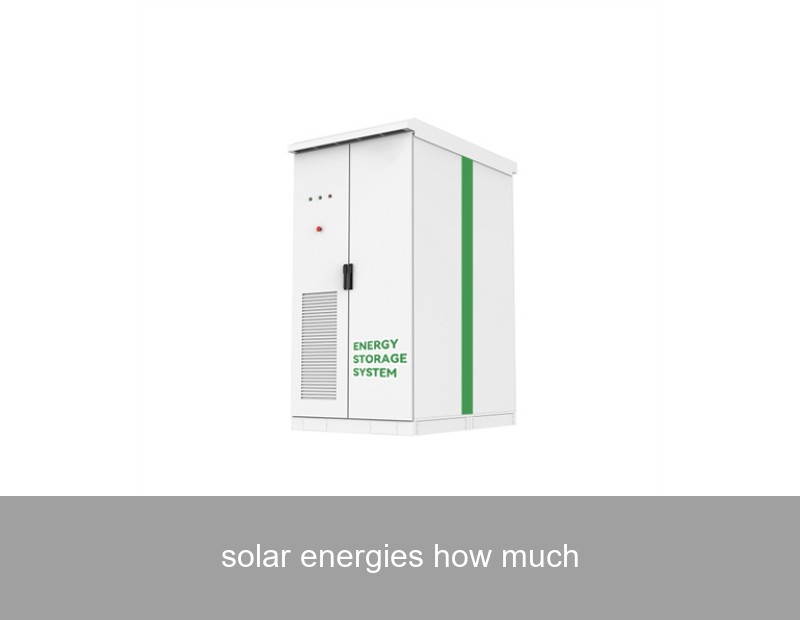
Image Source: Unsplash. A commercial battery energy storage system similar to solutions used in industrial applications.
The Solution: Intelligent Storage for True Energy Autonomy
Modern storage isn't just a "dumb" battery. It's an intelligent energy hub. The most effective systems, like those developed by Highjoule, integrate:
- Advanced Lithium-Ion Batteries: With high cycle life and depth of discharge for long-term value.
- Sophisticated Energy Management Systems (EMS): The "brain" that learns consumption patterns, predicts solar yield (using weather data), and optimizes charge/discharge cycles for maximum economic benefit.
- Grid-Interactive Capabilities: Safe, seamless integration with both solar inverters and the main grid.
- Scalable Architecture: Allowing capacity to be expanded as energy needs grow.
How Highjoule Turns Solar Potential into Reliable Power
Since 2005, Highjoule has been at the forefront of answering the real "solar energies, how much" question for our clients. We understand that every kilowatt-hour counts. Our product suite is designed to maximize the utility of every solar panel installed.
For residential clients, our HomePower series offers sleek, wall-mounted units with capacities from 10 to 20 kWh. They feature intuitive monitoring apps that show you exactly "how much" you're producing, storing, and saving in real-time, putting total energy control in the homeowner's hands.
For commercial and industrial (C&I) applications, our modular HISE (Highjoule Industrial Storage Engine) series scales from 30 kWh to multi-megawatt installations. These systems are engineered for the rigorous demand profiles of businesses, like the German bakery, ensuring process continuity and significant cost avoidance. For microgrids and utility-scale projects, our containerized MegaJoule solutions provide turnkey, grid-forming storage that stabilizes networks and enables higher penetration of renewables.
Our approach is holistic. We don't just sell hardware; we provide a complete energy resilience solution, including system design, commissioning, and ongoing performance monitoring through our cloud-based platform. This ensures our clients' storage assets perform optimally for their entire operational life, adapting to changing tariffs and energy needs.
Your Energy, Your Control: What's Your Next Step?
The journey to energy independence starts with a clearer question. Instead of just "how much will my solar panels produce?", ask: "How much of my energy bill can I eliminate? How much resilience can I gain for my home or business? How much can I contribute to a sustainable grid?"
The technology to answer these questions is here, proven, and economically viable. The next step is a personalized assessment. What does your unique energy profile look like? When are your peaks, and how does your solar production curve align? Are you ready to discover the true potential of your solar energy?
 Inquiry
 Online Chat