


Finding the Perfect Solar Panel 190W for Sale: A Smart Buyer's Guide
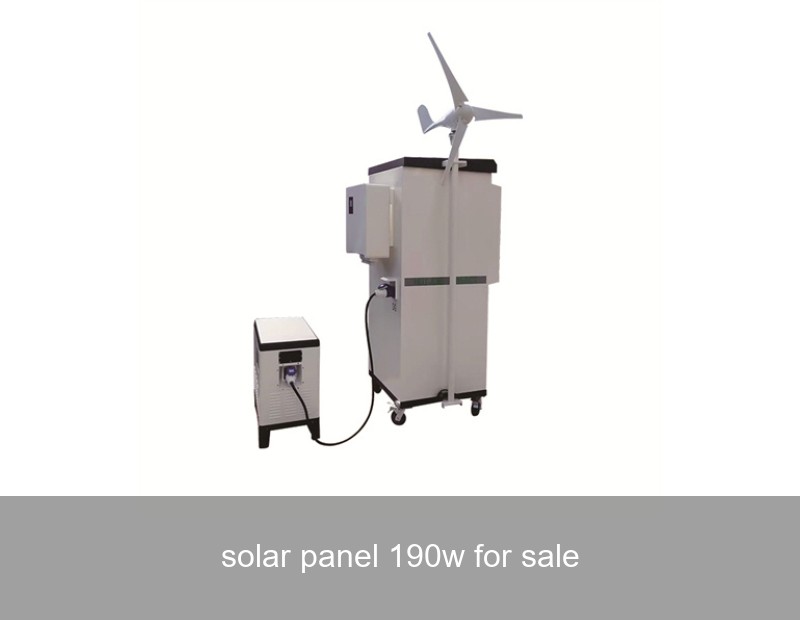
So, you're searching for a "solar panel 190W for sale." That's a specific and interesting choice. It often signals a savvy buyer looking to expand an existing array, power a specific off-grid application, or achieve a perfect fit for a limited space. But in today's vast solar market, is focusing solely on the wattage enough? This article will guide you through what a 190W panel truly offers, how it fits into modern energy systems, and the critical factors to consider beyond the price tag to ensure your investment delivers reliable, long-term power.
Table of Contents
What Does a 190W Solar Panel Really Mean Today?
A decade ago, a 190W solar panel was considered mainstream for residential use. Today, with panel efficiencies soaring, 190W typically falls into the range of compact or slightly older technology panels. You'll often find them in polycrystalline format or as smaller-format monocrystalline panels. They are frequently sold for specialized applications: as a precise upgrade to an older system built with similar wattage panels, for RVs and boats where size constraints are key, or for small off-grid setups like garden sheds or gate openers.
The crucial data point here is not just the nameplate wattage, but the panel's efficiency and dimensions. A modern 190W panel might be significantly smaller than a 190W panel from 2015. This is progress. When you see a "solar panel 190W for sale," immediately check its efficiency rating (now commonly 18-21% for standard panels) and its physical size to ensure it fits your available space.
Looking Beyond Wattage: The Real Factors That Matter
Focusing only on wattage is like buying a car based solely on horsepower. You need to understand the complete spec sheet. Here are the critical parameters to evaluate alongside that 190W rating:
- Cell Technology: Is it monocrystalline (higher efficiency, space-saving) or polycrystalline (often more cost-effective)?
- Tolerance: A +5% tolerance means your 190W panel could actually produce up to 199.5W under ideal conditions.
- Temperature Coefficient: This tells you how much power the panel loses as it heats up. A lower coefficient (e.g., -0.34%/°C vs. -0.41%/°C) means better performance on hot days.
- Durability: Look for certifications against hail, high wind loads, and potential-induced degradation (PID).

Image: Always inspect the specifications on the panel label, not just the advertised wattage. (Source: Unsplash)
The Modern Challenge: It's Not Just About the Panel
Here's the core insight for today's energy buyer: a solar panel by itself is just a component. Its true value is unlocked only when perfectly integrated with a high-quality balance of system (BOS). This includes charge controllers, inverters, and—most importantly—a battery storage system that captures and manages the power you generate.
Think about it. A 190W panel might produce beautiful, clean energy for 6 hours at peak sun. But without storage, that energy either gets used immediately or exported to the grid, often at a low rate. To maximize self-consumption and gain energy independence, you need an intelligent storage solution. This is where companies like Highjoule redefine the game. We don't just sell panels; we provide integrated, smart energy storage systems that turn solar generation into reliable, on-demand power. Our HES Series (Home Energy Storage) and C&I Battery Storage Systems are designed to seamlessly integrate with various solar inputs, optimizing every kilowatt-hour your panels produce, whether they're 190W or 400W each.
From Panel to Power: A Real-World Case Study
Let's look at a practical example from the German market, where self-consumption is a major driver. A small, family-run Gästehaus (guest house) in Bavaria had a south-facing roof space limited by historic architecture rules. They could only fit 12 panels of a specific, older 190W format to maintain aesthetic consistency. Their goal was to power their common areas and critical hotel systems, reducing grid dependence.
Phenomenon: The 2.28kW array (12 x 190W) produced enough energy, but its output was mismatched with the guest house's usage—high in the afternoon (when guests were out) and low in the mornings and evenings.
Data: Monitoring showed they were exporting over 60% of their solar generation and still drawing heavily from the grid during peak tariff hours.
Case & Solution: The owners integrated a Highjoule HES-10 modular battery system. This system didn't require replacing the existing panels. Instead, it took the DC power, managed it through Highjoule's intelligent energy management system (EMS), and stored the excess. The EMS learned the guest house's load patterns and optimized charging/discharging cycles.
Insight: Within a year, their self-consumption rate jumped from ~40% to over 85%, dramatically cutting their electricity bills. The 190W panels, once underutilized, became the reliable core of a resilient microgrid for the property. The key wasn't higher-wattage panels; it was intelligent storage and management.
Future-Proofing Your Solar Investment
Whether you're buying a few 190W panels or a hundred, think in terms of a system that can evolve. Can you easily add storage later? Is the inverter compatible with future battery tech? Highjoule's philosophy is built on this modularity. Our storage systems can be scaled over time, and our EMS software receives updates that continuously improve efficiency and grid interaction capabilities.
For commercial and industrial clients, this future-proofing is financial planning. A Highjoule C&I储能系统 not only provides backup power but can participate in demand charge management and grid services, creating new revenue streams. The solar panels—the generation assets—become significantly more valuable when coupled with such a dynamic storage solution.
| Component | Consideration for 190W Panel Buyers | Highjoule's Integrated Approach |
|---|---|---|
| Inverter / Charger | Must match panel VOC and system voltage. May be undersized for future expansion. | Provides scalable, hybrid inverters designed for easy integration of both solar and battery, with growth in mind. |
| Battery Storage | Often an afterthought, leading to compatibility issues. | The core offering. High-safety LiFePO4 batteries with built-in intelligence for optimal solar self-consumption. |
| Energy Management | Basic, if present at all. | Advanced EMS that learns consumption patterns, forecasts weather, and optimizes for cost or carbon savings. |

Image: A modern home energy setup combining solar generation with wall-mounted battery storage. (Source: Unsplash)
Your Energy, Your Decision: What's the Right Path?
Your search for a "solar panel 190W for sale" is the starting point of a more important journey: achieving true energy resilience. The right question may not be "Where can I find the cheapest 190W panel?" but rather "How can I build a system that makes the most of every watt I generate, today and in the future?"
We invite you to consider your ultimate goal. Is it simply to replace a broken panel, or is it to reduce your energy bills, secure backup power, and contribute to a sustainable grid? If it's the latter, how might your needs change in the next five years, and how will your energy system adapt? We're curious to hear what energy independence looks like for you.
 Inquiry
 Online Chat