


Powering Your Vision: The Ultimate Guide to Solar Panels for Cameras with Battery
Have you ever set up the perfect wildlife camera or security camera in a remote location, only to return weeks later to find it dead? Or perhaps you're a content creator who dreams of a truly off-grid live stream but are shackled by power cords. If this sounds familiar, you're facing a common modern dilemma: how to keep our always-on, always-watching devices powered where the grid ends. The solution is increasingly clear and sustainable: a dedicated solar panel for camera with battery. This isn't just about convenience; it's about unlocking permanent, renewable power for observation, security, and creativity. In this guide, we'll explore how this technology works, why it's a game-changer, and how the principles behind it are scaling to power entire homes and businesses.
Table of Contents
- The Power Problem: Why Cameras Go Offline
- How Solar-Powered Camera Kits Actually Work
- Key Components of a Robust System
- Real-World Case Study: Conservation in the Scottish Highlands
- Beyond the Camera: Lessons for Larger-Scale Energy Storage
- Choosing Your Solar Power System
The Power Problem: Why Cameras Go Offline
The core issue is simple: cameras, especially when recording video or transmitting data, are power-hungry. Traditional battery solutions—like disposable AA cells or even large rechargeable packs—require frequent, costly, and often disruptive maintenance visits. In harsh weather, batteries drain faster. This unreliability creates data gaps and security vulnerabilities. A solar panel for camera with battery solves this by creating a self-sustaining micro-power grid. The solar panel harvests energy during the day, the battery stores it for night and cloudy days, and the camera runs indefinitely. This principle of harvesting, storing, and intelligently managing renewable energy is the same one that powers entire off-grid homes and critical infrastructure—just on a smaller, more personal scale.
How Solar-Powered Camera Kits Actually Work
Think of it as a tiny, specialized power plant. It’s a closed-loop system with three main actors:
- The Solar Panel: Typically a small, durable monocrystalline or polycrystalline panel. It converts sunlight into direct current (DC) electricity.
- The Charge Controller: This is the brain. It regulates the voltage and current from the solar panel to safely charge the battery, preventing overcharging (which can damage batteries) and managing power flow.
- The Battery: The energy reservoir. It stores the solar-generated electricity for use when the sun isn't shining. For cameras, this is often a high-quality lithium-ion or lithium iron phosphate (LiFePO4) battery due to its long life, depth of discharge, and performance in temperature extremes.

Image Source: Unsplash - A solar panel providing autonomous power to a camera.
The elegance of this system is its simplicity and reliability. Once installed, it requires minimal intervention, providing peace of mind that your camera will keep recording. This reliability is paramount, whether you're monitoring a remote property or a sensitive ecosystem.
Key Components of a Robust System
Not all solar kits are created equal. The longevity and reliability of your setup depend on the quality of its core components.
| Component | What to Look For | Why It Matters |
|---|---|---|
| Solar Panel | High-efficiency cells, durable, weatherproof encapsulation, appropriate wattage (e.g., 10W-20W for a trail camera). | Determines how much energy you can harvest, especially in low-light winter months. |
| Battery | Lithium-based (LiFePO4 is excellent), sufficient capacity (measured in Amp-hours or Watt-hours), wide operating temperature range. | Defines your system's "uptime." A good battery ensures power through consecutive cloudy days. |
| Charge Controller | Maximum Power Point Tracking (MPPT) or high-quality Pulse Width Modulation (PWM). | MPPT controllers can be 20-30% more efficient, squeezing every bit of power from your panel, crucial in sub-optimal sunlight. |
These components mirror, in essence, the building blocks of the large-scale Battery Energy Storage Systems (BESS) that companies like Highjoule deploy for commercial and industrial sites. While the scale is different, the engineering principles—maximizing energy harvest, ensuring battery health and safety, and delivering reliable power—are directly transferable. Highjoule's expertise in integrating high-density lithium-ion batteries with intelligent energy management software for microgrids is the industrial-grade version of perfecting your camera's solar kit.
Real-World Case Study: Conservation in the Scottish Highlands
Let's look at a concrete example. The Woodland Trust in Scotland faced a challenge monitoring elusive pine martens across vast, treeless moorland restoration sites. Using traditional trail cameras with internal batteries required bi-weekly site visits, disturbing the area and consuming significant resources. In 2022, they deployed 15 camera stations equipped with robust 20W solar panels and external 12V/20Ah LiFePO4 battery packs.
The results were transformative:
- Uptime Increased from ~70% to 99.5%: Cameras stopped failing due to dead batteries.
- Site Visits Reduced by 80%: Staff only visited to collect SD cards or reposition cameras, saving hundreds of hours annually.
- Data Quality Soared: Continuous operation provided complete seasonal activity data, proving crucial for securing further conservation funding.
This case shows that the right solar panel for camera with battery system isn't an expense; it's an investment that yields better data, lower operational costs, and greater mission success. It's a microcosm of what businesses achieve when they invest in professional-grade solar-plus-storage: operational resilience and long-term savings.
Beyond the Camera: Lessons for Larger-Scale Energy Storage
The logic behind powering a camera indefinitely is the same logic driving the global transition to renewable energy. The sun doesn't always shine, and the wind doesn't always blow—so we need storage. This is where the expertise of a company like Highjoule becomes critical. Founded in 2005, Highjoule is a global leader in providing advanced, intelligent energy storage solutions. While we don't make small camera kits, the core technology is related.
Highjoule's commercial and residential battery systems, like the Highjoule H-Series, take the same concept—pairing high-efficiency solar with sophisticated battery storage—and scale it to power businesses, factories, and homes. Our systems use advanced lithium-ion battery racks managed by proprietary software that optimizes energy flow, much like the charge controller in your camera kit, but for an entire building's energy needs. For a farm in California using irrigation cameras or a European factory with extensive security monitoring, the principle is identical: ensure critical devices and operations never go offline by creating a resilient, renewable power ecosystem.

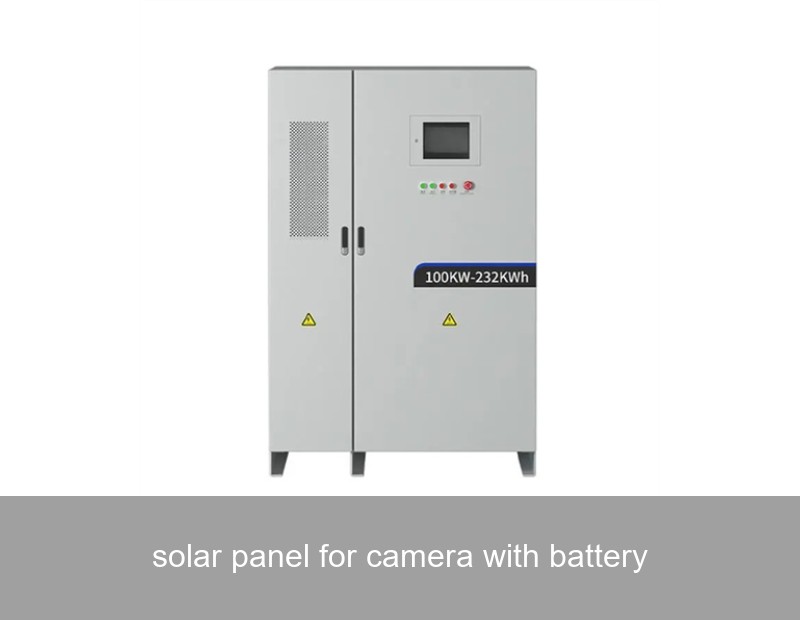
Image Source: Unsplash - A commercial battery energy storage system.
Choosing Your Solar Power System
Whether you're powering a single camera or considering storage for your home, ask these questions:
- What is my continuous power load? (For a camera: voltage, average current draw. For a home: review your energy bill).
- How many days of autonomy do I need? (How many cloudy days in a row must the battery support?).
- What are the environmental conditions? (Extreme heat, cold, or moisture demand higher-quality components).
- Is the system intelligently managed? (Does it protect battery health and optimize efficiency?).
For your camera, investing in a kit with a quality LiFePO4 battery and an MPPT controller is the equivalent of choosing a professional-grade solution. For larger needs, partnering with an experienced provider like Highjoule ensures you get a system designed for safety, longevity, and maximum return on investment, backed by nearly two decades of innovation in the field.
What's the next device or system in your life that could benefit from becoming energy-independent?
Whether it's the camera guarding your remote cabin, the sensors in your agricultural field, or the entire energy profile of your business, the move to solar-plus-storage is a step toward resilience and sustainability. The technology is proven, from the smallest scale to the largest. The question is no longer "if" it works, but "how" you can implement it most effectively for your specific needs.
 Inquiry
 Online Chat