


How to Efficiently Use Solar Panels to Charge a 200Ah Battery: A Complete Guide
So, you've got a 200Ah battery—maybe for your RV, boat, off-grid cabin, or backup power system. And you're looking to harness the sun to keep it charged. The question on your mind is likely: "How many solar panels do I actually need to charge a 200Ah battery, and how do I make the system reliable?" It's a fantastic move towards energy independence, but the journey from sunlight to stored power involves more than just connecting a panel to a battery. Let's demystify the process, explore the key components, and ensure your setup is efficient, safe, and built to last for years.
Understanding the Basics: Your 200Ah Battery and Solar Power
First, let's clarify what a 200Ah (Amp-hour) rating means. In simple terms, it tells you the battery's capacity. A 200Ah battery can theoretically deliver 200 amps for one hour, or 10 amps for 20 hours, before it's considered fully discharged. However, for battery health—especially with lead-acid or lithium-ion batteries—you should avoid deep discharges. Most experts recommend not using more than 50% of a lead-acid battery's capacity and up to 80-90% for Lithium Iron Phosphate (LiFePO4) batteries.
This is where solar panels come in. Their job is to replenish the energy you use. The key metric for panels is their wattage. To charge a battery, you need a charge controller that manages the power flow. Think of it this way: the solar panel is the water source, the charge controller is the regulated faucet, and the battery is the storage tank. You need the right flow rate to fill the tank efficiently without overflowing or damaging it.

Image: Solar panels are the engine of your charging system. (Photo by American Public Power Association on Unsplash)
Calculating Your Solar Panel Needs
Let's get practical. How many watts of solar do you need to charge a 200Ah battery? We'll use a common 12V battery system for this example.
- Determine Usable Battery Capacity: For a 12V 200Ah lead-acid battery (at 50% Depth of Discharge), usable energy = 12V x (200Ah x 0.5) = 1200 Watt-hours (Wh). For a LiFePO4 battery (at 80% DoD), it's 12V x (200Ah x 0.8) = 1920 Wh.
- Account for Recharge Time: Do you want to recharge in one full sun day? A common target is 5 hours of equivalent peak sunlight (this varies greatly by location—Global Solar Atlas is a great resource).
- Calculate Solar Array Size: Required solar power (in watts) = Usable Wh ÷ Peak Sun Hours. For our lead-acid example: 1200 Wh ÷ 5 h = 240 Watts. For LiFePO4: 1920 Wh ÷ 5 h = 384 Watts.
- Add Efficiency Losses: Real-world losses (dirt, temperature, wiring, controller efficiency) can be 20-30%. So, for the 384W need, a 480W to 500W solar array is a safe, effective target.
Therefore, to reliably charge a 200ah battery from empty to full in a day, you're typically looking at a 400W to 500W solar panel system. This could be one large panel or two to three smaller ones wired together.
Beyond the Panels: The Crucial System Components
Panels are just the start. A robust system has four core parts:
- Solar Panels: Monocrystalline panels are preferred for their higher efficiency, especially in limited space.
- Charge Controller: This is the brain. A Maximum Power Point Tracking (MPPT) controller is vastly superior to a PWM type for this application. It can increase charging efficiency by up to 30% by optimizing the voltage match between panels and battery.
- The Battery: The 200Ah storage unit. Lithium-ion (like LiFePO4) is becoming the standard for solar storage due to longer lifespan, faster charging, greater depth of discharge, and no maintenance.
- Inverter (if needed): To power standard AC appliances (like TVs, kitchen tools), you'll need an inverter to convert the battery's DC power to AC.
| Component | Key Consideration | Recommendation for a 200Ah System |
|---|---|---|
| Solar Panels | Efficiency & Space | 400-500W total, Monocrystalline |
| Charge Controller | Type | MPPT (e.g., 40A-50A rating for 500W/12V) |
| Battery | Chemistry | LiFePO4 for longevity, Lead-Acid for budget |
| Inverter | Continuous Power Rating | Size based on your AC load (e.g., 2000W-3000W) |
A Real-World Case Study: Off-Grid Living in the Scottish Highlands
Let's look at a concrete example. A couple in a remote part of the Scottish Highlands needed a reliable power system for their year-round off-grid home. Their primary load included a water pump, LED lighting, a refrigerator, and occasional use of a laptop and power tools. They started with a 200Ah lead-acid battery bank and a 300W solar array.
The Problem: During the long, cloudy winter months, they consistently faced energy deficits. The 300W array couldn't fully recharge the batteries on most days, leading to chronic undercharging, battery sulfation, and a shortened battery lifespan of just 2 years.
The Solution & Data: They upgraded their system based on a professional audit:
- Solar Array: Increased from 300W to 600W (two additional 300W panels).
- Charge Controller: Upgraded to a 60A MPPT controller.
- Battery Bank: Replaced with a 200Ah LiFePO4 battery (like those in Highjoule's Residential Energy Storage line), utilizing its 90% usable capacity.
The Result: Post-upgrade monitoring over a year showed a 70% reduction in "zero-sun" days where batteries fell below critical charge. Even in December, with an average of 1.5 peak sun hours, the system generated enough to cover their base loads. The LiFePO4 battery's performance remained stable, with an expected lifespan of over 10 years. This case highlights that oversizing your solar array by 20-30% above theoretical calculations is a wise investment for reliability, particularly in less sunny climates like Northern Europe or the Pacific Northwest of the US. You can explore more on climate-specific solar design from the U.S. Department of Energy.
Highjoule's Smart Solutions for Solar Charging
As a global leader in advanced energy storage since 2005, Highjoule understands that a system is more than the sum of its parts. Our products are designed to seamlessly integrate, taking the guesswork out of using solar panels to charge a 200ah battery.
For residential and small commercial applications, our HJS-LiFE Series batteries are the perfect match. A single 12V 200Ah LiFePO4 unit provides the full, safe usable capacity we calculated earlier. They come with integrated Battery Management Systems (BMS) for protection and can be easily paralleled for more capacity.
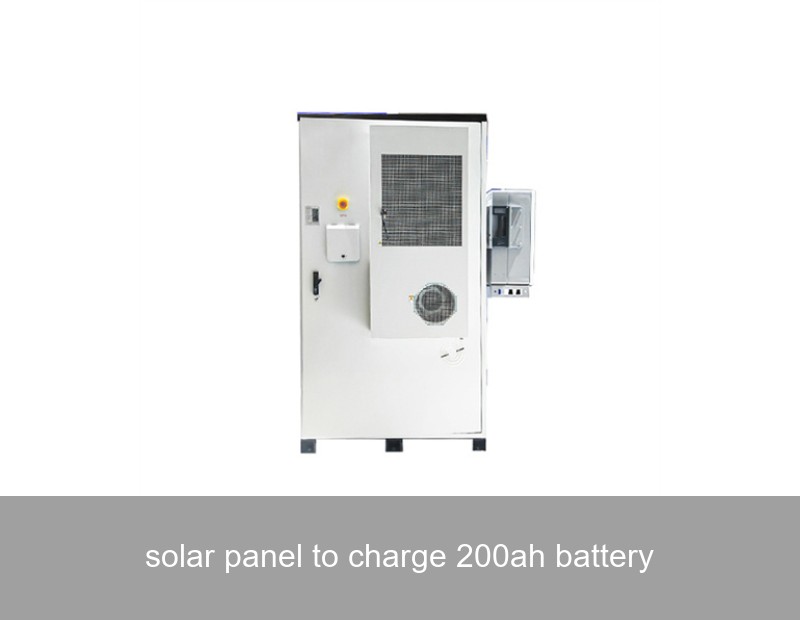
But we go further. Our Smart Hybrid Inverter-Chargers combine an MPPT solar charge controller, a high-efficiency inverter, and a grid/generator charger in one unit. This means you have a single, intelligent device managing all power flows: from solar to battery, from battery to your appliances, and even from the grid as a backup. For microgrid and larger industrial applications, our containerized Battery Energy Storage Systems (BESS) offer scalable, turnkey solutions. The goal is to provide not just hardware, but a complete, intelligent, and sustainable power solution that maximizes your return on investment and energy independence.

Image: Integrated systems simplify installation and management. (Photo by Kindel Media on Pexels)
Pro Tips for Installation and Maintenance
Installation Do's and Don'ts:
- Do angle your panels correctly (aim for latitude angle as a starting point).
- Do use proper gauge wiring to minimize voltage drop between panels and controller.
- Don't skimp on fuses and circuit breakers—safety is paramount.
- Do place your battery in a temperate, dry, and ventilated location.
Long-Term Health:
Regularly clean your panels. Dust and grime can reduce output by 10-15%. Monitor your system's performance—many modern charge controllers and inverters have Bluetooth apps. For lithium batteries, this is mostly about checking state of charge and ensuring the system is functioning; they require almost no maintenance compared to lead-acid.
Designing a system to charge a 200ah battery with solar power is an empowering project. By understanding your energy needs, sizing your components correctly, and choosing integrated, high-quality products like those from Highjoule, you can build a system that delivers clean, reliable power for decades. What's the first application you're planning to power with your solar-charged 200Ah battery?
 Inquiry
 Online Chat