


Unlocking Maximum Power: The Ultimate Guide to Solar Panels High Wattage
Have you noticed the solar panels on rooftops getting larger, yet sleeker? Or that commercial solar farms seem to be generating more power from the same patch of land? This isn't an illusion—it's the direct result of the industry's relentless push towards solar panels high wattage. For homeowners and businesses across Europe and the U.S., this evolution isn't just about technical specs; it's about achieving greater energy independence, maximizing return on investment, and accelerating the clean energy transition. But what's driving this shift to higher-wattage modules, and how can you ensure your system is truly optimized to harness this power? Let's dive in.
Table of Contents
- The Wattage Revolution: From Silicon to System
- Data Don't Lie: The Tangible Benefits of High-Wattage Panels
- Case Study: A Bavarian Dairy Farm's High-Power Turnaround
- The Storage Imperative: Why Your High-Wattage Array Needs a Smart Battery
- Future Horizons: What's Next for Solar Panel Efficiency?
- Your Energy Journey: Where Do You Go From Here?
The Wattage Revolution: From Silicon to System
Gone are the days when a 250-watt panel was the standard. Today, premium solar panels high wattage routinely exceed 400W for residential use, with commercial panels pushing past 600W and even 700W. This leap isn't magic; it's a confluence of advanced engineering. Key innovations include:
- Larger Wafer Sizes: The move from M2 to M6, M10, and now G12 (210mm) wafers creates a larger surface area for capturing sunlight, directly boosting power output.
- Cell Technology: The widespread adoption of monocrystalline PERC (Passivated Emitter and Rear Cell) cells increases light absorption and reduces electron recombination. Now, technologies like TOPCon (Tunnel Oxide Passivated Contact) and HJT (Heterojunction) are pushing efficiencies even further, often above 22%.
- Denser Packing & Shingling: Techniques like half-cut cells and shingled layouts reduce electrical resistance and minimize the impact of shading, allowing more of the panel's surface to be actively generating power.
But here's the crucial insight many miss: a high-wattage panel is only as good as the system it's integrated into. Imagine installing a Formula 1 engine in a car with a weak transmission and tiny fuel tank. You won't see its full potential. Similarly, pairing ultra-high-wattage panels with an outdated inverter or no energy storage is a missed opportunity. This is where system-level thinking, championed by companies like Highjoule, becomes critical.
Data Don't Lie: The Tangible Benefits of High-Wattage Panels
Why should you care about wattage ratings? The benefits translate into real-world advantages for your wallet and your energy footprint.
| Benefit | Explanation | Practical Impact |
|---|---|---|
| Higher Energy Yield per Roof | More watts per panel means you need fewer panels to meet your energy target. | Maximizes constrained roof space, ideal for urban homes or commercial buildings with limited area. |
| Reduced Balance of System (BOS) Costs | Fewer panels mean less racking, fewer connectors, and potentially lower labor installation time. | Can lower the overall cost per installed watt, improving your system's ROI. |
| Improved Aesthetics | A cleaner, less cluttered rooftop with fewer, more powerful panels. | Eases planning permission in sensitive areas and maintains property aesthetics. |
| Enhanced Performance in Low Light | Advanced cell technologies in high-wattage panels often perform better in dawn, dusk, and cloudy conditions. | Generates more usable energy throughout the day and across seasons, not just at peak sun. |
According to the National Renewable Energy Laboratory (NREL), the average efficiency of commercial modules has risen from around 15% to over 20% in the last decade, a key driver behind rising wattages. This means a modern 400W panel might produce the same annual energy as nearly thirty 250W panels from a decade ago.

Image: Modern high-wattage solar panels offer a sleek, efficient profile. (Source: Unsplash)
Case Study: A Bavarian Dairy Farm's High-Power Turnaround
Let's look at a real example. The Schmidt Family Dairy in southern Bavaria, Germany, faced rising operational costs and a corporate sustainability mandate from their buyer. Their existing 100kW system, using older 280W panels, couldn't cover their 24/7 cooling and milking operations.
The Challenge: Limited barn roof space, high and variable energy consumption, and the need for reliable backup power.
The Solution: In 2023, they partnered with Highjoule for a complete system redesign. The old array was replaced with 240 of Highjoule's recommended 425W bifacial monocrystalline panels (TOPCon technology), creating a new 102kW peak array on the same roof footprint. The true game-changer, however, was the integration with a Highjoule HPS-150 commercial battery energy storage system (BESS).
The Results (12-month period):
- Annual Generation Increase: 142,000 kWh vs. previous 98,000 kWh (a ~45% increase due to higher efficiency and better low-light performance).
- Self-Consumption Rate: Jumped from 35% to 92% with the intelligent battery storage buffering excess daytime production for use at night.
- Grid Dependence Reduction: The farm now operates as a grid-assisted microgrid, surviving nightly operations and short grid outages seamlessly.
- Payback Period: Projected to be under 7 years, thanks to German KfW subsidies for storage and drastically reduced peak-time grid purchases.
This case highlights that the value of solar panels high wattage is fully realized when paired with intelligent storage. The panels generate more potent "fuel," but the BESS ensures not a single kilowatt-hour is wasted.
The Storage Imperative: Why Your High-Wattage Array Needs a Smart Battery
This leads us to the most critical point in modern solar design. High-wattage panels can produce a massive surge of power in the middle of the day—often more than a home or business can immediately use. Without storage, this surplus is sold back to the grid at low rates (or may even be curtailed).
Highjoule's approach is to view storage not as an add-on, but as the intelligent core of the energy system. Our EcoCell Home and HPS Series commercial batteries are designed specifically to handle the high-input currents from modern, high-wattage arrays. They feature:
- High Round-Trip Efficiency (RTE): Exceeding 96%, meaning almost all the precious solar energy you capture is available for use.
- Advanced Battery Management Systems (BMS): Ensures safety, longevity (with warranties often extending to 10+ years), and optimal performance in diverse climates from Arizona heat to Scandinavian winters.
- Grid Services & Peak Shaving: For commercial clients, our systems can be configured to reduce demand charges—a huge portion of energy bills—by discharging the battery during periods of peak grid demand.

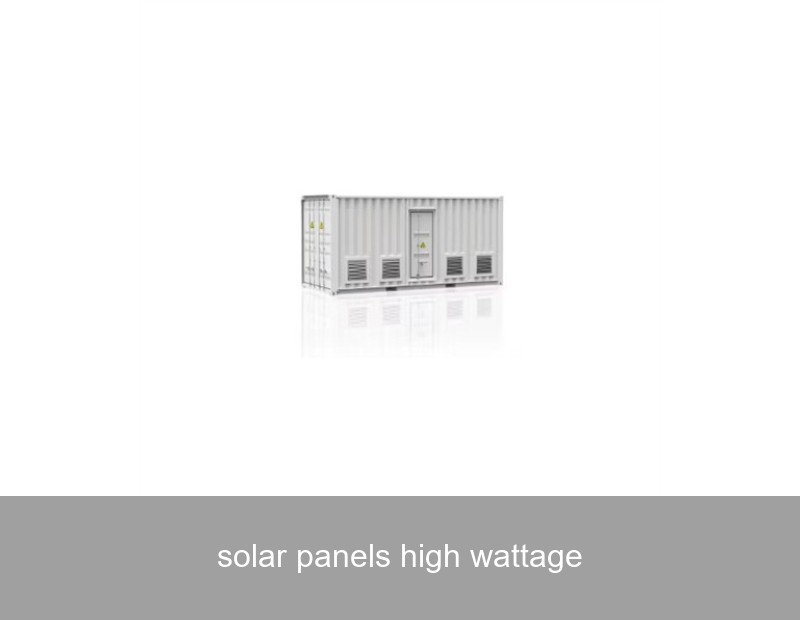
Image: A commercial-scale battery storage system, like Highjoule's HPS Series, is key to managing high solar output. (Source: Unsplash)
Future Horizons: What's Next for Solar Panel Efficiency?
The race for higher wattage continues. Perovskite-silicon tandem cells, which layer a perovskite film on top of traditional silicon, have achieved laboratory efficiencies over 33%, as reported by sources like ScienceDaily. While commercial availability is still on the horizon, it promises another significant leap.
However, the future isn't just about the panel. It's about the smart, integrated energy ecosystem. At Highjoule, we are pioneering AI-driven energy management platforms that connect your high-wattage solar array, battery storage, EV charger, and even home appliances into a single, autonomous system. This platform learns your usage patterns, weather forecasts, and electricity tariffs to make real-time decisions that maximize your savings and comfort.
Your Energy Journey: Where Do You Go From Here?
Choosing solar panels high wattage is a fantastic first step towards energy resilience. But the most important question to ask your installer isn't just about panel brand or wattage. It's this: "How will you design a complete system—panels, inverter, and especially storage—to ensure I capture, store, and use every possible kilowatt-hour my roof can produce?"
Are you ready to explore what a truly optimized, high-wattage solar-plus-storage system could do for your energy bills and your carbon footprint?
 Inquiry
 Online Chat