


Solar Power AC: How Much Can Your System Really Generate and Save?
You've seen the solar panels gleaming on rooftops and heard the promises of slashed electricity bills. But when you dig into the details, one question stands out: solar power AC how much? How much energy can a system actually produce for your air conditioning, and crucially, how much can it save you? The answer isn't a simple number. It's a fascinating interplay of technology, environment, and smart energy management. As a global leader in advanced energy storage since 2005, Highjoule helps homeowners and businesses worldwide move beyond guesswork to precise, reliable solar-powered comfort and savings.
Table of Contents
The Core Question: From DC Sunlight to AC Cool Air
Let's clarify the "AC" in your question. Your solar panels generate Direct Current (DC) electricity. Your home, your air conditioner, and the grid operate on Alternating Current (AC). The critical component bridging this gap is the inverter. Its efficiency is the first key to answering "solar power AC how much." A top-tier inverter might convert 98% of the DC power to usable AC, while an older model might only achieve 94%. That difference directly impacts the cool air flowing from your vents.
But the inverter is just the start. The real output of your solar AC system is dictated by a formula where several variables are constantly changing: sunlight intensity, panel orientation and tilt, temperature, shading, and system health. A system rated at 6 kW DC might, on a perfect day, deliver around 5 kW AC after conversion losses. Over a year, its production is measured in kilowatt-hours (kWh), the same unit on your utility bill.
Key Factors Determining Your Solar AC Output
To move from a vague estimate to a reliable forecast, you must consider these pillars:
- System Size (DC Rating): Measured in kilowatts-peak (kWp), this is the "engine size." A typical residential system in the U.S. ranges from 6 to 12 kWp.
- Location & Solar Irradiance: A roof in Arizona will inherently produce more kWh per kWp than one in Washington state. Tools like NREL's PVWatts Calculator use historical weather data to model this.
- Roof Characteristics: South-facing (in the Northern Hemisphere) with a 30-degree tilt is often ideal. Shade from trees or chimneys can drastically reduce output.
- Inverter Efficiency: As mentioned, this is your conversion gatekeeper. Modern string and microinverters aim for efficiencies above 97%.
- Air Conditioner Efficiency: Your AC's Seasonal Energy Efficiency Ratio (SEER) is crucial. A modern SEER 16 unit uses significantly less power than an old SEER 10 model to deliver the same cooling.

Image source: Unsplash. A well-installed rooftop solar system with a visible inverter, the heart of DC-to-AC conversion.
A Real-World Case: The Berlin Bakery
Let's ground this in data. A medium-sized artisan bakery in Berlin, Germany, faced crippling energy costs, especially in summer when production heat demanded constant air conditioning. They installed a 50 kWp rooftop solar array.
| Metric | Value | Note |
|---|---|---|
| Annual Solar Generation | 48,500 kWh AC | Modeled using local irradiance data |
| Summer AC Consumption | 28,000 kWh | Measured from previous bills |
| % of Summer AC Covered by Solar | ~65% | Direct self-consumption during daylight |
| Annual Electricity Bill Savings | €9,200 | At a blended rate of €0.19/kWh |
The bakery's story reveals a critical insight: solar production and AC demand are often perfectly aligned. The sunniest, hottest parts of the day are precisely when your AC works hardest. This maximizes "self-consumption" – using your solar power directly – which is more valuable than exporting it to the grid in many regions with lower feed-in tariffs. However, the bakery still exported excess power in spring/fall and drew from the grid at night. This leads us to the next evolutionary step.
Beyond the Inverter: The Game-Changing Role of Storage
So, you're covering 601-70% of your AC use with solar. What about the other 30-40%? What about cooling your home after sunset during a heatwave? This is where the equation transforms from "solar power AC how much" to "solar power AC how much, and when?"
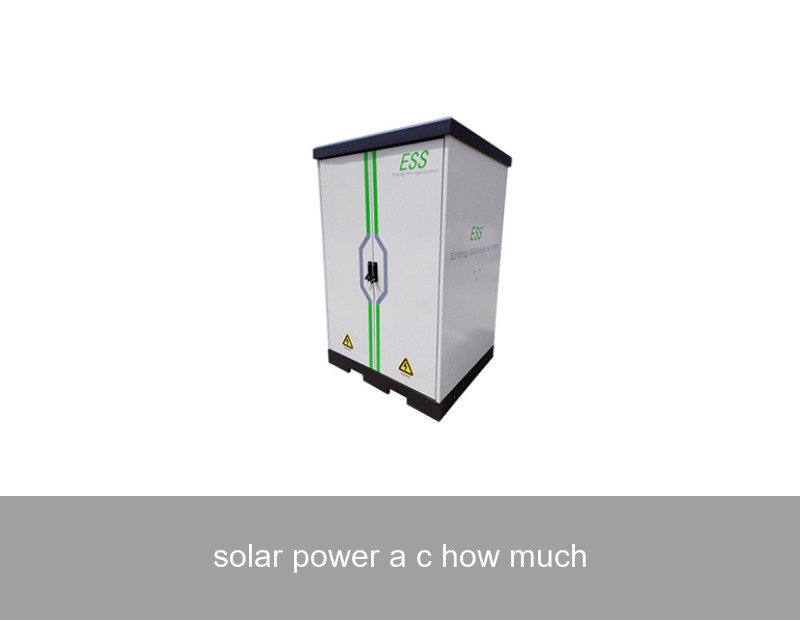
A battery energy storage system (BESS) is the missing link. It stores your daytime solar surplus and releases it exactly when you need it—during peak evening hours, during grid outages, or when electricity rates are highest. This is the cornerstone of true energy independence and maximized savings.

Image source: Unsplash. A compact, modern home battery system enabling energy storage for use anytime.
Calculating Your Potential Savings
Savings come from two main avenues: reducing grid purchases and avoiding peak demand charges (critical for businesses). Let's create a simplified framework:
- Step 1: Use a tool like PVWatts to estimate your annual solar AC production (kWh).
- Step 2: Analyze your utility bill. Note your cost per kWh and your summer monthly consumption.
- Step 3: Estimate your self-consumption rate (typically 30-50% without a battery, 60-80%+ with a battery).
- Step 4: Multiply your self-consumed solar kWh by your electricity rate. This is your direct saving.
For a more granular view, consider that according to the U.S. Energy Information Administration, the average U.S. residential electricity rate has risen consistently. Locking in a lower solar cost today hedges against future increases, amplifying long-term savings.
The Highjoule Solution: Intelligent, Integrated Power
Understanding "solar power AC how much" is the first step. Optimizing it for your unique needs is the next. This is where Highjoule's expertise comes into play. We don't just provide components; we deliver integrated, intelligent energy systems.
Our HPS Series residential and commercial battery storage systems are designed with this exact solar-AC synergy in mind. Featuring high-cyclerated lithium iron phosphate (LFP) cells for safety and longevity, our batteries integrate seamlessly with new or existing solar arrays. Coupled with our advanced Energy Management System (EMS), the Highjoule solution intelligently decides when to store solar energy, when to power your home, and when to draw from the grid, ensuring your AC runs on the cleanest, most cost-effective power available 24/7.
For larger commercial and microgrid applications, our GridSynk platform allows for sophisticated control, enabling businesses to not only save but also participate in grid services, turning a cost center into a potential revenue stream. By managing the peak demand spikes caused by large HVAC systems, we've helped clients like the Berlin bakery reduce their demand charges by over 40% on top of their solar savings.
Ready to Get a Precise Answer for Your Home or Business?
The journey to understanding your true solar potential for cooling and beyond begins with a detailed assessment. What is your current AC consumption during the summer months, and how does your utility's rate structure affect your bill?
 Inquiry
 Online Chat