


Understanding the Kosten of a 1000 kWh Stromspeicher: Investment, Value, and Future-Proofing
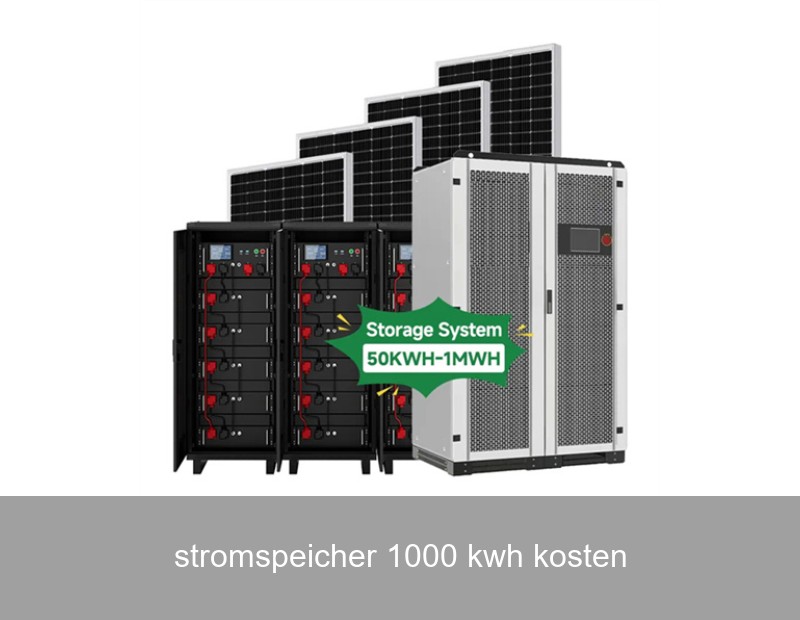
If you're exploring large-scale energy independence for your business, industrial facility, or community microgrid, you've likely encountered a key figure: a 1000 kWh battery storage system. The central question, of course, revolves around the stromspeicher 1000 kwh kosten. It's a significant consideration, but framing it solely as an expense misses the broader picture. This investment is fundamentally about energy security, operational predictability, and accelerating your sustainability goals. Let's demystify the costs, the factors that influence them, and the tangible return on investment such a system delivers.
Table of Contents
- The Cost Breakdown: What Makes Up a 1000 kWh System Price?
- Key Factors Influencing Your Final Investment
- Value Beyond the Price Tag: The PAS Framework (Phenomenon, Analysis, Solution)
- A Real-World Case Study: Data from a German Industrial Application
- The Highjoule Approach: Engineering Systems for Total Cost of Ownership
- Is a 1000 kWh System the Right Next Step for Your Energy Strategy?
The Cost Breakdown: What Makes Up a 1000 kWh System Price?
When discussing the kosten for a 1000 kwh stromspeicher, it's crucial to understand you're not just buying a battery. You're investing in a sophisticated, integrated energy system. The total cost typically encompasses several core components:
- Battery Cells & Modules (The Core Energy Bank): This is the largest cost segment, representing the lithium-ion (or other chemistry) cells that store the energy. Prices vary based on chemistry (LFP is popular for its safety and longevity), brand, and energy density.
- Battery Management System (BMS - The Brain): A critical component that ensures safety, monitors cell health, balances charge, and maximizes lifespan. A high-quality BMS is non-negotiable for a system of this scale.
- Power Conversion System (PCS - The Interpreter): This includes inverters and transformers that convert DC electricity from the batteries to AC for your facility and vice versa. Its power rating (in kW) determines how much energy you can use or charge at any given moment.
- Thermal Management System (The Climate Control): Essential for maintaining optimal battery temperature, this system (liquid or air-cooled) ensures efficiency, safety, and extends cycle life, especially important in variable climates across Europe and the US.
- System Integration, Software, & Controls: The "intelligence" layer. This includes system integration, energy management software (EMS), and often a gateway for monitoring and control. This software is what turns raw storage into a smart, revenue- or savings-generating asset.
- Installation, Civil Works & Grid Connection: Costs for site preparation, cabling, safety enclosures, and professional installation by certified engineers. For a 1000 kWh system, this is a substantial project requiring expert planning.
Key Factors Influencing Your Final Investment
Why can quotes for a "1000 kWh system" vary so widely? Several factors are at play:
| Factor | Impact on Cost & Performance |
|---|---|
| System Chemistry | Lithium Iron Phosphate (LFP) may have a higher upfront cost than some NMC variants but offers longer lifespan and superior safety, reducing TCO. |
| Inverter Power Rating | A 1000 kWh battery paired with a 500 kW inverter delivers energy slower than one with a 1000 kW inverter. Higher power output increases cost but provides greater flexibility. |
| Depth of Discharge (DoD) & Cycle Life | A battery rated for 6,000 cycles at 90% DoD offers more usable energy over its life than one rated for 4,000 cycles at 80% DoD, impacting long-term value. |
| Integration Complexity | Standalone systems are simpler. Integrating with existing solar, wind, or building management systems adds complexity but also unlocks greater synergies. |
| Local Regulations & Grid Fees | Permitting, grid interconnection studies, and specific safety standards in your region (e.g., VDE in Europe, UL in the US) can affect project costs. |
Value Beyond the Price Tag: The PAS Framework (Phenomenon, Analysis, Solution)
Let's analyze the decision through a structured lens: Phenomenon, Analysis, Solution.
Phenomenon: Rising and Unpredictable Energy Costs
Businesses and industries on both sides of the Atlantic are experiencing volatile electricity prices and an increasing frequency of grid instability events. This isn't just an invoice line item; it's a direct risk to operational continuity and financial forecasting.
Analysis: The Data Behind Self-Consumption and Grid Services
The financial rationale for a large-scale storage system is built on multiple revenue and savings streams. According to analysis by the International Renewable Energy Agency (IRENA), the levelized cost of electricity from battery storage has fallen dramatically, making it competitive with peak-time grid power. For a 1000 kWh system, the key value drivers are:
- Peak Shaving: Drawing from the battery during expensive peak-demand periods, drastically reducing demand charges from utilities—a major cost for commercial/industrial users.
- Increased Self-Consumption: Storing excess solar or wind energy for use when generation is low, maximizing your on-site renewable investment.
- Backup Power: Providing critical uptime for essential loads during grid outages.
- Frequency Regulation (in some markets): Providing grid-stabilization services for additional revenue.
The question shifts from "What does it cost?" to "What is the payback period and net present value?"

Solution: A Tailored, Intelligent Storage System
The solution is a system designed not just for capacity, but for intelligent energy arbitrage and control. This is where partnering with an experienced provider makes all the difference.
A Real-World Case Study: Data from a German Industrial Application
Consider a concrete example from our work at Highjoule. A mid-sized manufacturing plant in Bavaria, Germany, faced annual electricity costs exceeding €450,000, with nearly 40% attributed to peak demand charges. Their existing 800 kWp rooftop solar system was often curtailed during midday weekends.
The Highjoule Solution: We deployed a integrated 1050 kWh / 550 kW LFP battery storage system, coupled with our proprietary Adaptive Energy Manager (AEM) software.
The Data-Driven Outcome (First 12 Months):
- Demand Charge Reduction: Peak grid draw was reduced by 65%, saving over €110,000 annually on demand charges alone.
- Solar Self-Consumption Increase: Raised from 68% to 92%, effectively utilizing previously wasted solar generation.
- Overall Cost Savings: Total electricity costs reduced by approximately 28%.
- ROI Timeline: Based on these savings and considering available federal investment incentives (like those in the US Inflation Reduction Act or German support programs), the projected simple payback period is under 7 years, on a system with a 15-year design life.
This case illustrates how the stromspeicher 1000 kwh kosten transforms from a capital expenditure into a strategic investment with a clear financial and operational return.
The Highjoule Approach: Engineering Systems for Total Cost of Ownership
At Highjoule, with nearly two decades of experience, we view cost through the lens of Total Cost of Ownership (TCO). Our H-Series Industrial Storage Solutions are engineered for this exact scale (500 kWh - 3 MWh+). We focus on delivering long-term value:
- LFP Chemistry as Standard: We prioritize the safety, longevity, and stability of Lithium Iron Phosphate, ensuring your system operates reliably for thousands of cycles.
- Integrated, Containerized or Modular Designs: Our pre-engineered solutions, like the H-Cube 1000, streamline installation and reduce on-site labor costs. They arrive pre-tested and can be deployed rapidly.
- Intelligent Energy Management Software: The true value-driver. Our AEM software doesn't just monitor; it autonomously optimizes charge/discharge cycles based on weather forecasts, energy price signals, and your consumption patterns, maximizing your financial return automatically.
- Global Service & Warranty: Our comprehensive 10-year performance warranty and remote monitoring ensure your system performs as expected, year after year, protecting your investment.

Is a 1000 kWh System the Right Next Step for Your Energy Strategy?
The journey to energy resilience and cost control begins with a detailed analysis of your unique load profile, site conditions, and sustainability targets. While the initial kosten for a 1000 kwh stromspeicher is a key data point, the more compelling conversation is about your facility's specific energy challenges and the customized solution that addresses them.
What does your facility's peak demand profile look like, and how much could you save by shaving those peaks? How much of your on-site renewable generation is currently going to waste? Let's explore the specific numbers for your operation.
 Inquiry
 Online Chat