


Finding the Right Supplier of PST 2530 15A: Your Guide to Reliable Energy Storage Components
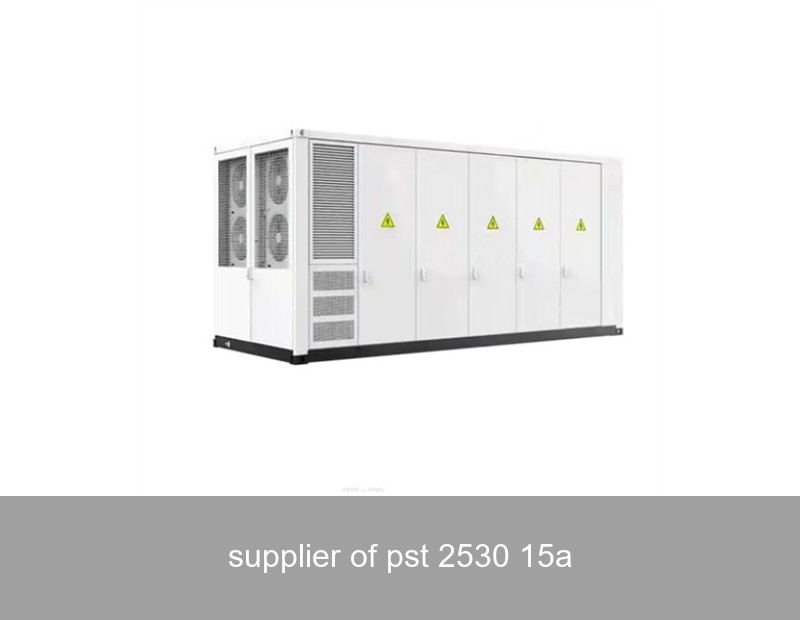
If you're in the business of building or maintaining energy storage systems, you've likely encountered the search for a critical component: a reliable supplier of PST 2530 15A. This isn't just about buying a part; it's about sourcing the backbone of safety and performance in battery energy storage systems (BESS). The PST 2530 15A fuse, a key player in DC protection, safeguards your investment from overcurrent events. But in a market flooded with options, how do you choose a partner that ensures quality, longevity, and system-wide intelligence? This article cuts through the noise, exploring not just the component, but the expertise and integrated solutions that truly power a resilient energy future.
Table of Contents
- The Phenomenon: The Hidden Criticality of DC Protection
- The Data: Why Component Quality Directly Impacts ROI
- The Case Study: A European Microgrid's Lesson in Sourcing
- The Insight: Beyond the Part – The Value of an Integrated System Partner
- The Highjoule Approach: Engineering Systems with Trusted Components
- Choosing Your Supplier: Key Questions to Ask
The Phenomenon: The Hidden Criticality of DC Protection
Walk into any modern battery storage installation, and your eyes are drawn to the sleek battery racks or the digital control screens. Rarely does anyone point out the humble fuse. Yet, for engineers and system integrators, components like the PST 2530 15A fuse are non-negotiable heroes. In a DC circuit, such as the link between a lithium-ion battery bank and its inverter, an overcurrent event (like a short circuit) doesn't have a natural zero-crossing point like AC power. This means faults can escalate into sustained, high-energy arcs extremely quickly, posing severe fire risks. The right fuse must interrupt this fault with precision and speed. Choosing a supplier based solely on price for such a component is a gamble with high stakes—system safety, operational uptime, and ultimately, the financial viability of your entire energy project.
The Data: Why Component Quality Directly Impacts ROI
Let's talk numbers. A study by the National Renewable Energy Laboratory (NREL) on BESS failures indicated that a significant portion of safety incidents and performance degradation can be traced back to sub-par balance-of-system (BOS) components, including protection devices. The cost of a system failure isn't just the replacement fuse; it's:
- Downtime Revenue Loss: For a commercial storage system performing peak shaving, downtime during high-tariff periods can cost thousands per day.
- Cascading Damage: A poorly performing protection device can fail to clear a fault, leading to catastrophic damage to expensive battery cells or power conversion equipment.
- Warranty & Insurance Implications: Using uncertified or non-compliant components can void system warranties and complicate insurance claims.
Investing in a certified, high-quality component from a reputable supplier of PST 2530 15A fuses is, therefore, a direct investment in risk mitigation and long-term return on investment.

Image: Precision components are the unsung heroes of safe and reliable energy storage systems. Source: Unsplash
The Case Study: A European Microgrid's Lesson in Sourcing
Consider the experience of a rural community microgrid project in Southern Spain. The project integrated 500 kW of solar PV with a 1 MWh lithium-ion BESS to achieve energy independence. Initially, to cut costs, the integrator sourced DC protection fuses, including the PST 2530 15A, from a low-cost online supplier. Within eight months, several fuses nuisance-tripped during normal operation, causing unexpected shutdowns. Worse, during a fault simulation test, one fuse failed to clear correctly, damaging a string inverter.
The project was delayed by six weeks. The final cost analysis revealed that the "savings" from the cheap components were eclipsed by:
- €15,000 in inverter repair costs.
- €8,500 in lost revenue from grid services not provided.
- €5,000 in labor for diagnostics and replacement.
The solution was a pivot to a technical partnership with a system-oriented provider. They didn't just sell replacement fuses; they provided a full audit of the protection coordination, ensuring all components from the battery to the grid interface were matched for optimal response. This holistic fix restored reliability and gave the operators peace of mind.
The Insight: Beyond the Part – The Value of an Integrated System Partner
The case study reveals a crucial insight: When you need a supplier of PST 2530 15A, what you truly need is a systems partner. The fuse is a symptom of a larger requirement: a coherent, well-engineered, and safe energy storage architecture. The best partners understand the entire chain: battery chemistry, thermal dynamics, BMS (Battery Management System) logic, and grid interaction. They don't just sell you a component; they ensure it is the right component for your specific voltage, interrupting rating, and application environment.
The Highjoule Approach: Engineering Systems with Trusted Components
This is where Highjoule's philosophy stands out. With nearly two decades of experience since 2005, we operate on a fundamental principle: true reliability is engineered at the system level. We don't view components as commodities. For us, every PST 2530 15A fuse, or its equivalent in our systems, is a carefully selected and validated part of a smarter whole.
Our commercial and industrial energy storage solutions, like the Highjoule H-Cube, are built with this integrated mindset. We source only from tier-1, certified component suppliers with proven track records. More importantly, our proprietary Energy Management Intelligence (EMI) platform actively monitors the performance of every system segment, including protection status. This means our systems aren't just protected by passive fuses; they are overseen by predictive software that can alert operators to potential issues before they lead to a fault condition.
For residential and microgrid applications, this systems-based approach translates into seamless integration. Whether it's a Highjoule Home system or a containerized MicroGrid Solution, the protection strategy is pre-engineered and tested under rigorous conditions. Our technical support team, staffed by engineers, understands these components at a granular level. So when you partner with Highjoule, you're not just finding a supplier; you're gaining a team that ensures every piece, down to the specific fuse, contributes to the system's safety, efficiency, and longevity. You can explore our system-first approach on our Solutions page.

Image: Large-scale BESS installations require component-level reliability for grid-scale performance. Source: Unsplash
What Makes a Fuse Suitable for Modern BESS?
| Feature | Why It Matters | Highjoule's Selection Criteria |
|---|---|---|
| High Interrupting Rating (IR) | Must safely stop very high fault currents common in dense battery arrays. | We select fuses with IR ratings significantly exceeding the calculated maximum prospective fault current of our systems. |
| DC Voltage Rating | Must match or exceed the system's maximum DC voltage. An under-rated fuse can fail to clear an arc. | Components are rated for the full voltage range of our battery strings, with a built-in safety margin. |
| Certifications (UL, IEC) | Independent verification of safety and performance claims. | We insist on globally recognized certifications, ensuring compliance for projects in the US, Europe, and beyond. |
| Time-Current Characteristic (TCC) | Must coordinate with upstream and downstream protection for selective tripping. | Our engineering team models TCC curves to ensure coordination, preventing unnecessary outages. |
Choosing Your Supplier: Key Questions to Ask
So, when your project requires a reliable supplier of PST 2530 15A or similar critical components, move beyond the procurement sheet. Ask potential partners these questions:
- Can you provide the full test certification (UL 248-15 or IEC 60269-6) for this component?
- How do you validate the compatibility of this protection device with specific battery chemistries and BMS signals?
- Do you offer system-level protection coordination studies, not just component sales?
- What is your technical support structure if we encounter an integration issue?
Your choice will define not just the quality of a single part, but the resilience of your entire energy asset. In an industry building the foundation for a sustainable future, can we afford to compromise on the fundamentals of safety and reliability?
 Inquiry
 Online Chat