


Top 10 Battery Suppliers in the World and the Rise of Intelligent Energy Systems
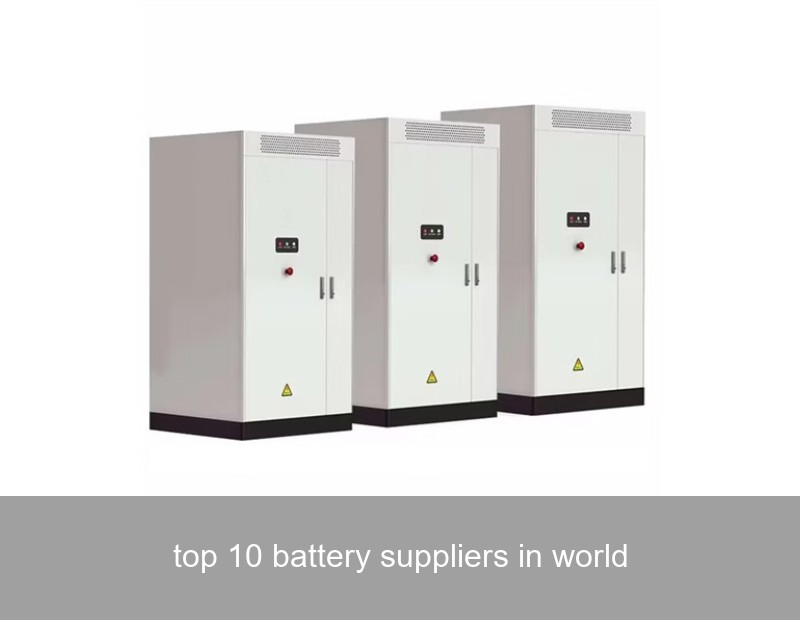
You flip a switch, and the light comes on. You plug in your EV, and it charges. This seamless flow of energy feels like magic, but behind it lies a complex, global industry undergoing a revolutionary transformation. At the heart of this shift are the top 10 battery suppliers in the world, powering everything from smartphones to entire cities. But here's a crucial insight: the raw battery cell is just the beginning. The true value for businesses and homeowners lies not merely in the container of energy, but in the intelligence that manages it. This is where the narrative evolves from simple supply to sophisticated, integrated solutions.
What Makes a Top Battery Supplier? It's Not Just Gigawatts
When we talk about the top battery suppliers in the world, the immediate metric is often Gigawatt-hours (GWh) of manufacturing capacity. It's a vital number, reflecting scale and market dominance. However, for an energy manager in Germany or a facility director in California, the criteria are more nuanced. They need to consider:
- Technology & Chemistry: Is it Lithium Iron Phosphate (LFP) for safety and longevity, or NMC for high energy density?
- Cycle Life & Warranty: How many charge-discharge cycles can the battery endure before significant degradation?
- Safety Certifications: Does the product meet stringent international standards like UL 9540 or IEC 62619?
- System Integration: Can the battery seamlessly communicate with solar inverters, grid signals, and building management systems?
- Software & Intelligence: This is the differentiator. A battery without smart software is like a powerful computer without an operating system.
This last point is critical. The leading suppliers are no longer just cell manufacturers; they are technology partners providing the brain for the brawn.
The Global Landscape: Top 10 Battery Suppliers in the World
The list of the top 10 battery suppliers in the world is dynamic, heavily influenced by the electric vehicle boom and global policy. Based on recent annual shipments and market influence, the leaders typically include a mix of Asian powerhouses and emerging Western contenders.
| Company (Headquarters) | Key Focus | Notable Strength |
|---|---|---|
| CATL (China) | EV & Stationary Storage | Market share leader, innovative cell-to-pack tech |
| BYD (China) | EV & Stationary Storage | Vertical integration, Blade Battery design |
| LG Energy Solution (Korea) | EV & Residential Storage | High-energy density NMC, major automaker supplier |
| Panasonic (Japan) | EV (Tesla) | Long-standing NCA chemistry expertise |
| SK On (Korea) | EV | Fast-charging technology, aggressive expansion |
| Samsung SDI (Korea) | EV & Stationary Storage | Premium prismatic and cylindrical cells |
| CALB (China) | EV | Rapid capacity growth, aerospace background |
| Gotion High-tech (China) | EV & Storage | Strong in LFP technology |
| Northvolt (Sweden) | EV & Sustainable Storage | European sustainability champion, gigafactory scale |
| Envision AESC (China/Japan) | EV | Zero-accident safety record, integrated solutions |
Source: Compiled from industry reports including SNE Research and BloombergNEF (BloombergNEF).
This list is dominated by EV-focused giants. But where does that leave a commercial building owner or a community seeking a turnkey storage solution? This gap is filled by companies like Highjoule, which act as master integrators. We select premium cells from trusted partners within this ecosystem and engineer them into complete, intelligent Battery Energy Storage Systems (BESS). Our IntelliBESS platform, for instance, doesn't just store energy; it uses AI-driven software to optimize when to charge from the grid or solar, when to discharge to avoid peak tariffs, and how to ensure the system's health for decades.

Credit: A modern BESS installation, similar to Highjoule's commercial solutions. Image from Unsplash.
Beyond the List: A Case Study in System Intelligence
Let's move from global rankings to a concrete example. Consider a mid-sized dairy processing plant in Bavaria, Germany. Their challenge wasn't a lack of power, but its cost and reliability.
- Phenomenon: High energy consumption during peak production hours coincided with the highest grid electricity prices (peak tariffs). Voltage dips occasionally disrupted sensitive machinery.
- Data: Energy audit revealed 40% of their monthly electricity bill was driven by consumption during 3 peak hours each weekday. A single voltage-related stoppage could cost over €15,000 in lost product and downtime.
- Case Study: The plant installed a 500 kWh / 1000 kWh Highjoule IntelliBESS Commercial system, integrated with their existing solar array. The system's software was configured for peak shaving and backup power. During peak price windows, the BESS seamlessly powers critical loads, avoiding grid draw. It also provides sub-second transition to backup power during grid disturbances.
- Insight: The result? A 28% reduction in monthly demand charges and complete immunity from short grid outages. The project payback period was under 5 years. The key wasn't just the quality of the lithium-ion cells inside the Highjoule cabinet (though that's foundational), but the proprietary Energy Management System (EMS) that makes constant, automated economic decisions. This is the value-add that transcends the component supplier list. (IRENA on Energy Storage).
Choosing Your Partner: More Than Just a Battery
So, if you're evaluating storage, how do you proceed? Knowing the top 10 battery suppliers in the world is a great starting point for understanding cell technology. But your checklist for a successful project should expand:
- Full System Warranty & Support: Look for a single provider responsible for the entire system—battery racks, power conversion system (PCS), thermal management, and software.
- Grid Services Readiness: Can the system participate in frequency regulation or virtual power plants for additional revenue? Highjoule systems are designed with this interoperability in mind.
- Scalability: Can you start with a 100 kWh system and easily expand to 1 MWh as your needs grow? Modular design is crucial.
- Local Expertise: Especially in Europe and the U.S., having local engineering support, certified installers, and responsive service is non-negotiable for long-term performance.
At Highjoule, with nearly two decades of experience since 2005, we bridge the gap between world-class cell technology and real-world application. Our services encompass everything from initial feasibility studies and system design to commissioning, remote monitoring, and lifecycle management. We provide the peace of mind that your investment is optimized, safe, and sustainable.

Credit: Modern energy system monitoring, a core aspect of Highjoule's service. Image from Unsplash.
The Future of Storage: What's Next?
The landscape of the top 10 battery suppliers in the world will continue to evolve with new chemistries like sodium-ion and solid-state on the horizon. (U.S. Department of Energy on Battery Recycling). But the parallel evolution in software and grid integration will be equally transformative. The future BESS will be an autonomous grid citizen, negotiating energy trades, providing resilience, and maximizing renewable consumption.
Given this trajectory, what specific energy challenge—be it demand charge management, renewable self-consumption, or backup power resilience—is most critical for your organization to solve in the next 18 months?
 Inquiry
 Online Chat