


Top 5 Hybrid Solar Inverter in Sweden: Powering a Sustainable Future
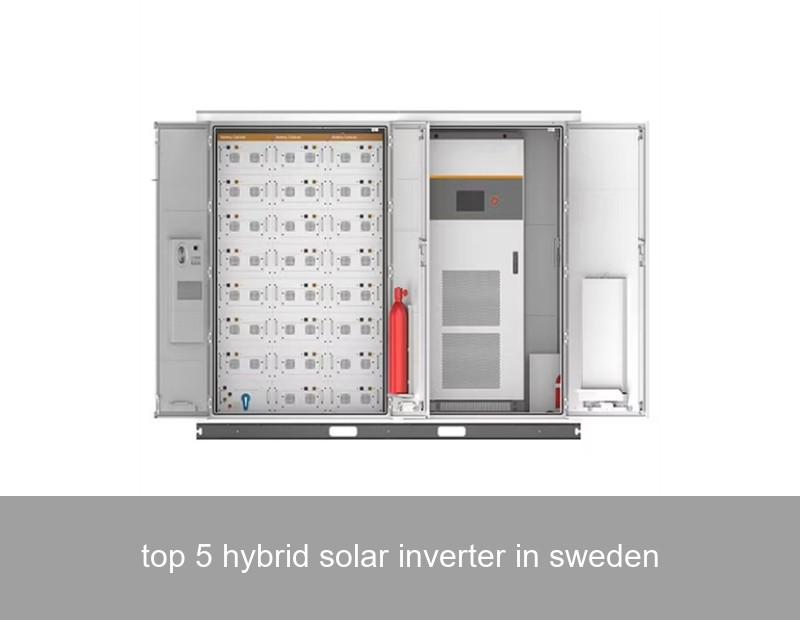
As Sweden charges towards its ambitious goal of 100% renewable electricity by 2040, homeowners and businesses are increasingly looking to maximize their energy independence. The heart of any modern solar-plus-storage system is the hybrid solar inverter. This intelligent device doesn't just convert solar DC power to usable AC; it manages battery storage, grid interaction, and your home's energy flow. Choosing the right one is crucial. In this guide, we explore the top 5 hybrid solar inverter technologies gaining traction in the Swedish market and explain how integrating them with a complete system, like those from Highjoule, unlocks true energy resilience.
Table of Contents
- The Swedish Solar Surge: More Than Just Panels
- What Makes a Hybrid Inverter "Top" for Sweden?
- Top 5 Hybrid Solar Inverter Contenders for the Swedish Market
- Case Study: A Gothenburg Household's Journey to 90% Self-Consumption
- Beyond the Inverter: The Highjoule Integrated System Advantage
- Is Your Home Ready for Intelligent Energy Management?
The Swedish Solar Surge: More Than Just Panels
You've likely noticed the growing shimmer of solar panels on rooftops across Stockholm, Malmö, and the countryside. This isn't just a trend; it's a response to rising electricity costs, a desire for sustainability, and improved technology. However, a common challenge persists in Sweden's climate: solar production peaks in summer, while energy demand soars in the dark, cold winter. Without a way to store surplus summer energy, you're forced to export it to the grid at a lower price, only to import expensive power later. This is where the hybrid inverter, coupled with a battery, becomes a game-changer, transforming a solar system from a seasonal contributor to a year-round energy asset.
What Makes a Hybrid Inverter "Top" for the Swedish Market?
Not all hybrid inverters are created equal, especially for Nordic conditions. When evaluating the top options, Swedish consumers should prioritize:
- High Efficiency in Low-Light Conditions: Excellent performance during Sweden's long autumn and winter mornings/evenings.
- Robust Battery Compatibility & Management: Seamless integration with leading battery chemistries (like LiFePO4) for optimal lifespan and safety in varying temperatures.
- Advanced Energy Management Software: Intelligent logic that learns consumption patterns and automatically optimizes for self-consumption or cost-saving based on time-of-use tariffs.
- Grid Services & Blackout Protection: The ability to form an off-grid power supply during outages—a critical feature for rural areas.
- Local Support & Certification: Reliable local installers and compliance with Swedish and EU standards (e.g., VDE-AR-N 4105).
Top 5 Hybrid Solar Inverter Contenders for the Swedish Market
Based on technology, market presence, and suitability for Swedish conditions, here are five leading hybrid inverter brands. Think of this as a shortlist for your research.
| Brand/Line | Key Strengths for Sweden | Considerations |
|---|---|---|
| SolarEdge Home Hub Inverter | Outstanding safety with optimized power electronics, superb module-level monitoring, and strong software for consumption tracking. | Often requires brand-matched batteries, which can influence system cost flexibility. |
| Huawei SUN2000 Smart Energy Solution | High string input voltage, allowing longer strings which is efficient for larger roofs. Strong AI-based energy management. | As with any major brand, ensure your installer has deep, local technical support expertise. |
| Fronius Symo Hybrid | Excellent reputation for durability and efficiency. "Snapshot" feature simplifies system design. Strong backup power capabilities. | The hybrid system can involve separate inverter and battery management units, needing more installation space. |
| Victron Energy MultiPlus-II | The go-to for robust off-grid and marine applications. Incredibly flexible, programmable, and perfect for complex systems or cabins. | Configuration can be more technical, requiring a highly skilled installer for optimal residential use. |
| GoodWe Lynx Home U Series | Strong value proposition with high efficiency ratings. Good compatibility with various batteries and user-friendly monitoring app. | Relatively newer brand in the Nordics, so verifying local installer network depth is advised. |
Note: This list is based on independent market analysis and installer feedback. The "best" inverter is the one perfectly matched to your specific home, consumption, and future goals.
Case Study: A Gothenburg Household's Journey to 90% Self-Consumption
Let's look at real data. The Andersson family in Gothenburg installed a 12 kWp solar array in 2022. Initially with a standard inverter, their self-consumption rate was only 35%, meaning most solar energy was sold to the grid. In spring 2023, they upgraded to a hybrid inverter system paired with a 15 kWh lithium-iron-phosphate (LiFePO4) battery.
- Pre-Update (2022): Annual self-consumption: ~35%. Grid import: 8,500 kWh.
- Post-Update (2023-24): Annual self-consumption: ~90%. Grid import reduced to 1,200 kWh.
- Financial Impact: Despite the investment, their annual electricity bill dropped by over 75%. The system is projected to pay for itself in under 9 years, aided by Sweden's energy tax reduction schemes for solar storage.

The key to their success wasn't just the inverter hardware, but the intelligent energy management system that orchestrated solar production, battery charging/discharging, and household load in real-time.
Beyond the Inverter: The Highjoule Integrated System Advantage
At Highjoule, with nearly two decades of experience in advanced energy storage, we view the hybrid inverter as a critical component within a smarter whole. Our approach ensures the inverter, battery, software, and your energy goals work in perfect harmony.
Our H-Energy Platform doesn't just connect devices; it unifies them:
- Hardware-Agnostic Design: We can integrate with top-tier inverters (like those mentioned) and select the optimal battery technology (such as our proprietary LiFePO4 packs) for your needs, avoiding vendor lock-in.
- AI-Powered Energy Operating System (EOS): This is the true brain. It analyzes weather forecasts, electricity price signals, and your consumption habits to make predictive decisions, storing energy when it's cheap or sunny, and discharging it when it's expensive or dark.
- Commercial & Industrial Scale: For businesses and microgrids in Sweden, our large-scale containerized BESS (Battery Energy Storage Systems) provide grid stability, peak shaving, and backup power, integrating seamlessly with large solar farms.
Think of it this way: you can buy a premium engine (the inverter), but without the right transmission, chassis, and onboard computer, you won't win the race for efficiency. Highjoule provides the complete, high-performance vehicle for your energy journey. For deeper insights into grid integration, the IEA's report on grid-scale storage highlights the macro-trends we're enabling at the local level.
Future-Proofing with Vehicle-to-Grid (V2G) Readiness
The next frontier is integrating your electric vehicle. Our systems are being designed with V2G (Vehicle-to-Grid) readiness, anticipating a future where your EV battery can act as a mobile storage unit for your home, further enhancing resilience. This aligns with pioneering research from institutions like Chalmers University of Technology on the Swedish power system's evolution.

Is Your Home Ready for Intelligent Energy Management?
Choosing from the top hybrid solar inverters is an excellent first step. But the real question is larger: What specific energy independence and cost-saving targets do you have for your Swedish property? Are you looking merely to reduce bills, or to ensure critical power during winter storms? How might your energy needs evolve with an electric vehicle or a home expansion?
We invite you to move beyond comparing spec sheets. Let's discuss designing a system where every component, from the inverter to the battery to the software, is selected and integrated with your unique Swedish lifestyle in mind. What would 90% energy self-sufficiency mean for you this coming winter?
 Inquiry
 Online Chat