


Uni Solar Amorphous Silicon Solar Panels: A Deep Dive into a Flexible Thin-Film Technology
Have you ever imagined solar panels that can bend, are lightweight, and perform well in low-light conditions? For years, the solar industry was dominated by rigid, glass-encapsulated crystalline silicon panels. But a different technology once promised a more versatile future: Uni-Solar amorphous silicon panels. While less common today, understanding this unique thin-film photovoltaic (PV) technology offers crucial insights into the evolution of solar energy and the ongoing quest for flexible, integrated solutions. As a global leader in smart energy storage, Highjoule recognizes that the history of PV innovation informs today's hybrid systems, where diverse generation sources, from classic silicon to emerging technologies, are paired with advanced battery storage for maximum resilience.
Table of Contents
- What is Uni-Solar Amorphous Silicon?
- How Amorphous Silicon PV Technology Worked
- The Legacy: Advantages and Challenges
- A Real-World Case Study: The Power of Durability
- Amorphous Silicon's Niche in the Modern Energy Landscape
- The Critical Role of Modern Energy Storage
- How Highjoule Integrates Diverse Energy Sources
What is Uni-Solar Amorphous Silicon?
Uni-Solar, a brand under the former United Solar Ovonic, was a pioneer in manufacturing amorphous silicon (a-Si) solar panels. Unlike traditional crystalline silicon (c-Si) with its ordered atomic structure, amorphous silicon has a randomized, non-crystalline structure. This allowed Uni-Solar to deposit thin layers of photovoltaic material onto flexible substrates like stainless steel or polymer, creating lightweight, durable, and bendable solar modules. Their signature triple-junction technology stacked three layers of a-Si to capture a broader spectrum of light, improving efficiency and stability.

Image: A classic flexible Uni-Solar panel. Its lightweight and bendable nature allowed for unique installation options not possible with rigid panels.
How Amorphous Silicon PV Technology Worked
The core innovation was in the manufacturing. Using a process called chemical vapor deposition (CVD), thin films of silicon were applied to a rolling substrate, enabling high-volume production. The triple-junction design was key:
- Top Junction: Absorbed blue light.
- Middle Junction: Absorbed green/yellow light.
- Bottom Junction: Absorbed red and infrared light.
This multi-layer approach helped mitigate a fundamental issue called the Staebler-Wronski effect, where a-Si cells experience initial light-induced degradation. Uni-Solar's design aimed for a more stable, though lower, operational efficiency compared to crystalline panels.
The Legacy: Advantages and Challenges
Uni-Solar panels carved out a specific niche due to their unique property set.
| Advantages | Challenges |
|---|---|
|
|
A Real-World Case Study: The Power of Durability
A compelling testament to Uni-Solar's durability comes from a 2019 assessment of a commercial installation in the Midwestern United States. A large warehouse with a low-slope, membrane roof installed 250 kW of Uni-Solar PVL-144 laminates in 2008. The roof couldn't support traditional racking, making the lightweight, adhesive-mounted Uni-Solar product an ideal choice.
The Data, Over a Decade Later:
- Initial Power: 250 kW DC system (2008).
- 2019 Measured Output: ~215 kW DC (approximately 14% degradation). Annual Degradation Rate: Averaged ~1.3%, aligning with or exceeding warranty expectations.
- Key Finding: Despite harsh winters, hot summers, and no active cleaning, the laminate integrity was flawless with no water ingress. The system consistently outperformed production models in winter and cloudy conditions, validating the low-light advantage.
This case, documented in an NREL report on PV reliability, highlights how the right technology for the specific application (a fragile roof) can deliver reliable, long-term generation. The challenge for the site owner now is optimizing the value of that stable, but aging, generation asset—a challenge perfectly addressed by modern energy storage.
Amorphous Silicon's Niche in the Modern Energy Landscape
While large-scale production has ceased, existing Uni-Solar installations continue to operate, and the principles of flexible, lightweight PV live on. The technology's legacy informs current Building-Integrated Photovoltaics (BIPV) and flexible panel research. Today, the conversation has shifted from standalone generation to integrated energy systems. Whether your power comes from legacy thin-film, high-efficiency monocrystalline panels, or a wind turbine, its true potential is unlocked when paired with intelligent storage and energy management.
The Critical Role of Modern Energy Storage
This is the pivotal insight for any energy consumer: the source of generation is only one part of the equation. Solar generation, regardless of panel type, is intermittent. Energy storage is the enabling technology that transforms solar from a supplemental power source into a reliable, resilient, and cost-optimizing asset.
Think about it: A durable Uni-Solar array on a warehouse produces power steadily for decades. Without storage, excess midday power is exported to the grid at low rates, and the building buys power back in the evening at high rates. With a battery energy storage system (BESS), that self-generated power can be stored and used on-site when it's most valuable, maximizing self-consumption, providing backup power during outages, and enabling participation in grid services programs.

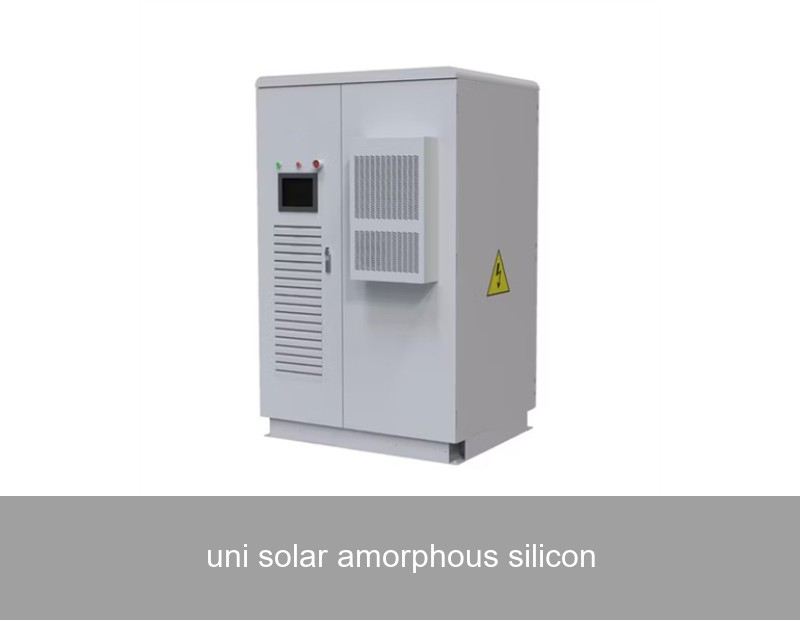
Image: A modern battery energy storage system (BESS) like those from Highjoule, enabling energy independence and grid stability.
How Highjoule Integrates Diverse Energy Sources
Since 2005, Highjoule has specialized in creating intelligent storage solutions that future-proof energy investments. Our systems are generation-agnostic. Whether you have an existing Uni-Solar installation, a new high-efficiency solar farm, or a combination of renewables, our HPS (Highjoule PowerStack) commercial and industrial battery systems can seamlessly integrate.
Our HI-OS energy management platform uses AI-driven forecasting to optimize charge/discharge cycles based on your generation profile, utility rate structure, and consumption patterns. For a site with an older Uni-Solar array, this means:
- Extending Asset Value: Maximizing the financial return of the existing PV investment.
- Enhancing Resilience: Providing critical backup power, leveraging the stable solar input as a recharge source during grid outages.
- Grid Independence: Increasing on-site consumption of solar energy, reducing demand charges, and protecting against volatile energy prices.
For new installations, Highjoule offers complete solar-plus-storage solutions, designing the optimal blend of PV technology and storage capacity to meet specific financial and operational goals, be it for a manufacturing plant in Germany, a commercial building in California, or a remote microgrid.
Looking Beyond the Panel: Your Energy Ecosystem
The story of Uni-Solar amorphous silicon teaches us that innovation in energy is multifaceted—it's about materials science, manufacturing, durability, and application-specific design. Today's energy revolution builds on these lessons, focusing not just on how we generate electrons, but on how we intelligently manage, store, and deploy them.
Does your facility, whether equipped with legacy solar or considering a new installation, have a strategy to capture the full value of every kilowatt-hour generated? What would a 100% resilient, self-optimized energy system look like for your operation?
 Inquiry
 Online Chat