


Understanding the Investment: What Determines a 100 kVA Solar System Price in Sweden?
If you're a business owner, farm operator, or managing a sizeable property in Sweden, you've likely felt the pinch of rising electricity costs and the growing push for sustainability. The idea of energy independence through solar power is more attractive than ever. A 100 kVA (kilovolt-ampere) system, roughly equivalent to a 100 kW (kilowatt) DC system under ideal conditions, is a popular choice for substantial commercial, industrial, or agricultural energy needs. But when you start researching, you'll find that the 100 kVA solar system price in Sweden isn't a single, simple figure. It's a spectrum, influenced by a complex interplay of technology, geography, and long-term value. Let's demystify the costs and explore what your investment truly buys in the Swedish market.
Table of Contents
The Price Breakdown: More Than Just Panels
So, what are you actually paying for? A commercial-grade 100 kVA solar installation is a sophisticated engineering project. The hardware is just one part of the equation.
- Solar Panels (PV Modules): Typically 30-40% of the cost. Tier-1 monocrystalline panels with high efficiency (21%+) command a premium but yield more energy per square meter—a key consideration if roof space is limited.
- Inverters: The system's brain, converting DC to AC. For a 100 kVA system, you might use several commercial string inverters or a central inverter. Quality here dictates efficiency and system lifespan.
- Mounting System & Hardware: Designed to withstand decades of Swedish weather, from Karlskrona's coastal winds to Kiruna's heavy snow loads.
- Energy Storage (Optional but Increasingly Common): Adding a battery energy storage system (BESS) is a separate, significant investment but transforms the system's capabilities.
- Installation, Wiring, and Grid Connection: Labor, electrical components, and the process to connect to and comply with the local grid (nätsäljare).
- Planning, Permits, and Software: This includes system design, energy yield simulations, building permits, and often a subscription for monitoring software.
As of 2024, for a high-quality, grid-tied 100 kVA solar system without storage in Sweden, you can expect a turnkey price range of approximately 700,000 to 1,200,000 SEK (before any tax deductions or incentives). This wide range is our first clue that the cheapest option upfront is rarely the most economical over 25+ years.
The Swedish Factor: Climate, Grid, and Incentives
Sweden presents a unique environment for solar. Contrary to intuition, southern Sweden has solar insolation levels comparable to northern Germany, a solar leader. The long summer days offer excellent production, while winter output is limited. This seasonality profoundly impacts system design and economics.
Financially, the Swedish state supports solar through a tax deduction for renewable energy production (Förnybar elproduktion). For commercial entities, you can deduct 30% of the labor cost for installation from your tax bill. Furthermore, any excess electricity fed back to the grid is sold, providing a modest but ongoing revenue stream or credit.
The local grid company's policies (nätnytta, grid tariffs) are perhaps the most critical local factor. Many regions are moving towards capacity-based tariffs (peak demand charges). This means your biggest grid cost isn't just total consumption (kWh), but the highest 15-minute power draw (kW) in a month. This changes the game, making solar—and especially solar-plus-storage—a tool for peak shaving and direct cost avoidance.
The Storage Premium: Why Your 100 kVA System Might Need a Battery
This brings us to the most significant trend in commercial solar: integration with storage. A solar-only system exports surplus midday power and imports power in the evening and winter. A solar-plus-storage system allows you to capture that surplus and use it when you need it most.
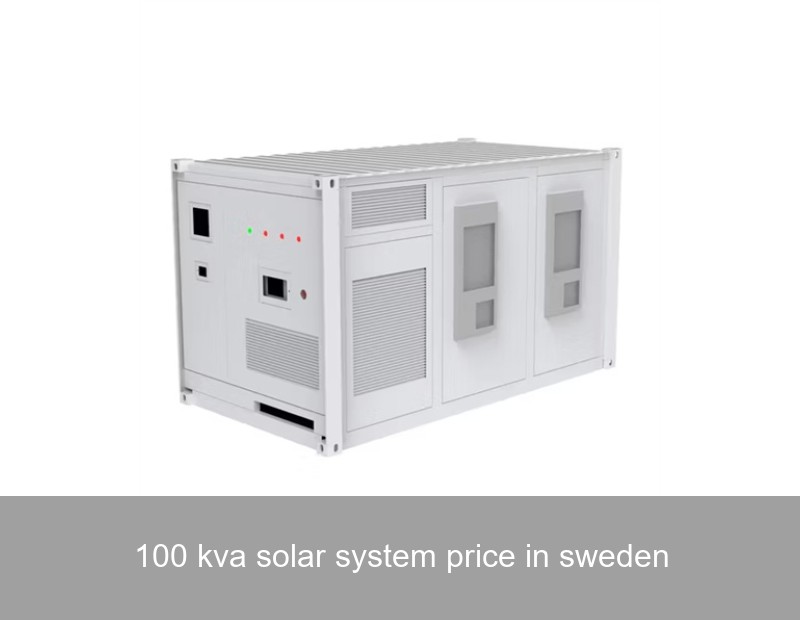
For a 100 kVA solar array, pairing it with a scalable battery system like Highjoule's H-Series Commercial ESS unlocks new value dimensions:
- Peak Shaving: Actively cap your power draw from the grid to avoid high demand charges.
- Backup Power: Ensure critical operations continue during a grid outage.
- Energy Arbitrage: Buy grid electricity when it's cheap (overnight) to charge the battery, and use it during expensive peak hours.
Adding storage increases the initial 100 kVA solar system price in Sweden by 50-100%, but the ROI calculation shifts from simple payback on energy to a more complex value stack including grid fee savings, increased self-consumption, and resilience. 
A Real-World Case Study: Västra Götaland Farm
Let's look at concrete data. A large dairy farm in Västra Götaland, facing rising energy costs and a desire for sustainability, installed a 102 kVA solar PV system in 2022. The system, comprising 240 high-efficiency bifacial panels, was initially designed without storage.
| Metric | Value |
|---|---|
| Annual Production | ~95,000 kWh |
| Self-Consumption Rate | ~65% |
| Grid Export | ~35,000 kWh/year |
| Estimated Payback Time | 8-9 years |
Post-Storage Impact: The battery was programmed to discharge during the morning and evening demand peaks. The result? A 22% reduction in their monthly grid demand charge and an increase in self-consumption to over 90%. The combined system's payback is now projected at under 7 years, thanks to the dual benefit of energy savings and grid fee optimization. This case perfectly illustrates why the conversation is moving beyond just solar capacity price to integrated energy management.
The Highjoule Approach: Intelligent Systems for Maximum ROI
At Highjoule, we understand that a 100 kVA solar system is a major capital decision. Our role isn't just to supply equipment but to engineer a solution that maximizes your return and resilience. For the Swedish market, we provide:
- High-Efficiency, Northern-Climate Optimized Components: We select PV panels with proven low-light performance and robust inverters from trusted partners, all configured for the Swedish environment.
- Our Core Technology: The Highjoule Energy Management System (EMS): This is where the intelligence lies. Our proprietary EMS doesn't just react; it learns your load patterns, forecasts weather and energy prices, and optimally dispatches your solar and battery storage. It actively manages energy flows to minimize your total cost of ownership, automatically performing peak shaving and energy arbitrage.
- Scalable Battery Storage Solutions: Our modular H-Series battery cabinets allow you to start with a capacity that fits your budget and scale up as your needs or electricity market dynamics change.
- Full Lifecycle Support: From initial feasibility and financial modeling using tools like NREL's PVWatts Calculator to installation, grid compliance, and 24/7 system monitoring, we partner with you for the long term.

Looking Beyond the Sticker Price
Therefore, the most pertinent question isn't "What is the price of a 100 kVA solar system in Sweden?" but rather "What is the total value of energy independence and cost predictability for my business over the next 25 years?"
The initial investment must be weighed against:
- Locking in a significant portion of your electricity cost at a fixed rate (sunshine is free!).
- Protecting your operations from volatile and likely increasing future grid prices.
- Enhancing your sustainability profile, a factor increasingly important to customers, partners, and regulators.
- Building operational resilience with backup power capabilities.
To get a truly accurate picture, a professional energy audit and simulation is essential. Factors like your specific load profile, roof orientation and condition, local grid tariffs, and your sustainability goals will all shape the final design and cost. For authoritative, independent information on solar in Sweden, you can refer to resources like Energimyndigheten (Swedish Energy Agency).
What specific energy challenge—be it unpredictable demand charges, a desire for backup power, or a bold carbon neutrality goal—is driving you to consider a 100 kVA solar solution today?
 Inquiry
 Online Chat