


How Much Does a System on Grid Cost? Your 2024 Investment Guide
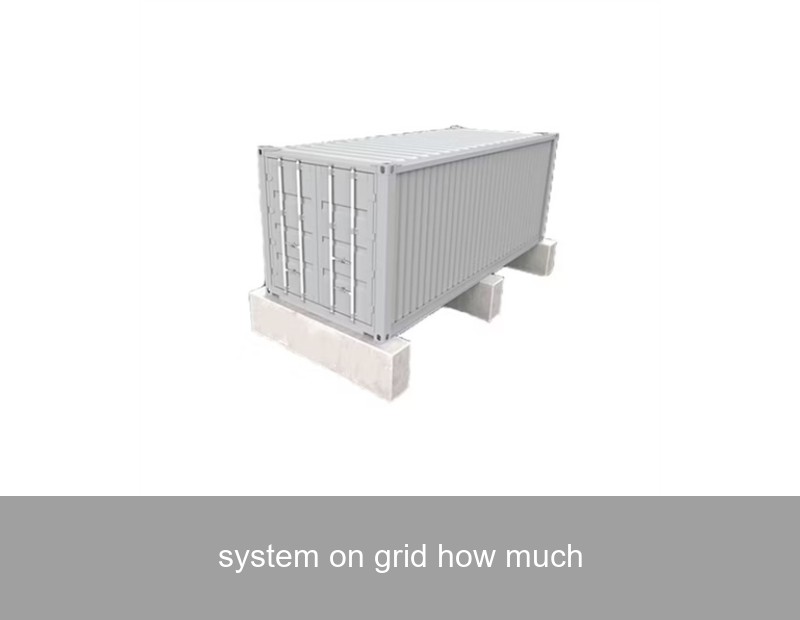
You're considering a grid-tied solar system, and the big question is front and center: how much does a system on grid cost? It's a smart question, and the answer isn't a single number. Think of it like asking "how much does a house cost?"—it depends on size, location, quality, and the features you choose. In the world of renewable energy, understanding the investment in an on-grid system is the first step toward energy independence and long-term savings. As a global leader in advanced energy storage since 2005, Highjoule has helped thousands of commercial, industrial, and residential clients navigate this exact question, transforming their energy costs into a predictable, sustainable investment.
Table of Contents
- The Real Cost Breakdown: More Than Just Panels
- Key Factors That Swing the Price Tag
- Real-World Insight: A German Manufacturing Case Study
- The Hidden Game-Changer: The Role of Battery Energy Storage (BESS)
- Highjoule Solutions: Tailoring Your On-Grid System for Maximum ROI
- Making the Decision: Is an On-Grid System Worth It For You?
The Real Cost Breakdown: More Than Just Panels
When budgeting for an on-grid (or grid-tied) solar system, you're investing in a complete energy ecosystem. The total cost encompasses several core components:
- Solar Panels (Photovoltaic Modules): Typically 25-35% of the total system cost. Prices vary by efficiency and technology (monocrystalline, polycrystalline).
- Inverters: The brain of the system, converting DC solar power to usable AC power. Accounts for 10-15% of costs. Crucial for system efficiency and longevity.
- Mounting System & Hardware: The skeleton that secures your panels to the roof or ground. Represents about 10% of the total.
- Installation & Labor: Professional design, permitting, and installation. This can be 15-25% of your investment, varying greatly by region and project complexity.
- Permits, Inspection, and Interconnection Fees: Often overlooked, these administrative costs with your local utility and municipality are essential and can add a few thousand dollars.
In the United States, as of 2024, the average cost for a residential on-grid solar system before incentives ranges from $15,000 to $25,000 for a typical 6kW to 8kW system. In Europe, prices are similarly situated but can be higher in some markets like the UK or lower in others like Germany, heavily influenced by local supply chains and regulations.

Image Source: Unsplash - Professional solar installation is a key component of system cost and long-term reliability.
Beyond the Sticker Price: Incentives and Lifetime Value
The initial quote isn't the final story. Significant financial incentives dramatically reduce the net cost. In the U.S., the federal Investment Tax Credit (ITC) allows you to deduct 30% of the system cost from your federal taxes. Many states offer additional rebates. In Europe, schemes like feed-in tariffs (FITs), tax reductions, or direct grants are common. For a $20,000 system, the U.S. ITC alone brings your net investment down to $14,000.
Then, calculate the lifetime value. A system with a 25-year warranty will produce decades of free electricity, insulating you from utility rate hikes. The question shifts from "how much does it cost?" to "what is my return on investment (ROI) and payback period?"
Key Factors That Swing the Price Tag
Why does your neighbor's quote differ from yours? These variables are crucial:
| Factor | Impact on Cost | Highjoule's Insight |
|---|---|---|
| System Size (kW) | Directly proportional. More panels = higher equipment & labor cost. | Right-sizing is key. We use detailed energy analytics to design a system that matches your consumption, avoiding over- or under-spending. |
| Energy Consumption | Drives the required system size. Higher usage needs a larger system. | Our smart energy audits identify efficiency gains first, potentially reducing the solar capacity you need to install. |
| Roof Type & Condition | Complex roofs (tile, steep pitch) increase installation time and cost. | Our site assessment includes a structural evaluation to ensure a safe, code-compliant installation without surprises. |
| Location | Local labor rates, permit fees, and average sunlight (solar insolation) vary by region. | With operations across the US and Europe, Highjoule has localized expertise to provide accurate regional costing. |
| Component Quality | Premium, high-efficiency panels and inverters cost more upfront but yield more energy and last longer. | We partner with tier-1 manufacturers and offer our own Highjoule H-Series Hybrid Inverters, engineered for durability and peak efficiency in both residential and commercial applications. |
Real-World Insight: A German Manufacturing Case Study
Let's move from theory to practice. In 2023, Highjoule partnered with a mid-sized automotive parts manufacturer near Stuttgart, Germany. The client's primary goal was to reduce soaring energy costs and gain predictability.
- Challenge: High daytime energy demand, exposure to volatile spot market electricity prices, and a desire to utilize existing roof space.
- Solution: A 250 kWp on-grid solar PV system, integrated with a Highjoule C.I. Commercial & Industrial Battery Energy Storage System (BESS) with 500 kWh capacity.
- Cost & Data: The total turnkey project investment was approximately €380,000. However, with German federal and state (Baden-Württemberg) subsidies for solar and storage, the net investment was reduced by over 20%.
- Result: The system now covers 40% of the facility's daytime load. The BESS performs peak shaving—storing solar energy when production is high and discharging it during expensive peak grid periods—saving an additional 15% on grid demand charges. The projected payback period is under 7 years, thanks to high German electricity prices and intelligent storage management.
This case highlights that for commercial entities, the "system on grid" cost must be evaluated alongside strategic storage to maximize financial returns. You can explore more on commercial energy trends from the International Renewable Energy Agency (IRENA).
The Hidden Game-Changer: The Role of Battery Energy Storage (BESS)
Discussing on-grid system cost is incomplete without addressing batteries. While not mandatory for a basic grid-tie system, adding a Battery Energy Storage System (BESS) is becoming a standard upgrade for resilience and economics.
Why add storage to an on-grid system?
- Energy Time-Shifting: Store excess solar from the afternoon to use in the evening, increasing self-consumption from 30-50% to 70-90%.
- Backup Power: Maintain critical loads during grid outages—a feature pure on-grid systems cannot offer.
- Demand Charge Management: For businesses, this is crucial. BESS can discharge to cap your peak power draw, slashing a major portion of your utility bill.
Yes, it adds to the initial cost (anywhere from $8,000 to $20,000+ for a residential system), but it fundamentally changes the value proposition. Highjoule's Residential Energy Hub seamlessly integrates solar, storage, and grid power into one intelligent system, managed by our AI-driven OptiCharge™ platform. It automatically optimizes for cost savings, self-consumption, or backup readiness based on your preferences and real-time utility rates.

Image Source: Unsplash - A modern Battery Energy Storage System (BESS) is key for maximizing on-grid solar economics.
Highjoule Solutions: Tailoring Your On-Grid System for Maximum ROI
At Highjoule, we don't just sell components; we deliver optimized energy solutions. Our approach to the "how much does it cost?" question is consultative and holistic.
For Homeowners: The Highjoule Home System
Our all-in-one package includes high-efficiency panels, our proprietary hybrid inverter, and our scalable lithium-ion home battery. The system is designed for future expansion and comes with the Highjoule 360° Monitoring app, giving you full visibility into your production, consumption, and savings in real-time. We handle everything from design and permitting to installation and interconnection, providing a single, clear price.
For Businesses & Microgrids: Highjoule C.I. & Microgrid Solutions
Commercial projects require precision engineering. Our team conducts a deep dive into your utility bills, load profiles, and operational goals. We then model systems using our advanced software, often presenting scenarios with and without storage to clearly show the long-term financial impact. Our C.I. BESS units are modular, allowing for growth as your needs change. For critical facilities or remote operations, our microgrid controllers can manage a mix of solar, storage, and generator assets for ultimate reliability. For authoritative safety and standards information, we recommend the National Fire Protection Association (NFPA) guidelines.
Making the Decision: Is an On-Grid System Worth It For You?
So, how much does a system on grid cost? As you've seen, it's a range defined by your unique needs. The more pertinent question is: What is the value of locking in decades of clean, low-cost electricity and taking control of your energy future?
The economics have never been better. Solar panel costs have fallen over 80% in the last decade, while grid electricity prices continue to rise globally. When you factor in available incentives and the option to add smart storage, the payback period for a well-designed system is often between 6-10 years, with decades of nearly free energy to follow.
Ready to move from a generic question to a personalized answer? What does your last utility bill reveal about the potential savings a Highjoule system could unlock for your home or business? We invite you to share your energy goals with our experts for a tailored preliminary assessment.
 Inquiry
 Online Chat