


Demystifying the 100 kW Solar Panel Price: A Smart Investment Guide for Businesses
So, you're considering a 100 kW solar panel system. That's a fantastic decision, placing you squarely in the commercial and industrial (C&I) solar arena. But when you start searching for that magic number—the 100 kW solar panel price—you quickly find it's not so simple. Quotes can vary wildly, leaving you wondering what you're *really* paying for. Is it just panels and inverters, or is there more to the story? As a leading energy storage provider since 2005, Highjoule is here to guide you through the true cost components and how to maximize the value of every kilowatt-hour your system produces.
Table of Contents
- Beyond the Sticker Shock: The 100 kW System Price Breakdown
- Key Factors Influencing Your Total Project Cost
- From Quote to ROI: A Real-World Case Study
- The Game Changer: Adding Storage to Your Solar Investment
- How Highjoule Integrates for a Smarter 100 kW Solution
- Your Solar Journey: What's the Right Next Step?
Beyond the Sticker Shock: The 100 kW System Price Breakdown
Let's be clear: a headline price per watt for a 100 kW system can be misleading. In the U.S. and Europe, a turnkey commercial 100 kW solar installation typically ranges from $130,000 to $250,000+ before incentives. That's a broad range because the final 100 kW solar panel price is a sum of several critical parts:
- Hardware (Modules & Inverters): This includes the solar panels themselves and the inverters that convert DC to AC power. Premium, high-efficiency panels cost more but may yield better long-term returns in constrained spaces.
- Balance of System (BOS): This is everything else: racking, wiring, conduits, disconnects, and the crucial monitoring system.
- Soft Costs: Often underestimated, these include engineering, permitting, interconnection fees, and labor. These can vary significantly by region and project complexity.
- Installation & Labor: The expertise of the installer is paramount for system performance and longevity.
Therefore, focusing solely on the per-watt cost of the panels is like buying a car based only on the engine price. You need to consider the entire vehicle.
Image: A commercial-scale rooftop installation similar to a 100 kW system. Credit: Unsplash
Key Factors Influencing Your Total Project Cost
Why does your neighbor's quote differ from yours? Here are the main levers:
| Factor | Impact on 100 kW Solar Panel Price | Consideration |
|---|---|---|
| Location | High impact on labor, permits, and incentives. | Interconnection fees in the US can vary by utility. In Europe, local grid requirements differ. |
| Roof Type & Condition | Can increase structural BOS and labor costs. | A complex roof with multiple penetrations requires more engineering and mounting hardware. |
| Panel & Inverter Efficiency | Higher efficiency = higher hardware cost, but potentially more energy/kW. | For limited roof space, premium panels can be cost-effective by maximizing output. |
| Local Incentives | Dramatically reduces net cost. | In the US, the Investment Tax Credit (ITC) offers 30%. In Europe, schemes vary by country (e.g., feed-in tariffs, tax breaks). |
From Quote to ROI: A Real-World Case Study
Let's move from theory to practice. Consider a mid-sized manufacturing facility in Bavaria, Germany. The goal: offset a consistent daytime energy load.
- System Size: 105 kWp (peak kilowatt)
- Initial Quote (Hardware + Installation): €145,000 (approx. $155,000 at the time).
- Key Challenge: High afternoon consumption, but solar peaks at midday. Without storage, they would still pull significant power from the grid at higher rates.
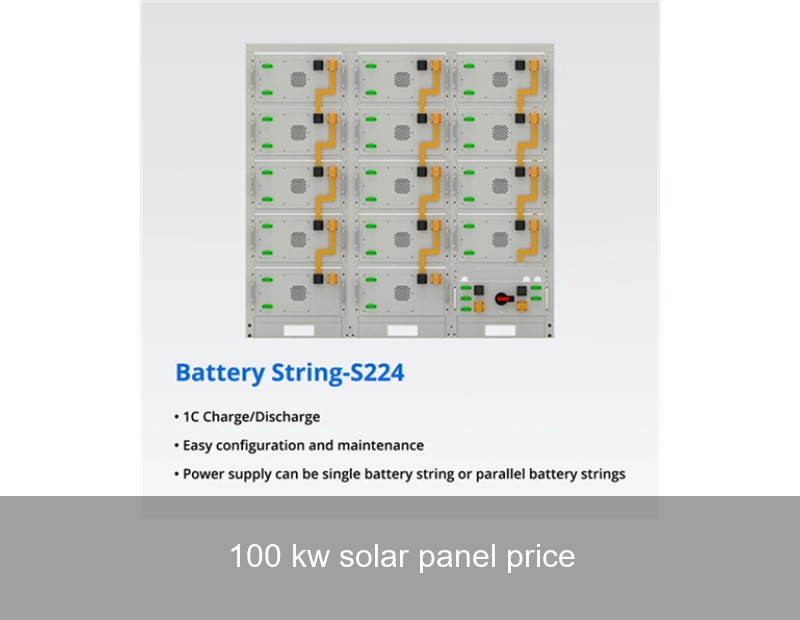
- Solution & Added Cost: The facility integrated a Highjoule H-Cube 50 battery energy storage system (BESS). This added to the upfront cost but transformed the economics.
- Result: The system now stores excess midday solar energy and discharges it during the high-cost late afternoon peak. This peak shaving strategy, combined with intelligent energy management, increased their on-site consumption of solar power from ~55% to over 85%. The payback period for the combined solar+storage system was calculated to be under 7 years, compared to an estimated 9 years for solar alone, thanks to drastically reduced grid dependence during peak tariffs.
This case shows that the true metric isn't just the 100 kW solar panel price, but the Levelized Cost of Energy (LCOE)—the average cost of electricity over the system's life. Storage can lower your effective LCOE by capturing otherwise wasted energy.
The Game Changer: Adding Storage to Your Solar Investment
This brings us to a critical insight. For modern businesses, solar alone is often no longer the complete answer. The sun doesn't always shine when you need power most. This is where battery energy storage systems (BESS) become indispensable. They turn your solar array from a intermittent source into a reliable, dispatchable power asset.
Think about it: What happens to your excess solar generation at noon on a sunny Saturday if your facility is closed? Without storage, it's often fed back to the grid at a low feed-in tariff. A BESS stores that energy for you to use when rates are high or when the grid is down.
Core Benefits of Solar + Storage:
- Energy Independence: Reduce reliance on the volatile grid and protect against rising utility rates.
- Peak Shaving: Avoid costly demand charges by using stored solar energy during peak periods.
- Backup Power: Ensure critical operations continue during grid outages.
- Enhanced ROI: Maximize self-consumption of solar energy, improving the financial return of your entire system.

Image: A modern battery energy storage system installation. Credit: Unsplash
How Highjoule Integrates for a Smarter 100 kW Solution
At Highjoule, we don't just sell batteries; we provide intelligent energy platforms. For a 100 kW solar project, our role is to seamlessly integrate storage, making the entire system more valuable and resilient.
Our flagship product for commercial applications like a 100 kW solar setup is the Highjoule H-Cube Series. These modular, containerized or rack-mounted BESS solutions are designed for scalability and simplicity. Paired with our advanced Energy Management System (EMS), the H-Cube doesn't just store energy—it makes intelligent decisions on when to charge, when to discharge, and when to participate in grid services (where available), all to optimize your economic return.
When you partner with Highjoule, you're not just getting a component; you're getting a holistic energy strategy. We work with your solar installer or directly with you to design a system that:
- Right-sizes the battery capacity to your load profile and solar generation.
- Ensures seamless communication between solar inverters and our storage system.
- Provides a clear dashboard to monitor your energy production, consumption, and storage status in real-time.
This integrated approach ensures that the conversation moves beyond the initial 100 kW solar panel price to a discussion about total energy cost management and long-term value creation. For more on how grid integration is evolving, see this report from the International Energy Agency (IEA).
Your Solar Journey: What's the Right Next Step?
The journey to a smarter, more resilient energy future starts with asking the right questions. Instead of "What is the 100 kW solar panel price?", consider asking:
- "What is my facility's specific load profile, and how can solar+storage be sized to match it?"
- "What are my total energy costs, including demand charges, and how can I reduce them holistically?"
- "How do I future-proof my investment against both rising energy costs and increasing grid instability?"
The most successful projects are those planned with the end goal in mind: reliable, low-cost, and sustainable power. So, what's the primary energy challenge your business is looking to solve in the next five years?
 Inquiry
 Online Chat