


10000 Watt Battery Backup: Your Ultimate Guide to Whole-House Energy Security
Imagine this: a severe storm rolls through your neighborhood. The lights flicker and then go out completely. For most, this means a scramble for flashlights, spoiled food, and anxious waiting. But for a growing number of homeowners and businesses, it's merely a quiet, seamless switch to a different power source—their own. This is the reality enabled by a robust 10000 watt battery backup system. In this guide, we'll demystify what a 10kW battery backup can do for you, explore the technology behind it, and show you how it's becoming the cornerstone of modern, resilient energy independence.
Table of Contents
- What is a 10000 Watt Battery Backup System?
- The Rising Demand: Why 10kW is the New Benchmark
- Key Components of a 10kW Home Battery System
- Real-World Case: A German Household's Journey to Energy Autonomy
- Choosing the Right System: What to Look For
- The Highjoule Solution: Intelligent Power for Demanding Needs
- Future Trends and Your Next Steps
What is a 10000 Watt Battery Backup System?
Let's break it down simply. A 10000 watt (10kW) battery backup refers to a system's power output capacity—its ability to deliver electricity at any given moment. Think of watts as the "flow rate" of power. A 10,000-watt system can simultaneously power a significant portion of a typical home's critical loads. It's important to distinguish this from energy capacity, measured in kilowatt-hours (kWh), which is the "total volume" of energy stored. A common pairing might be a 10kW inverter with a 15-20kWh battery, allowing you to run high-power appliances and sustain them for hours.
So, what can a 10kW system realistically handle during an outage? It's designed for whole-house or near-whole-house backup. We're talking about essentials and comforts: refrigeration, lighting, HVAC fans, well pumps, security systems, and even high-draw appliances like an electric stove or clothes dryer (managed sequentially). This level of coverage moves beyond keeping a few lights on—it maintains your normal life.
The Rising Demand: Why 10kW is the New Benchmark
The shift towards 10kW-class systems isn't accidental. It's a direct response to several converging phenomena.
Phenomenon: Increasing grid instability and electrification. From more frequent extreme weather events in the US to energy security concerns in Europe, grid reliability is a top-of-mind issue. Simultaneously, homeowners are switching from gas to electric vehicles, heat pumps, and induction cooktops.
Data: According to the U.S. Energy Information Administration (EIA), the average annual electricity outage time for U.S. customers has been trending upward in recent years[1]. In Europe, the push for decarbonization is accelerating the retirement of traditional baseload power plants, changing grid dynamics. A 2023 report by the International Energy Agency (IEA) highlights the critical role of demand-side flexibility, including battery storage, in ensuring grid stability[2].
Insight: The "basic" 5kW backup system that sufficed five years ago often struggles with today's all-electric, connected households. The 10kW threshold has emerged as the new standard for truly comprehensive backup that can handle modern loads and provide meaningful grid services, like peak shaving, to reduce energy bills.
Key Components of a 10kW Home Battery System
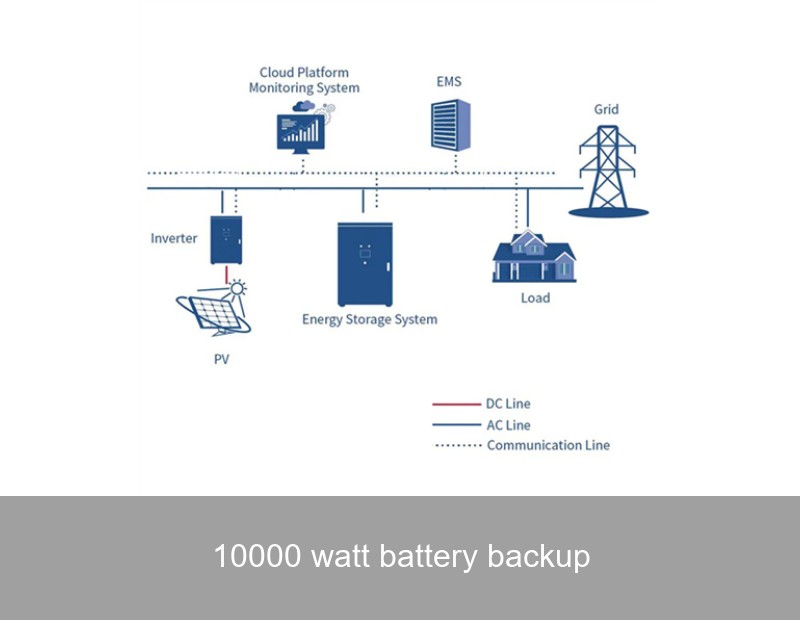
Understanding the parts will help you make an informed decision. A complete system is more than just a battery box.
- The Battery Modules: The heart of the system. Lithium Iron Phosphate (LFP) chemistry is now the industry leader for residential storage due to its superior safety, longevity (often 6,000+ cycles), and stable performance.
- The Inverter/Charger: The brain and brawn. This critical component converts DC battery power to AC for your home (and AC to DC for charging). For a 10kW system, you need a hybrid or AC-coupled inverter rated for continuous 10kW output or higher.
- The Battery Management System (BMS): The guardian. A sophisticated BMS monitors every cell for voltage, temperature, and current, ensuring safety, optimizing performance, and maximizing lifespan.
- System Controller & Software: The commander. This is the user interface—often a smartphone app—that lets you set preferences, monitor energy flow, and control your system. Intelligent software can learn your usage patterns and automatically optimize for self-consumption or cost savings.

Image Source: Unsplash - A modern home battery installation similar to Highjoule's clean, modular designs.
Real-World Case: A German Household's Journey to Energy Autonomy
Let's look at concrete data from a project in Bavaria, Germany. The Müller family lives in a 250m² detached home with a heat pump, an electric vehicle, and a 12kW rooftop solar array. Their goal: maximize self-consumption of solar energy and achieve near-total independence from the volatile grid.
| Parameter | Detail |
|---|---|
| Location | Bavaria, Germany |
| System Installed | Highjoule HPS-10 with 10kW inverter & 20kWh LFP storage |
| Primary Goals | Backup power, solar self-consumption, cost reduction |
| Results (First Year) | Grid energy consumption reduced by 78% |
| Self-consumption rate of solar power increased from 35% to 92% | |
| Full home backup during 3 grid outages (longest: 11 hours) |
"The system's intelligent management was key," explained Mr. Müller. "It automatically charges the battery with excess solar, powers the house in the evening, and even uses a small reserve to shave our peak demand. During an outage last winter, the heat pump kept running—we didn't even notice the grid was down for hours." This case exemplifies the dual value of a 10kW system: daily financial benefit and unwavering reliability.
Choosing the Right System: What to Look For
Not all 10kW systems are created equal. Here are the critical factors to evaluate:
- Scalability: Can you easily add more battery modules later if your needs grow (e.g., buying a second EV)?
- Depth of Discharge (DoD) & Warranty: A reputable product will allow a high DoD (e.g., 90-100%) and back it with a strong, long-term warranty (e.g., 10 years, 70% retained capacity).
- Grid Services & Software Intelligence: Can the system participate in virtual power plant (VPP) programs for additional revenue? Does its software proactively manage energy based on weather forecasts and time-of-use rates?
- Installation & Service Network: Choose a provider with certified, local installers. System design and installation quality are as important as the hardware itself.
The Highjoule Solution: Intelligent Power for Demanding Needs
At Highjoule, with nearly two decades of experience in advanced energy storage, we've engineered our HPS-10 (Home Power System) series specifically to meet and exceed the demands of the 10kW backup class. Our systems are designed for the European and North American markets, complying with the strictest safety and grid codes.
What sets a Highjoule system apart is its integrated intelligence. The Highjoule Energy Operating System (HEOS) doesn't just react; it predicts and optimizes. By integrating local weather data and your utility's tariff structure, it makes real-time decisions to store, discharge, or conserve energy, putting you in complete control. Our modular LFP battery packs are built for decades of reliable service and can be expanded incrementally.
For commercial and industrial applications, our scalable GridShield solutions provide the same robust backup and energy arbitrage capabilities at a much larger scale, ensuring business continuity and significant operational cost savings. From a single-family home to a manufacturing facility, Highjoule delivers a tailored, future-proof power solution.

Image Source: Unsplash - Professional monitoring a large-scale battery system, analogous to Highjoule's commercial GridShield solutions.
Future Trends and Your Next Steps
The evolution of home energy systems is moving towards true bi-directional hubs. Your 10000 watt battery backup will soon be an integral node in a smarter grid, potentially communicating with your EV to use its battery (vehicle-to-home or V2H) during prolonged outages or selling power back during extreme demand peaks.
The question is no longer if you need a backup system, but how comprehensive it should be. As you consider taking control of your energy resilience, what is the one critical load or aspect of your daily life that a power outage absolutely cannot disrupt? Identifying that priority is the perfect first step toward designing your ideal energy security solution.
Ready to explore what a Highjoule 10kW system could look like for your specific home and energy goals? Our network of expert energy consultants is ready to provide a personalized assessment.
 Inquiry
 Online Chat