


Understanding the 150 Unit Solar Panel Price: Investment, Value, and Long-Term Savings
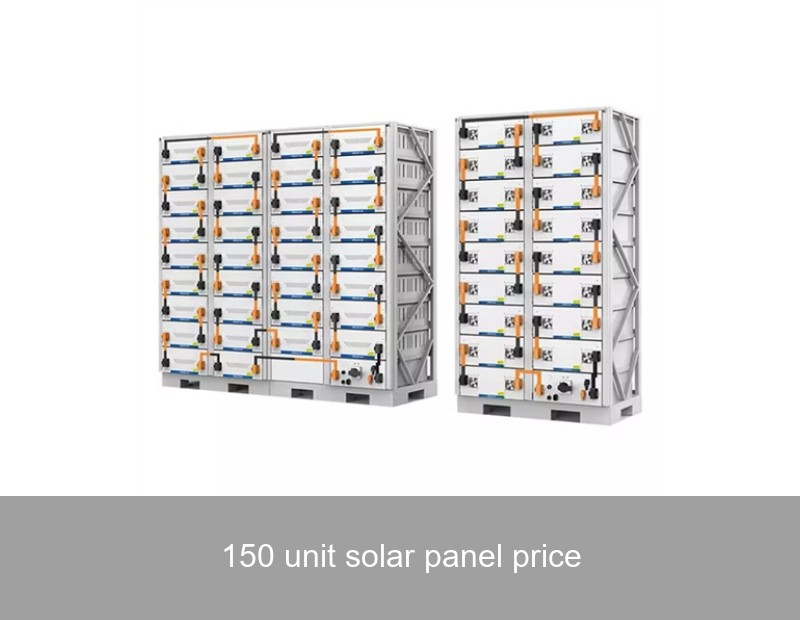
If you're considering a significant solar installation for your commercial property, farm, or community project, you've likely come across the term "150 unit solar panel price." It's a common benchmark for larger-scale systems, but what does that price truly encompass? More importantly, what determines the real value and return on investment behind that initial number? As energy costs remain volatile and sustainability goals become urgent, moving beyond the simple per-panel cost to understand total system performance, durability, and intelligent energy management is key. This is where partnering with an experienced provider like Highjoule, a global leader in advanced energy storage systems since 2005, transforms a capital expenditure into a strategic asset.
Table of Contents
- The Price Puzzle: More Than Just Panels
- Key Factors Influencing Your 150-Panel System Cost
- The Storage Imperative: Why Your Solar Investment Demands a Battery
- Real-World Case Study: A U.S. Agricultural Cooperative's Success
- The Highjoule Solution: Intelligent Storage for Maximized Returns
- Future-Proofing Your Energy Infrastructure
The Price Puzzle: More Than Just Panels
Let's address the elephant in the room first. A quick online search for "150 unit solar panel price" might yield a wide range, from $45,000 to well over $90,000. This variance isn't random; it's a signal. The panel modules themselves, while a major component, typically account for only about 25-30% of the total installed system cost. The rest—and the real determinant of your system's lifetime value—lies in the "balance of system" (BOS). This includes high-efficiency inverters, robust mounting structures, intricate electrical wiring, and critically, professional system design, permitting, and installation. Choosing based on the lowest per-panel quote can often mean compromising on these vital elements, leading to reduced energy production, higher maintenance costs, and a shorter system lifespan.
Key Factors Influencing Your 150-Panel System Cost
To make an informed decision, you need to unpack the quote. Here are the primary levers affecting the final price:
- Panel Technology & Efficiency: Premium monocrystalline panels with efficiencies above 22% cost more upfront but generate significantly more power in limited space, improving your long-term cost per kilowatt-hour (kWh).
- Inverter System: Will you use string inverters, power optimizers, or microinverters? Each has different cost, efficiency, and monitoring implications, especially for roofs with partial shading.
- Installation Complexity: Roof type, pitch, accessibility, and local labor rates dramatically impact installation costs. A ground-mounted system for a rural business has different economics than a commercial rooftop array.
- Regulatory & Grid Connection: Permit fees, interconnection studies, and meeting local utility requirements can add substantial soft costs, which vary greatly by region in both the U.S. and Europe.
Think of it this way: you're not buying a box of 150 panels. You're investing in a power plant for your property. The quality of its engineering determines its output.
The Storage Imperative: Why Your Solar Investment Demands a Battery
Here's a crucial insight often missing from initial price discussions: solar panels alone are no longer the complete solution. They generate power when the sun shines, but what about evenings, peak demand periods, or grid outages? Without storage, a significant portion of your solar energy might be sold back to the grid at low rates, only for you to buy it back later at a premium. This is where adding a battery energy storage system (BESS) becomes a game-changer, fundamentally altering the economics of your solar investment.
Integrating a storage solution like those from Highjoule allows you to:
- Maximize Self-Consumption: Store excess solar energy for use at night, increasing your energy independence from ~30% to 70% or more.
- Reduce Demand Charges: For commercial users, utilities often charge based on peak power draw. Batteries can discharge during these short peaks, slashing this portion of your bill.
- Ensure Resilience: Maintain critical operations during grid outages, a feature increasingly valuable for businesses, farms, and communities.

Image: A modern commercial solar installation paired with battery storage units. Source: Unsplash
Real-World Case Study: A U.S. Agricultural Cooperative's Success
Let's look at real data. A mid-sized almond farming cooperative in California's Central Valley was facing rising operational costs and grid instability during heatwaves. They installed a 67.5 kW system (approximately 150 high-efficiency panels) but paired it with a Highjoule H2 Series Commercial Battery System with 120 kWh of storage capacity.
| Metric | Before Highjoule System | After Highjoule System |
|---|---|---|
| Monthly Grid Energy Cost | $4,200 | $850 |
| Peak Demand Charge Reduction | 0% | 92% |
| Self-Consumed Solar Energy | ~35% | ~85% |
| Grid Outage Protection | None | Critical cooling & operations for 10+ hours |
The "150 unit solar panel price" for this project was a line item. The total system cost, including Highjoule's intelligent storage and energy management software, delivered a payback period of under 6 years. More importantly, it provided predictable energy costs and operational resilience against wildfires and public safety power shutoffs (PSPS), threats all too familiar in the region. This case underscores that the ultimate metric isn't cost-per-panel, but cost-per-managed-kilowatt-hour over the system's 25+ year life.
The Highjoule Solution: Intelligent Storage for Maximized Returns
This is where Highjoule's expertise, honed since 2005, becomes critical. We don't just supply batteries; we provide integrated, intelligent energy storage systems that make your solar investment work harder. For a 150-panel solar array, our engineers design a storage solution that aligns perfectly with your load profile and economic goals.
Our flagship H2 Series Commercial & Industrial (C&I) systems feature:
- Scalable Architecture: Modular design allows you to start with a right-sized system and expand as your needs grow, protecting your initial investment.
- Advanced Lithium Iron Phosphate (LFP) Chemistry: Renowned for safety, longevity (over 6,000 cycles), and stable performance, ensuring your storage asset lasts for decades.
- AI-Powered Energy Management System (EMS): Our software doesn't just store and release energy. It learns your consumption patterns, weather forecasts, and utility rate schedules to autonomously optimize when to charge, discharge, or hold, maximizing financial returns.
For residential clusters or microgrid applications, such as a community of 10-20 homes utilizing a shared 150-panel solar farm, our Residential Vault and Microgrid Controller solutions enable energy sharing and collective resilience, a concept gaining rapid traction in both European and U.S. markets.
Future-Proofing Your Energy Infrastructure
The energy landscape is shifting from a one-way grid to a dynamic, interactive network. In Europe and parts of the U.S., time-of-use rates and grid service programs (like frequency regulation) are becoming standard. An intelligent Highjoule system positions you to participate in these revenue streams, turning your energy asset into an income generator. When evaluating your "150 unit solar panel price," ask your provider: Does this system design include a pathway for storage? Is the inverter storage-ready? How will I adapt to future utility tariffs?

Image: Advanced energy management software dashboard monitoring solar and storage performance. Source: Unsplash
For authoritative information on solar technology and storage trends, you can refer to resources like the National Renewable Energy Laboratory (NREL) or the International Renewable Energy Agency (IRENA).
Your Next Step: From Price to Strategy
So, the conversation needs to evolve. Instead of fixating on the "150 unit solar panel price," the strategic question is: What is the total cost and value of a resilient, intelligent, and maximally efficient solar-plus-storage energy system for my specific needs? Highjoule's team of product and technical experts is ready to help you analyze that. We provide end-to-end support, from initial feasibility and financial modeling to system design, commissioning, and long-term performance monitoring.
What specific energy challenge—be it unpredictable bills, demand charge spikes, or the need for backup power—is driving you to explore solar, and how can we design a solution that turns that challenge into a competitive advantage?
 Inquiry
 Online Chat