


Understanding the Key Commercial Solar System Components for Maximum ROI
You've decided to invest in a commercial solar system. It's a smart move, promising energy independence and significant cost savings. But let's be honest: when your contractor starts talking about inverters, optimizers, and battery storage, it can feel like a different language. The truth is, the long-term performance and financial return of your solar investment hinge entirely on the quality and integration of its core commercial solar system components. Choosing the right parts isn't just about technical specs; it's about building a resilient, efficient, and intelligent energy asset for your business.
Table of Contents
- Beyond the Panels: The Heart of Your Commercial Solar Array
- The Critical Role of Power Conversion: Inverters
- Intelligence on the Roof: Optimizers and Microinverters
- Storing Your Sunshine: The Battery Storage Imperative
- The Brain of the System: Energy Management Software
- Case Study: Maximizing a German Logistics Hub's Solar Investment
- Choosing Your Components: A Framework for Decision-Making
Beyond the Panels: The Heart of Your Commercial Solar Array
While solar panels (modules) are the most visible component, they are just the beginning. A high-performance commercial system is an ecosystem of interconnected parts. Think of it like a high-performance car: the engine (panels) is crucial, but the transmission, fuel injection, and computer system (the other components) determine its real-world efficiency, reliability, and control. Key commercial solar system components include:
- Solar Modules: Convert sunlight into direct current (DC) electricity.
- Inverters: The system's workhorse, converting DC to usable alternating current (AC).
- Mounting & Racking: The structural foundation ensuring safety and optimal tilt.
- DC/AC Optimizers & Microinverters: Module-level electronics for enhanced performance.
- Battery Energy Storage Systems (BESS): Store excess energy for use anytime.
- Energy Management System (EMS): The intelligent software brain for monitoring and control.
- Switchgear & Safety Components: Isolators, breakers, and combiners for protection.
The Critical Role of Power Conversion: Inverters
If panels produce the raw material, inverters are the factory that refines it. They transform the variable DC output from panels into grid-compliant AC power. For commercial applications, the choice often centers on central string inverters or module-level power electronics (MLPE). Central inverters are cost-effective for large, unshaded roofs. However, their "string" design means the performance of the entire chain is limited by its weakest panel—a problem if part of your roof is shaded in the afternoon.
This is where companies like Highjoule add immense value. Our integrated solutions often feature advanced string inverters with multiple Maximum Power Point Trackers (MPPTs). This design allows different roof sections with varying orientations or shading patterns to be wired into separate MPPTs, mitigating losses and boosting overall yield. It's a balance of robustness, efficiency, and cost for large-scale installations.
Intelligence on the Roof: Optimizers and Microinverters
For commercial sites with complex roofscapes, chimneys, or intermittent shading from nearby structures, MLPEs are a game-changer. Power optimizers (paired with a string inverter) or microinverters (inverters on every panel) enable each module to operate independently.
| Feature | Power Optimizers | Microinverters |
|---|---|---|
| Key Function | Condition DC at the panel, send to central inverter | Convert DC to AC directly at each panel |
| Best For | Large sites with modular shading, seeking a balance of performance and cost | Extremely complex shading, designs requiring maximum design flexibility |
| Monitoring | Panel-level performance data | Panel-level performance data |
The result? Shade on one panel doesn't cripple the output of twenty others. You also gain granular, panel-level monitoring, allowing facility managers to pinpoint issues instantly—saving time and preserving revenue. Highjoule's design philosophy often incorporates smart optimizers for commercial projects because they deliver most of the benefits of module-level control while maintaining the scalability and serviceability advantages of central inverter architecture.
Storing Your Sunshine: The Battery Storage Imperative
Here's a fundamental truth: solar production and business energy demand are rarely perfectly aligned. Without storage, excess midday solar energy is exported to the grid, often at low rates, only for you to buy back expensive power in the evening. Adding a battery transforms your system from a cost-saver to a strategic energy asset. Key commercial solar system components now must include storage.
Modern commercial battery storage systems like the Highjoule H-Cube series are designed for this. They allow you to:
- Increase Self-Consumption: Use your solar energy day and night, slashing utility bills.
- Provide Backup Power: Keep critical loads operational during grid outages.
- Participate in Grid Services: In some markets, earn revenue by providing grid stability services.
When evaluating storage, look beyond just capacity (kWh). Consider power rating (kW), round-trip efficiency, cycle life, and the sophistication of the integrated inverter/charger. Highjoule's systems use lithium iron phosphate (LFP) chemistry, renowned for its safety, longevity, and stability—a non-negotiable for commercial installations.

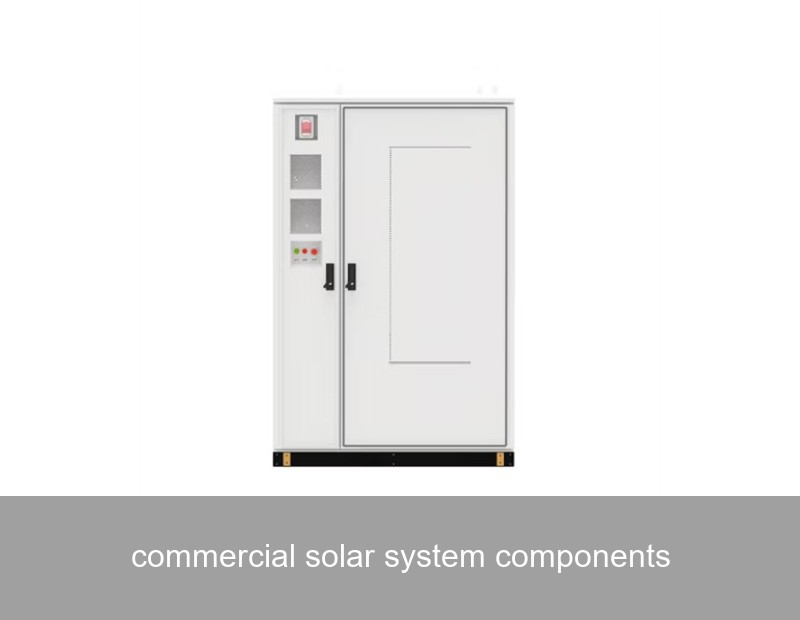
Image: A modern containerized battery storage unit, similar to Highjoule's H-Cube, enables businesses to store solar energy for round-the-clock use. (Source: Unsplash)
The Brain of the System: Energy Management Software
The hardware generates and stores power, but the software orchestrates it. An Energy Management System (EMS) is the intelligence that ties all commercial solar system components together. A top-tier EMS, such as Highjoule's Horizon OS, doesn't just show you pretty graphs; it makes autonomous, profit-maximizing decisions.
It continuously analyzes weather forecasts, electricity tariff schedules, and on-site consumption patterns. Then, it decides in real-time: should solar power charge the batteries, run the facility, or be exported? When is the most profitable time to dispatch stored energy? This dynamic optimization is where the highest level of ROI is unlocked, often improving the payback period significantly.
Case Study: Maximizing a German Logistics Hub's Solar Investment
Let's look at a real-world application. A major logistics company in North Rhine-Westphalia, Germany, had a 500 kWp solar array on its warehouse roof. Despite the sizable installation, their annual electricity cost savings plateaued at 35% due to heavy afternoon shading from a neighboring building and no storage.
The Challenge: Low self-consumption rate, significant shading losses, and no utilization of excess solar generation.
The Highjoule Solution: We conducted a detailed audit and proposed a system enhancement:
- Retrofitted power optimizers to the existing shaded string sections, recovering an estimated 15% of lost production.
- Integrated a Highjoule H-Cube 200 battery storage system (200 kWh / 150 kW).
- Connected the entire system to our Horizon OS energy management platform.
The Data-Driven Result: Within the first year of operation:
- Self-consumption rate jumped from 35% to over 80%.
- Overall energy costs were reduced by an additional 40% on top of previous savings.
- The EMS automatically leverages time-of-use tariffs, discharging batteries during peak price periods.
- Granular monitoring identified underperforming modules for swift maintenance.
This case underscores that upgrading key commercial solar system components—even on an existing array—can dramatically improve financial outcomes. You can read more about Germany's solar storage trends from Fraunhofer ISE, a leading research institute.
Choosing Your Components: A Framework for Decision-Making
So, how do you navigate these choices for your project? Ask these strategic questions:
- What is my primary goal? (Maximize bill savings, ensure backup power, meet sustainability targets?)
- What is my site's specific profile? (Analyze shading, roof integrity, load patterns, and local utility rules.)
- Do I want a "set-and-forget" system or a dynamic energy asset? The latter requires intelligent storage and software.
- Who will provide long-term service and performance guarantees? Component quality is vital, but system-level integration and support are paramount.
This is where partnering with an experienced provider like Highjoule makes the difference. We don't just supply components; we engineer integrated solutions. From initial site assessment and financial modeling to commissioning and lifelong monitoring via Horizon OS, we ensure every commercial solar system component works in concert to deliver on your business's energy and financial goals.

Image: Professional monitoring and maintenance are key to ensuring commercial solar components perform optimally for decades. (Source: Unsplash)
Given the rapid evolution of energy markets and technology, what is the one energy challenge in your operations that a smarter integration of solar and storage could solve tomorrow?
 Inquiry
 Online Chat